
How to Evaluate an Automatic Panel Processing Machine for Output and Flexibility
Choosing an automatic panel processing machine sounds straightforward until the evaluation team sits down with actual production data. On paper, many machines can cut, drill, groove, label, or route. In real factories, the question is tougher: can the machine keep output stable when order sizes shrink, board types change, and design files arrive in inconsistent formats?
For furniture and panel manufacturers, output and flexibility are often treated as separate goals. They should not be. A fast machine that slows down during job changeover, struggles with nesting optimization, or creates downstream bottlenecks at edge banding is not truly productive. Likewise, a highly configurable machine that cannot hold repeatable tolerance under continuous load may look versatile in a demo, but expensive on the shop floor.
A practical evaluation framework needs to connect mechanics, software, workflow, maintenance, and future product mix. That broader view is familiar across the industries monitored by PWFS. Whether looking at corrugated board lines, offset presses, die-cutting systems, or CNC woodworking routers, the pattern is similar: the best equipment is rarely the one with the most dramatic headline speed. It is the one that preserves accuracy and usable throughput under changing production conditions.
Start with the real definition of output
Many machine comparisons fail because “output” is reduced to maximum feed speed or spindle speed. That is only one layer. Technical evaluators should separate three things:
- Rated speed under ideal conditions
- Sustained throughput during a normal shift
- Saleable output after rework, sorting, and downstream matching
In panel processing, sustained throughput is usually the more useful decision metric. A machine may process sheets quickly but lose time in loading alignment, tool changes, scrap evacuation, barcode reading, or part sorting. If one cell produces components faster than labeling, edge banding, or packaging can absorb them, the speed advantage turns into WIP congestion rather than usable capacity.
Ask vendors to demonstrate cycle performance across mixed jobs, not just repeated cutting of the same rectangular panel. If your production includes cabinets, wardrobe parts, invisible connectors, hinge drilling, grooves, and small batch custom orders, the machine should be evaluated under those realities.
Flexibility is not a brochure word
In the whole-house customization segment, flexibility usually means the machine can handle variable dimensions, frequent file changes, multiple panel materials, and a high SKU count without excessive setup work. But flexibility has a cost if the machine architecture is not designed for it.
A useful test is to examine what happens when the machine moves from one order family to another. How much manual intervention is required? Does the operator need to reassign tools, recheck offsets, adjust clamps, or manually manage dust and offcut behavior? Can the control system automatically identify part programs from MES or ERP-linked data, or does it still rely on manual file calls that create avoidable mistakes?
This is where woodworking machinery starts to resemble high-end print and packaging equipment. In offset printing, raw speed matters less if registration drifts during substrate changes. In panel processing, flexibility matters less if precision degrades when material density, thickness, or panel coating changes.
Machine structure tells you more than the sales pitch
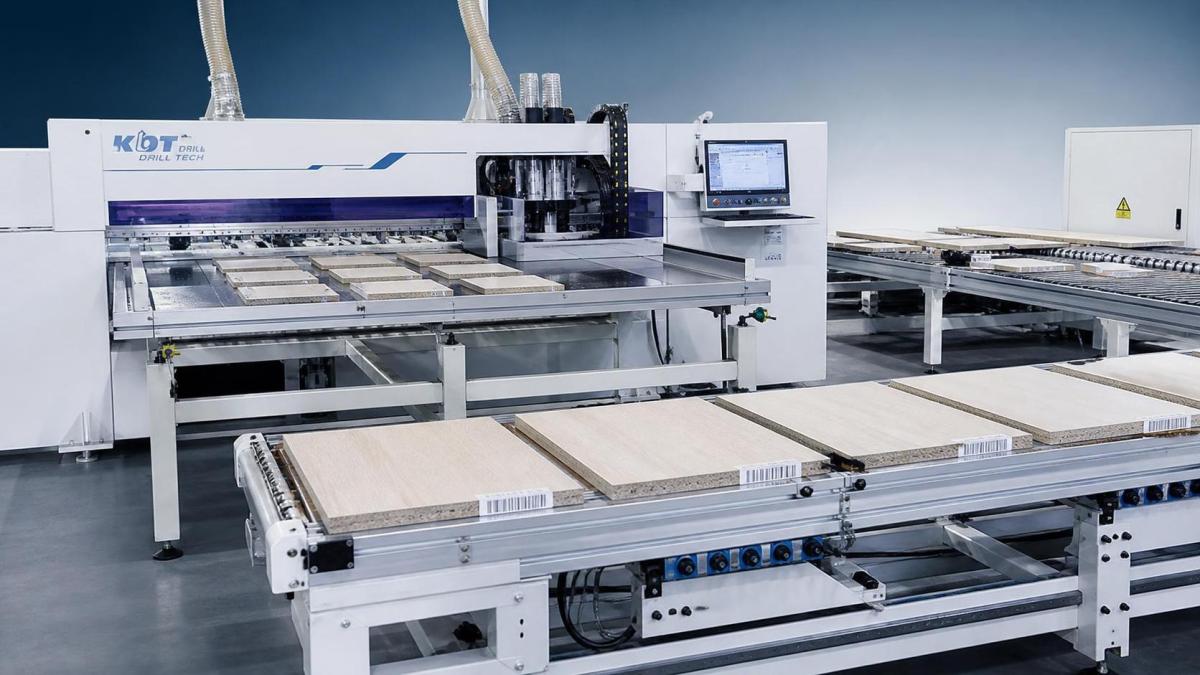
Before discussing software features, look at the physical build. Frame rigidity, gantry design, transmission system, spindle configuration, drilling block arrangement, and vacuum zoning all affect both output and quality. These are not glamorous topics, but they are often where long-term performance is decided.
A machine intended for continuous industrial use should maintain dimensional consistency under repeated acceleration and deceleration. That sounds obvious, yet high-mix production puts unusual stress on motion systems because the machine is constantly changing direction, tool path complexity, and hold-down demands. Prof. Lyra Sterling’s kinematics-oriented perspective at PWFS is relevant here: dynamic balance matters just as much as static precision. A machine can be accurate when measured at rest and still lose consistency when pushed through dense, variable routing cycles.
Pay attention to chip evacuation as well. In CNC wood processing, poor dust extraction is not just a cleanliness issue. It affects cut quality, tool temperature, edge condition, and sensor reliability. If chips accumulate in grooves or around smaller parts, the machine may keep moving while quality quietly drops.
Software compatibility is part of machine performance
An automatic panel processing machine is no longer just a mechanical asset. It is a node in a digital production chain. For technical evaluation, software compatibility deserves the same attention as spindle power or feed architecture.
The main questions are practical:
- Can the machine read common design and production data formats from your existing CAD/CAM stack?
- How well does it connect with MES, barcode systems, order tracking, and optimization software?
- Can it support automated job queuing and rule-based production logic?
- What happens when source data is incomplete or inconsistent?
This matters because hidden labor often sits in data preparation rather than cutting. Mr. Julian Thorne’s capital and digital transformation lens at PWFS points to a recurring issue: many factories buy advanced machines but continue running them like isolated islands. The machine then appears less flexible than it really is because upstream data handling remains manual.
When comparing suppliers, ask for a workflow demonstration from order entry to machine execution, not just a local control screen demo. The difference is substantial.
Evaluate precision in the context of downstream processes
Panel processing quality should never be judged at the cutting table alone. A component can appear acceptable after routing or drilling but create trouble at edge banding, assembly, or hardware insertion. That is why technical evaluation should include downstream fit, not just immediate machining appearance.
For example, if your line includes PUR or laser edge banding, panel edge integrity becomes more sensitive. Small deviations in edge straightness, breakout, or surface burn can show up later as bonding inconsistency or cosmetic defects. If assembly relies on concealed connectors or pre-drilled hardware positions, positional repeatability matters more than nominal speed claims.
This cross-process view is one reason PWFS covers both CNC routers and panel edge banders, while also tracking adjacent disciplines like die cutting and high-speed print registration. Good factories do not optimize a single machine in isolation; they optimize the transfer of quality from one process to the next.
Compare setup loss, not just run time
One of the most expensive blind spots in equipment selection is underestimating setup-related loss. In custom furniture production, frequent order switching can consume more time than cutting itself. Tool library management, suction cup repositioning on certain machine types, fixture changes, label synchronization, and operator verification all affect the real output window.
A machine should be assessed for how easily it recovers from normal interruptions: broken tools, vacuum issues, panel warpage, unreadable labels, incorrect nesting data, or urgent insert orders. Machines that are fast only when everything goes right are hard to scale in a mixed-order environment.
Maintenance and spare parts should enter the decision early
A technically impressive machine can become a weak investment if wear parts, service response, or remote diagnostics are inadequate. Evaluators should ask which components are standard industrial items and which are proprietary. That distinction affects both lead time and bargaining power later.
Tooling strategy matters too. Different panel materials, decorative surfaces, and board constructions place different demands on cutters and drills. If the machine’s productivity depends on a narrow tooling window, operating cost may rise or process stability may become fragile. Usually this needs to be checked against your own material mix rather than vendor samples alone.
Do not ignore compliance, traceability, and plant constraints
Not every selection issue is about speed or machining capability. Some projects are constrained by dust control, electrical standards, operator safety, labeling traceability, or material chain-of-custody requirements. Dr. Alistair Vance’s compliance-oriented approach at PWFS is a useful reminder that automation decisions often interact with export requirements, factory audit expectations, and documentation discipline.
These items usually need confirmation against local regulations, target markets, and plant engineering conditions. It is better to surface them early than discover late-stage integration problems after machine shipment.
A better way to compare suppliers
If two machines appear similar, the better comparison is not a feature checklist but a scenario test. Build a sample evaluation around your own product families, batch sizes, board types, software flow, and downstream requirements. Then score each option against a few non-negotiables: stable throughput, data connectivity, repeatable quality, recovery from interruptions, and supportability.
That approach often changes the outcome. The “fastest” machine may not be the most productive one. The “most flexible” one may demand too much skilled operator input. And the cheapest offer may require hidden process workarounds that erode its initial advantage.
An automatic panel processing machine should be evaluated as part of a manufacturing system, not as an isolated purchase. If the machine can translate digital design intent into repeatable parts, maintain output across mixed orders, and feed downstream processes without creating instability, it is probably worth serious consideration. If not, a high-spec brochure will not fix the gap. The next step is usually a disciplined parameter review: materials, part geometry, daily order mix, software interfaces, maintenance expectations, and the exact tolerance demands of the processes that follow.
Related News
Get weekly intelligence in your inbox.
No noise. No sponsored content. Pure intelligence.
