
It is late in the shift, and the cabinet shop floor looks busy rather than controlled. A nested-based CNC router is waiting for material because the cut panels have not been labeled. The edge bander is running, but operators keep stopping to sort parts for several jobs at once. Near assembly, a cabinet door is missing hinge cups because the drilling program did not match the latest design revision. None of these events necessarily means that a machine has failed. More often, they reveal that the shop’s workflow has outgrown the way information, panels, and decisions move between stations.
This is where automation decisions become difficult. A shop may know that manual handling, repeated setup, and rework are consuming capacity, yet a larger or faster machine is not automatically the answer. Selecting automated woodworking solutions for cabinets means matching equipment capability to the actual production mix: batch size, cabinet construction, material range, design variability, available floor space, and the people who must keep the system running. A poor match can merely shift the queue from one work center to another.
Start with the production pattern, not the machine brochure
Two cabinet shops can make similar products and require very different automation paths. One may repeatedly produce a limited group of standard kitchen units in medium batches. Another may receive a continuous stream of one-off whole-house orders, each with different panel sizes, drilling patterns, finishes, and delivery sequences. Both shops may want more output, but the first may benefit most from higher-speed material flow, while the second may need better data control and rapid changeover before adding major machine capacity.
The first practical task is to map the work as it is actually performed. Follow one job from design release to packed cabinet components. Record where panels wait, where people interpret drawings, where parts are moved twice, and where a change in one cabinet item forces a manual correction downstream. The important observation is not simply cycle time at the CNC. It is the elapsed time from an approved cutting list to a correctly machined, edged, drilled, and identifiable part.
During this review, separate demand into useful groups rather than relying on an overall monthly volume. A useful grouping may include repeat cabinet carcasses, variable-size panels, shaped doors, compact one-off orders, and jobs with special edge treatments. Then ask whether each group must pass through the same routing, drilling, and edge-banding path. If it does not, a single highly automated line may create unnecessary detours.
The warning signs of a mismatched automation project
Several conditions deserve attention before selecting equipment. If operators frequently search for the correct panel or hardware instruction, the limitation may be identification and software release discipline. If the CNC is idle while staff prepare sheets, load panels, or remove finished parts, material handling may be the constraint. If edge banding is the recurring bottleneck, increasing routing capacity may only build a larger buffer of unfinished components.
Another warning sign is purchasing a machine around the fastest anticipated job rather than the normal one. A machine designed for uninterrupted high-volume throughput can be difficult to justify when the shop spends much of the week switching materials, processing irregular panels, or responding to revised customer selections. Conversely, a flexible stand-alone cell can become a labor-intensive choke point when recurring work reaches stable, repeatable batch levels.
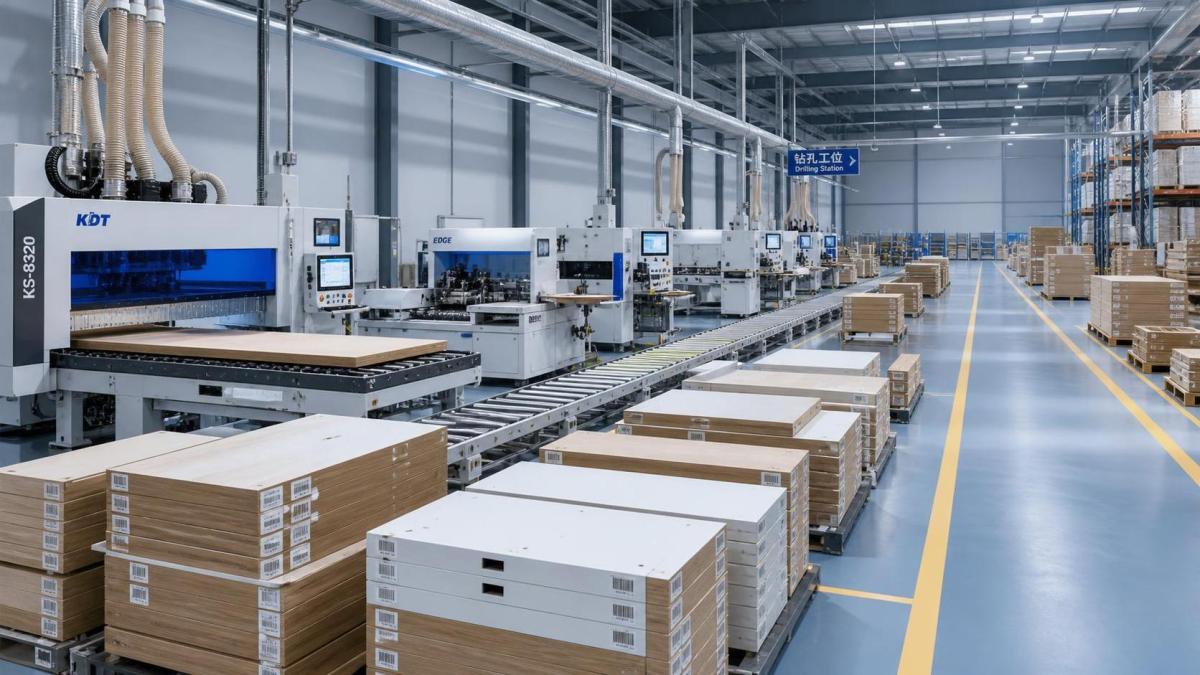
Define batch size in terms that affect workflow
Batch size is not only the number of cabinets on an order. For machining, it can mean how many panels use the same nesting strategy, drill pattern, tool set, material, thickness, and edge treatment before a meaningful change occurs. A nominally large project may still behave like many small batches if every room has custom dimensions. A small order can behave efficiently if it uses a well-controlled library of parts and hardware patterns.
The table should not be read as a purchase prescription. It is a way to frame trade-offs. For example, a shop with mixed work may decide that automated loading is appropriate for common sheet materials while retaining manual intervention for unusual panels, fragile finishes, or small components. Partial automation is often more workable than forcing every job through one rigid route.
Trace the cabinet panel through each decision point
A cabinet part carries more than dimensions. It carries grain direction, decorative face requirements, edge-banding instructions, drilling locations, hardware selection, orientation, assembly destination, and sometimes a priority linked to installation sequencing. Automation works reliably when those instructions remain connected to the panel rather than being reconstructed at each station.
For nested-based production, assess how the design data becomes a cutting program and whether panel labels are generated at the right point in the process. Labels applied after cutting may be acceptable for simple work, but they can become a risk when multiple jobs are nested together. The better question is whether every finished component can be identified without relying on an operator’s memory or a temporary handwritten note.
For CNC routing, compare more than spindle power or table dimensions. Review tool-changing capacity, vacuum zoning, spoilboard management, dust extraction compatibility, router access for small parts, and the software’s treatment of remnants and nesting. A router that cuts quickly but requires frequent manual sorting, tool correction, or sheet repositioning may not improve completed-part flow.
Drilling deserves the same scrutiny. Cabinet construction often depends on accurate shelf holes, connector bores, dowel holes, hinge cups, and hardware patterns. A routing-only approach can be flexible, but it may be inefficient when drilling becomes dense or must be processed on multiple faces. Through-feed drilling, CNC boring, or a combination of routing and drilling stations should be assessed against panel geometry and the frequency of hole-pattern changes. The goal is not to remove every manual operation; it is to avoid sending parts through avoidable handling loops.
Edge banding is often where the plan becomes real
Many automation proposals concentrate on panel cutting because it is visually impressive and easy to measure. Yet edge banding frequently determines whether a cabinet component reaches assembly smoothly. A shop may create accurate blanks rapidly, then accumulate work-in-process because different edge materials, glue methods, thicknesses, corner requirements, and panel shapes require repeated adjustment.
When reviewing an edge bander, begin with the materials the shop actually processes. Melamine, veneer, PVC or ABS edging, solid-wood lippings, and panels with sensitive decorative surfaces do not behave identically. Consider whether the equipment supports the intended adhesive method, including PUR hot melt applications where moisture resistance and bond requirements make it relevant. Laser-based edge sealing may also be considered where compatible material systems and the desired visual finish justify its process requirements. Neither approach should be selected merely because it is regarded as advanced; adhesive handling, cleaning routines, maintenance capability, and material sourcing must be part of the decision.
Also examine part routing before and after edging. Are all four edges processed in one sequence, or are panels stacked and returned later? Can the system identify which edges receive banding and which remain exposed for later joining? Does the shop have a controlled method for keeping left- and right-hand components distinct? An edge bander can be highly productive, but it cannot correct poor sequencing from upstream.
Choose the level of material handling with restraint
Automated loading, unloading, return conveyors, buffer storage, sorting, and robotic transfer can reduce repetitive handling. They can also occupy floor space, add safety interfaces, and make recovery more complex when a panel is damaged or a program is revised. The right level depends on how predictable the work is and how often people must intervene.
For smaller or variable batches, simple lifting assistance, organized staging, panel-return systems, and barcode-controlled routing may remove more daily friction than a fully linked transfer line. These measures can reduce physical strain while preserving the ability to pull a special part out of sequence. For stable higher-volume flow, automated sheet loading and downstream transfer may become more compelling because the same handling pattern repeats often enough to keep the equipment utilized.
Ask a practical recovery question during demonstrations: if one panel is rejected, misidentified, or changed after machining, how does the system prevent that exception from confusing the remaining job? The answer should cover physical routing, label status, program revision control, and communication with assembly. A system designed only for ideal flow may struggle in a custom cabinet environment.
Software connection is a production requirement, not an optional add-on
The most useful automated woodworking solutions for cabinets keep design intent connected to manufacturing instructions. The connection may involve cabinet design software, CAD/CAM output, nesting optimization, machine programs, label printing, and production scheduling. The exact software stack varies, but the decision criteria remain similar: who releases a job, how changes are approved, how machine files are versioned, and how operators know which revision is valid.
Before approving equipment, run representative production files through the proposed workflow. Include a standard base cabinet, a variable-height pantry unit, a panel with multiple hardware bores, a grain-sensitive door, and a part requiring nonstandard edge treatment. Observe whether the process transfers the required instructions automatically or whether staff must re-enter dimensions, choose an assumed orientation, or manually alter a machining file.
Where a manufacturing execution system is being considered, do not treat it as a dashboard purchase. Its value depends on dependable status information from the floor and disciplined job release. If the system records a part as complete while it is waiting at the edge bander, planning decisions will still be distorted. Start with a limited number of statuses that people can maintain consistently, then expand only when the data is trusted.
Make the decision around constraints, not isolated capacity
A sound selection process identifies the current constraint and the likely next constraint after improvement. If the immediate issue is inconsistent drilling accuracy, a new loading system will not solve it. If the actual constraint is shortage of skilled operators for repetitive panel movement, adding another stand-alone CNC may deepen the problem. In cabinet production, the limiting point often moves as each stage is improved.
Review each proposal against a few operational questions: Can it process the full practical range of panel dimensions and materials? How much setup is needed between normal jobs? Which tasks remain manual, and are they safe and repeatable? What happens to labels and work order status during rework? Can maintenance be performed without causing excessive disruption? Does the layout leave room for material staging, dust extraction, service access, and future routing changes?
It is equally important to compare the operator skills required after installation. Automation changes work; it does not eliminate the need for judgment. Someone must manage tooling, inspect cut and edge quality, resolve data exceptions, maintain dust collection performance, control adhesives, and respond when a panel does not follow the expected route. Training plans should reflect those responsibilities rather than focusing only on the machine start button.
A phased route is usually easier to validate
Rather than committing to every element at once, many shops can reduce risk by establishing a reliable digital handoff and part-identification method first. Once cutting, drilling, edging, and assembly can trace the same job information, it becomes easier to see where automation will genuinely remove delay. The next investment may be a more suitable CNC cell, an edge-banding upgrade, or handling support around the most repetitive transfer.
After each change, inspect completed cabinet parts rather than relying only on machine utilization. Look for correct orientation, clean edges, accurate holes, readable labels, controlled work-in-process, and fewer ambiguous handoffs. If one improvement causes a queue elsewhere, that is useful evidence for the next decision, not proof that the first investment was wrong.
The strongest automation choice is rarely the one with the longest feature list. It is the arrangement that lets the shop process its normal cabinet mix with fewer interpretation errors, less unnecessary movement, and enough flexibility to handle exceptions without losing control of the job. When equipment, data, material flow, and operator responsibilities are evaluated together, automation becomes a practical production method rather than an expensive collection of isolated machines.
