
Working Range Checks That Reduce Sheet-Size Risks in Nesting CNC Procurement
The advertised table size is not the usable nesting area
A nesting CNC can look correctly sized on a quotation and still create sheet-handling problems on the production floor. The usual cause is a procurement team comparing nominal machine dimensions with nominal board dimensions, without confirming what area is actually available for cutting under normal operating conditions.
This risk is especially common with “1325” machines, a designation often associated in the market with an approximately 1,300 mm by 2,500 mm format. That shorthand may be useful for initial comparisons, but it does not establish the usable cutting envelope, the permitted sheet overhang, the reference position of the board, or whether fixtures and vacuum zones reduce practical capacity. A full-size panel that fits physically on a bed may still be unsuitable for reliable nested production.
For buyers sourcing equipment for cabinet components, furniture parts, doors, laminated panels, plywood, MDF, or composite boards, working-range verification should happen before a supplier comparison reaches the final commercial stage. It affects yield, material purchasing, loading method, downstream finishing, factory layout, and acceptance testing. A small mismatch between board size and practical working area can turn into frequent manual intervention across every shift.
Why nominal sheet dimensions create procurement exposure
Panel materials are sold in several common formats, but nominal dimensions do not always match delivered dimensions. Manufacturing tolerances, protective edge allowance, packaging, moisture movement in wood-based boards, and customer-specific sheet formats can all affect what reaches the machine. A buyer who specifies only “process 1,220 × 2,440 mm panels” has not yet defined the actual machine requirement.
The more relevant question is: what is the largest incoming sheet that must be loaded, referenced, held, machined, and unloaded without compromising part quality or operator safety? That question includes more than X and Y travel.
For example, an operation may need a margin around the panel to avoid cutting directly at the edge of the spoilboard, to maintain vacuum sealing, or to allow a pusher, locating stops, or automated loading equipment to function. If a program places parts close to the sheet boundary, an apparently minor loss of usable area may force changes to the nesting pattern. The result may be lower material yield, more offcuts, or a need to trim boards before machining.
A range issue can also appear only after installation. A machine may accept a standard sheet when it is manually positioned with care, yet not when a lift table, loading arm, alignment system, or return conveyor is added. Procurement decisions should account for the intended production configuration, not only the bare machine.
Separate travel, support area, vacuum area, and permitted overhang
Suppliers and buyers sometimes use “working area” to describe different things. A disciplined request for quotation should separate the following dimensions rather than relying on one headline number.
- Axis travel: the programmed movement available to the cutting head or gantry along each axis.
- Table support area: the physical surface on which the panel rests.
- Effective vacuum area: the area where vacuum zoning can hold the workpiece adequately for the intended cutting strategy.
- Referenceable area: the part of the table where a sheet can be positioned consistently against stops, pins, sensors, or other locating features.
- Permitted overhang: any portion of a sheet that may extend beyond the table, and the operating conditions under which that is allowed.
- Machinable margin: the edge clearance needed to prevent tool collision, vacuum loss, poor support, or inaccurate edge cuts.
These values can differ substantially in practice. A table may be longer than the axis travel. Axis travel may extend farther than the effective vacuum grid. Locating devices may occupy part of the usable surface. A sheet may be supported when centered but not when referenced to one side for repeatable loading. Each condition should be clarified in drawings and in the acceptance plan.
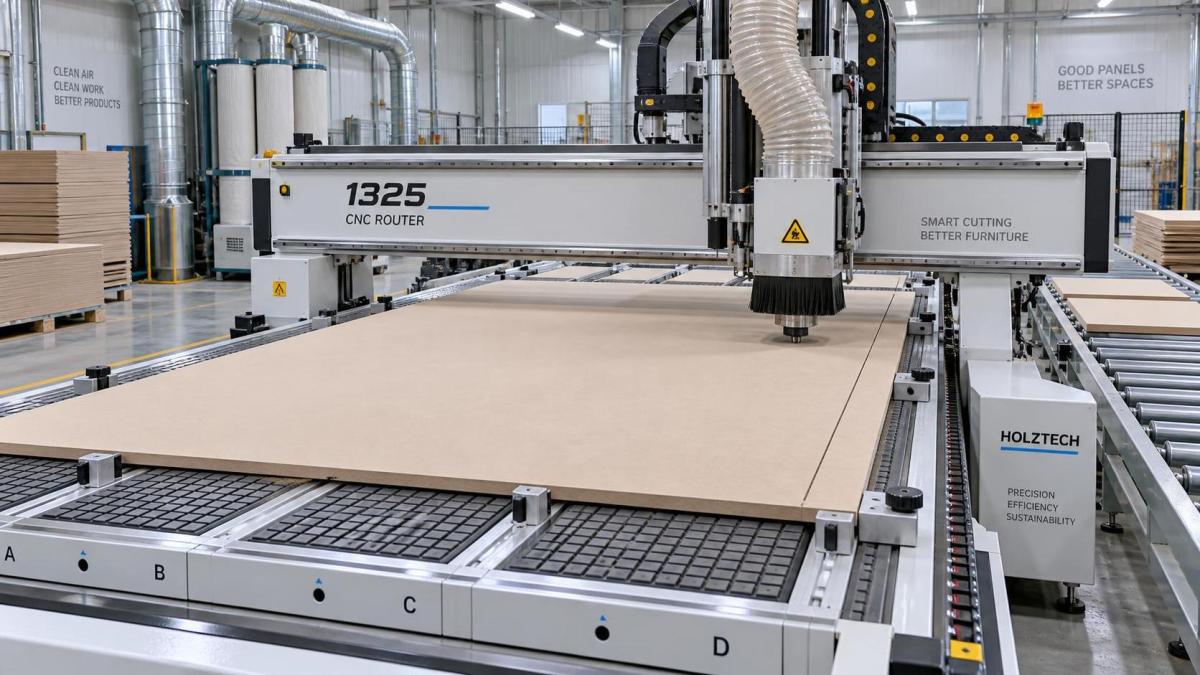
What a buyer should verify for a 1325-format nesting machine
The “1325” description should be treated as a starting point for technical review, not as a final sheet-size commitment. The procurement file should identify the maximum panel dimensions in millimeters, including real incoming tolerance. It should also state whether panels are loaded manually, by scissor lift, by vacuum lifter, or by an automated infeed system.
When evaluating a machine described as a 1325 nesting format, the product documentation for the ZD1325 nesting machine working range can be used as a model-specific reference point during this review. The buyer should still request confirmation of the working envelope, actual table arrangement, board location method, and usable area with the proposed configuration. Product naming alone cannot replace those checks.
Useful questions for the supplier include:
- What are the maximum X and Y cutting travels, measured from the machine’s usable program origin?
- What sheet size can be processed while maintaining full vacuum support for through-cuts?
- Which vacuum zones remain effective when a full sheet is loaded?
- Are locating pins, side stops, clamps, or sensors located inside the stated work area?
- Can the machine process panels that are slightly oversized relative to nominal purchase dimensions?
- What edge clearance is required for common nesting operations, including through-routing and onion-skin cutting?
- Does the answer change when an automatic loading or unloading option is installed?
A supplier response should ideally include a dimensioned table layout or engineering drawing. Written clarification matters because phrases such as “suitable for 4 × 8 sheets” can be interpreted differently. A drawing reveals whether the sheet is fully supported, whether the intended datum position is practical, and where the cutter can reach relative to the sheet edges.
Vacuum performance can shrink the practical range
Nesting is particularly sensitive to workholding because many jobs use through-cuts to separate parts from a full panel. The vacuum system must resist lateral cutting forces and keep small or narrow parts stable near the end of the program. Full-sheet capacity is only useful if the hold-down arrangement supports the planned cutting process.
Buyers should ask how the vacuum table is divided into zones and how those zones are selected. A large panel may cover the table well, while a smaller panel or an irregular offcut may leave open zones that reduce available vacuum. The operating team may need gaskets, masking methods, or zoning procedures to maintain hold-down. Those practices are normal in many shops, but they should be understood before estimating cycle time and labor requirements.
The spoilboard also affects usable sheet processing. Its flatness, porosity, surfacing condition, and sealing at the edges influence vacuum performance. If the machine is expected to process thin, bowed, or low-density sheet material, the need for consistent support becomes more demanding. The correct procurement question is not whether vacuum is installed; it is whether the proposed table, pump capacity, zoning layout, and process method suit the company’s panel mix.
Allow for tooling, dust extraction, and edge-quality constraints
Working range is often reviewed as a static geometry issue, but machining takes place in motion. Tool diameter, cutter projection, collet clearance, aggregate heads, and dust-hood movement can limit how close an operation can safely run to a physical boundary. The effect may be modest for simple profiling and more important for drilling patterns, angled operations, or jobs using larger tooling assemblies.
Dust extraction deserves a practical check as well. A full-size sheet can remain within nominal dimensions while chips accumulate near the edge if the hood loses effective contact or if airflow is disrupted by an unsuitable setup. This is not a reason to assume that a machine cannot cut close to an edge; it is a reason to ask the supplier to demonstrate the intended process rather than confirm only an axis number.
Edge quality requirements influence the decision. A plant producing internal cabinet parts may tolerate a small trim margin that would be unacceptable for visible-faced components, prefinished boards, or high-value veneered material. If edge damage, breakout, or finish chipping requires a later trim pass, the nesting plan and useful panel area change again. Procurement specifications should connect range requirements to the actual quality standard of the finished part.
Build the sheet-size requirement from production data
The best working-range requirement comes from recent purchase records and production programs, not from a single “standard sheet” assumption. Procurement teams can review a representative sample of incoming panels and classify them by material, thickness, actual dimensions, and frequency of use. They can then identify which sheets must run without trimming, which are occasional exceptions, and which will be introduced in planned product lines.
There is no need to force every rare format through one machine. A slightly oversized specialty panel may be better routed through a different process, trimmed before nesting, or handled by a larger-format line. The decision depends on annual volume, material value, delivery reliability, and the cost of adding a second handling step. What causes trouble is leaving that decision implicit until production begins.
Use representative nests in factory acceptance testing
A machine acceptance test should not rely solely on a no-load travel demonstration. Buyers can provide representative CAD/CAM files containing typical part density, small components, narrow rails, through-cuts, drilled holes, and edge-near features. The test panel should match the maximum routine sheet size and material type identified in the procurement specification.
The purpose is to observe the complete sequence: loading, location, vacuum engagement, machining, part retention, removal, and table cleanup. If automated handling is included, the test should use that equipment rather than a manual workaround. The resulting evidence is more useful than a broad assurance that the machine handles a certain board format.
Acceptance criteria should be written in operational language. Examples include the ability to reference the specified sheet without interference, machine all programmed features within the defined margin, retain designated small parts until removal, and unload the panel without contact damage. Tolerances, cut quality expectations, and measurement methods should be agreed in the purchase documentation rather than inferred after delivery.
Range decisions should reflect the cost of exceptions
A larger table or wider travel range may raise the equipment price, floor-space requirement, and energy demand. It may also affect transport, installation, and the size of associated loading equipment. Choosing the largest possible format is not automatically the best decision.
However, selecting a machine that is only barely adequate can create recurring exception costs: pre-trimming sheets, manual repositioning, rejected nests, extra material handling, and reduced flexibility when board suppliers change available formats. These costs are easy to underestimate because they are distributed across material, labor, scheduling, and quality functions rather than appearing as one machine expense.
The sound procurement approach is to define a usable sheet envelope, verify it against the actual process, and document the conditions that make it valid. A nesting CNC should be evaluated on the area where boards can be located, held, and machined predictably—not merely on the dimensions suggested by its model designation.
Related News
Get weekly intelligence in your inbox.
No noise. No sponsored content. Pure intelligence.
