
How to Choose Folder Gluers for Beverage Cartons by Speed, Glue Accuracy, and Board Range
If you are comparing folder gluers for beverage cartons, the biggest mistake is to start with the top speed on the brochure. Beverage carton work is rarely limited by nameplate speed alone. What usually decides whether a machine performs well is how steadily it runs your actual carton styles, how accurately it applies glue at production pace, and how well it handles the board range you use every day. A fast machine that loses bonding consistency or struggles with thin coated stock will cost more than a slower machine with stable output.
That is the real selection question: not “Which folder gluer is fastest?” but “Which one can hold speed, glue precision, and board adaptability at the same time for our mix of jobs?”
Start with the cartons, not the machine brochure
Technical evaluations go off track when the team compares machines before defining the carton profile clearly enough. Beverage cartons look simple from a distance, but production behavior changes a lot depending on structure, substrate, finish, and downstream packing demands.
Before you compare suppliers, lock down these variables:
- Carton styles: straight-line, crash-lock, multi-point, wrap-around, or specialty promotional formats
- Board types: SBS, FBB, coated board, recycled board, laminated stock, varnished or film-laminated surfaces
- Board thickness range actually used in production
- Blank size range, especially the smallest and largest formats
- Glue pattern requirements: side seam only, multi-line gluing, intermittent gluing, cold glue or hot melt integration
- Output expectations after die-cutting and before packing
A short answer for most buyers: choose the machine that runs your most difficult beverage carton reliably, not the one that looks strongest on an average job.
That difficult job is usually where the decision is made. It may be a small-format six-pack carrier, a moisture-sensitive coated carton, or a promotional pack with multiple folds and narrow glue flaps. If the folder gluer cannot stabilize that work, its advantage on standard jobs matters less.
How to judge speed on folder gluers for beverage cartons
Speed matters, but brochure speed and usable production speed are not the same thing. For beverage packaging, usable speed is the highest sustained output at which folding geometry, glue placement, compression time, and discharge quality all remain within your acceptable reject level.
In practice, three speed numbers matter more than the headline figure:
- Stable running speed on your main carton format
- Stable speed on your most difficult board and coating combination
- Recovery speed after job change, stoppage, or glue-system adjustment
Many evaluators focus only on the first. Experienced teams ask where the machine begins to drift. At what speed do glue lines start to wander? When do folded edges lose squareness? At what point do fishtailing, skewing, or flap misalignment appear? Those thresholds tell you far more than a maximum meters-per-minute claim.
There is also a line-balance issue. If the die-cutter upstream or packer downstream cannot match the speed range, paying extra for a much faster folder gluer may not improve real throughput. It can even increase instability if operators are constantly slowing down, catching jams, or adjusting for inconsistent blank feed.
Ask suppliers to show speed under conditions close to your job mix. A trial on plain stock with a simple straight-line carton is useful, but it does not answer the beverage carton question well enough.
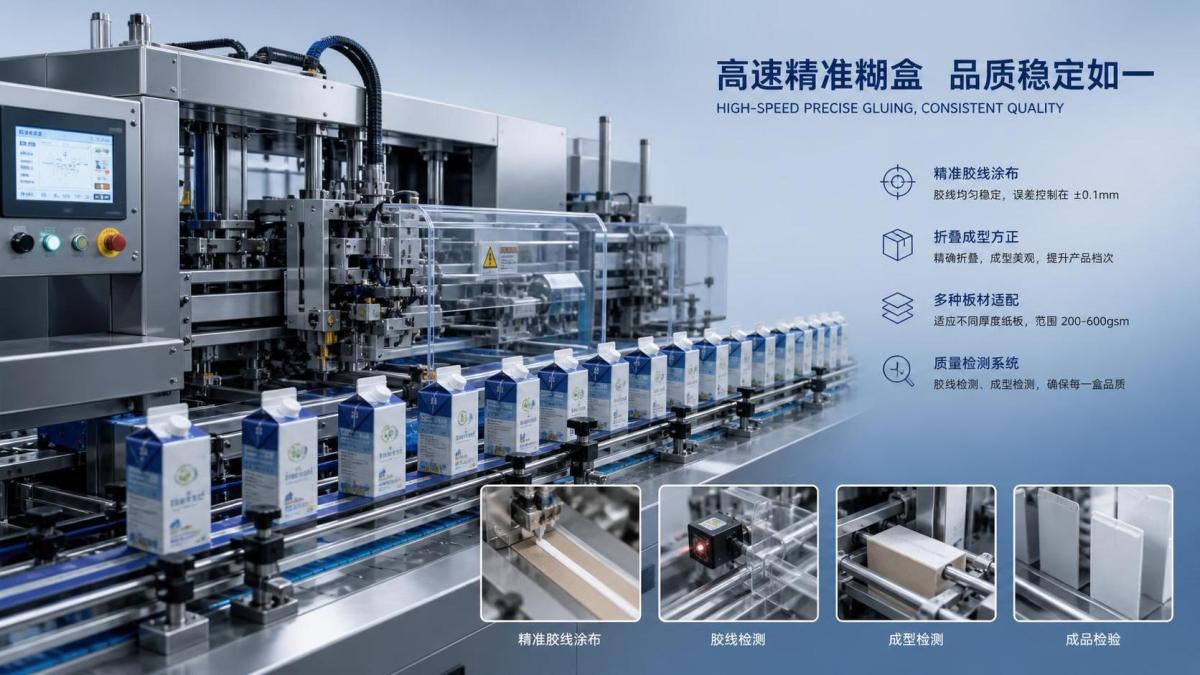
Glue accuracy is where many buying mistakes happen
For beverage cartons, glue accuracy is not a cosmetic detail. It affects bond strength, carton squareness, machine cleanliness, compression reliability, and how the pack behaves in filling, transport, and shelf handling.
When glue placement is slightly off on a folding carton for cosmetics, the result may be visible but manageable. On beverage work, especially where cartons carry weight or face cold-chain or humid conditions, poor glue control can become a structural problem.
What should you look at?
First, consistency of bead position at speed. Not just one good sample, but repeatability across a longer run. A machine that places glue well at moderate speed but drifts under production pace is a risk.
Second, glue volume control. Too little glue causes weak bonding. Too much glue creates squeeze-out, contamination, and drying problems. On coated or low-absorbency board, over-application can be as damaging as under-application.
Third, glue system compatibility with your cartons. Some beverage formats need more than a standard cold-glue setup. If your jobs involve specialty carriers, reinforced seams, or difficult surfaces, confirm whether the machine supports the right application heads, monitoring options, and changeover flexibility.
A common misunderstanding is to treat glue accuracy as only a gluing-unit issue. It is not. Feeding stability, blank alignment, pre-breaking quality, folding rail precision, belt pressure, and compression section control all affect whether the glue actually lands and holds where it should.
This is why demo samples should be checked after conditioning, not only immediately after the run. A bond that looks fine right away may fail later if glue penetration, pressure dwell, or substrate behavior is not right.
Board range is more than minimum and maximum thickness
Suppliers usually state a board range in millimeters or gsm, but technical evaluators should read that number carefully. A machine may technically accept a broad range while performing very differently across it.
For beverage cartons, board range needs to be judged in four layers:
- Thickness capability
- Surface compatibility
- Format stability across size extremes
- Tolerance to board variability from batch to batch
That last point gets ignored too often. Board range is not only about ideal material. It is about how the folder gluer reacts when real production stock varies in stiffness, warp, moisture, caliper, coating friction, or crease recovery.
If your beverage packaging plant runs both lightweight promotional cartons and heavier multipack outers, the machine has to transition between those jobs without becoming difficult to set. A broad board range is valuable only if changeovers remain practical and settings are repeatable.
Ask directly how the machine behaves at the lower and upper ends of your actual operating range. Thin board may expose feeding and folding instability. Heavy or stiff board may expose limits in pre-breaking, belt pressure, or compression dwell. Those are operating truths, not edge cases.
Where technical evaluations usually get stuck
Most selection teams are not confused about basic specs. They get stuck when two or three machines all look acceptable on paper. That is where better questions matter.
For example:
- How much operator intervention is needed to maintain registration and bond quality during long runs?
- How repeatable are settings after job recall?
- How quickly can the glue section be cleaned when switching adhesives or after contamination?
- How sensitive is the machine to die-cut blank quality coming from upstream?
- What happens when running at 70% to 85% of claimed maximum speed, which is often the real production zone?
These questions expose the difference between a machine that can run and one that can live on a production floor.
Another point worth checking is integration. Beverage carton converting rarely happens in isolation. You may need compatibility with inspection systems, code-reading, reject management, batch traceability, and upstream/downstream automation. In that context, a folder gluer is part of a line architecture, not a standalone purchase.
PWFS often frames this correctly: the value of a converting machine is not only in its isolated mechanism, but in how it fits the wider corrugated, printing, die-cutting, and automated production environment. That is a useful lens for technical teams comparing capital equipment across the packaging chain.
What to test during a supplier trial
If you only take one thing from this article, let it be this: send difficult samples to the trial, and evaluate output after the run with a checklist that reflects production reality.
A practical trial should include:
- Your actual beverage carton blanks, including at least one challenging structure
- The board grades you really buy, including coated or slippery stock if relevant
- The adhesive system intended for production use
- Target speed bands, not just a brief sprint at maximum speed
- Operator setup time and changeover observation
Then inspect:
- Glue line position repeatability
- Bond strength after curing or conditioning
- Carton squareness and folding symmetry
- Scuffing, marking, or cracking on printed/coated surfaces
- Reject rate over a meaningful run length
- Ease of recovering from stoppages and restarts
Do not let a trial become a polished performance around one ideal sample. The machine should prove it can tolerate the variation your plant sees every week.
The best choice depends on your production profile
There is no universal best folder gluer for beverage cartons. The right choice depends on what failure costs you most.
If your plant is constrained by output, you may prioritize stable high-speed running and quick setup recovery. If your cartons carry more structural load or run in humid distribution conditions, glue control and compression reliability should rank higher. If your SKU mix is broad, board range and changeover repeatability may matter more than absolute top speed.
One pattern shows up often in evaluations: teams overbuy on speed and underbuy on process stability. Six months later, they are running well below rated speed because that is where quality holds. It is a costly lesson.
A better buying approach is to score each machine on three layers:
- Can it run our current core jobs with low risk?
- Can it absorb foreseeable SKU or substrate changes?
- Can our operators maintain performance without constant expert intervention?
If the answer is strong on all three, the machine is probably a serious fit.
Final buying advice
When choosing folder gluers for beverage cartons, keep the evaluation grounded in production behavior. Speed is only valuable when folding remains stable. Glue accuracy only matters when it stays consistent across the full run. Board range only helps when the machine handles real substrate variation without turning setup into a daily struggle.
The safest decision usually comes from testing your hardest jobs, checking bond quality after conditioning, and judging the machine as part of the full converting line. That is how technical teams avoid buying a machine that looks impressive in a demo but underdelivers in beverage carton production.
FAQ
Is higher speed always better for beverage carton production?
No. Higher speed is useful only if glue placement, folding accuracy, and carton compression remain stable. A lower-rated machine with better consistency often produces more saleable cartons per shift.
What is the most overlooked factor when selecting a folder gluer?
How the machine handles material variation. Many machines run well on ideal blanks but become unstable when board stiffness, coating, or moisture condition changes.
Should I focus more on glue system specs or folding section design?
You need both. Glue quality depends on the gluing unit, but real bond performance also depends on feed alignment, fold control, pressure, and compression time.
How many carton types should be included in a supplier trial?
At minimum, test your main volume job and one or two difficult formats. If the machine passes only the easiest sample, the trial is incomplete.
When does a wide board range matter most?
It matters when your plant runs mixed SKUs, seasonal promotions, or different board grades from multiple suppliers. In those cases, flexibility affects uptime directly.
Image Placeholder List
- - Suggested placement: after the section discussing usable speed versus brochure speed. Image content: a technical evaluation workflow showing carton sample, glue line inspection, fold alignment check, and output assessment during a machine trial. Alt text: “Checklist for evaluating folder gluers for beverage cartons during production trials.”
Internal Link Anchor Text Suggestions
- folder gluer buying checklist: guide or resource page
- how die-cut blank quality affects gluing performance: technical article
- carton converting line integration basics: industry insight page
- cold glue vs hot melt in folding carton production: comparison article
- common defects in beverage carton folding and gluing: troubleshooting page
External Authoritative Source Suggestions
- Brand official technical documentation from folder gluer manufacturers
- Industry association materials on carton converting and packaging performance
- Adhesive supplier technical guides for carton bonding and substrate compatibility
Related News
Get weekly intelligence in your inbox.
No noise. No sponsored content. Pure intelligence.
