
Choosing Industrial Printing Solutions for Southeast Asia’s Humid, High-Volume Markets
Choosing industrial printing solutions for Southeast Asia begins with the production environment, because a line that appears efficient during a dry factory acceptance test can behave very differently after months of exposure to humid air, variable board moisture, frequent product changes, and sustained order pressure. Press speed remains relevant, but it is only one variable in a wider operating equation. Registration drift, ink-water balance, adhesive cure, paper curl, corrosion at exposed interfaces, and delayed access to critical spares can determine whether nominal capacity becomes usable output.
For high-volume packaging work, the selection basis should connect the complete material path: incoming paper or board, conditioning, printing, conversion, inspection, packing, and dispatch. A fast machine surrounded by unstable upstream material or constrained downstream handling will create waste faster than it creates saleable product. The preferred configuration is therefore the one with repeatable performance across the expected humidity range, substrate mix, order profile, and maintenance conditions of the actual site.
Start with the Material Condition, Not the Rated Speed
Paper-based substrates exchange moisture with ambient air. In tropical production environments, this can change flatness, stiffness, dimensional stability, and surface behavior between delivery, storage, printing, and die-cutting. Coated sheets may curl differently from uncoated grades; recycled-content liners can vary across deliveries; and corrugated blanks may react to uneven moisture exposure at the edges. These changes directly affect feeder reliability, side-lay consistency, print registration, crease quality, and glue adhesion.
A useful specification should define the substrate range in operational terms rather than accepting a broad catalogue claim. It should identify basis weights, sheet or web widths, calipers, coating types, flute profiles where applicable, recycled-content variation, and the condition in which material reaches the feeder. Samples should include the difficult stock, not merely flat and recently produced material. If a converter regularly receives boards that have been stored in partially open warehouses or transported through wet weather, those conditions deserve representation during trials.
Climate control cannot always eliminate moisture movement, particularly at loading bays and between production areas. The equipment should therefore have adjustment systems that are accessible, repeatable, and documented. On sheetfed equipment, this includes feeder air settings, separation adjustments, side-guide behavior, transfer gripper condition, anti-static provisions, and mechanisms for monitoring double-sheet events. On corrugated operations, attention moves to paper preconditioning, steam quality, temperature control, pressure distribution, and the relationship between line speed and moisture removal.
Humidity also affects consumables. Fountain solution behavior, ink tack, drying response, water-based coating performance, starch adhesive consistency, and hot-melt glue open time may all shift with temperature and moisture. A procurement comparison that treats consumables as minor operating details can overlook the source of recurring instability. The machine supplier, ink or adhesive supplier, and local process team should agree on compatible chemistry before installation, especially where food-contact packaging or low-odor applications are involved.
Registration Must Be Evaluated Through the Whole Shift
Color approval on a short run is not enough evidence for selecting an offset press or other high-precision print platform. The relevant question is whether registration and color can remain within the required production tolerance while the press warms up, plates change, paper batches change, and ambient conditions move during the shift. Mechanical precision, control software, ink train condition, dampening stability, and substrate handling all interact.
Request trial evidence that shows make-ready behavior and sustained production behavior separately. A system may reach acceptable color after intervention, yet require excessive adjustment whenever humidity rises or a new paper lot enters the feeder. Automated color measurement can reduce response time, but it should not be assessed only as a feature list. The evaluation should establish where measurements are taken, how the system reacts to deviation, whether correction occurs in time for the job length, and how rejected sheets are identified and segregated.
For packaging work, registration should be judged alongside downstream geometry. A printed image can appear acceptable at the delivery pile but become visibly misaligned after die-cutting, embossing, folding, or gluing. Print-to-cut registration, blank squareness, crease placement, and glue-flap position should be verified using the same artwork and substrate combination intended for routine production. This is particularly important for cartons with metallic decoration, fine type near folds, small windows, or graphics that cross panel boundaries.
Match the Machine Architecture to the Production Mix
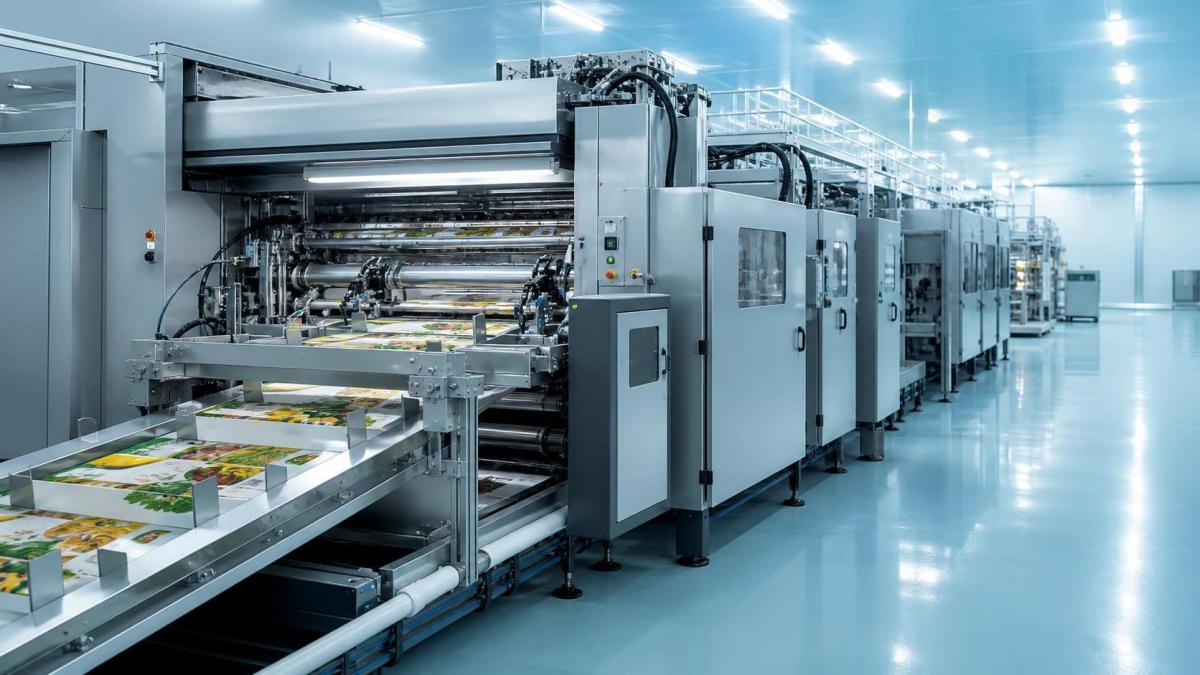
Industrial printing solutions Southeast Asia often need to accommodate a broad mix of e-commerce transit packaging, retail cartons, promotional work, and short replenishment cycles. A line designed around one stable, long-run product may become inefficient when frequent changeovers dominate the schedule. Conversely, a highly flexible configuration can introduce unnecessary complexity if the daily mix consists mainly of repeat work on standard formats.
For corrugated board production, the board line should be reviewed as a thermal and mechanical process rather than simply a width-and-speed purchase. Steam quality, condensate management, preheater wrap control, brake responsiveness, splice performance, corrugating-roll condition, glue application uniformity, and cut-off accuracy influence board quality. A quoted maximum speed has limited value if the line must slow substantially to maintain bond strength or dimensional consistency on the common grades being run.
Where preprint, litho-lamination, or high-graphics carton work is required, the transfer path between printing and converting deserves equal scrutiny. Stack conditioning, drying or curing time, pallet protection, and identification of work-in-progress can prevent color and surface defects from appearing as unexplained converting losses. Storage space should be treated as part of the process design; insufficient buffer space tends to force material into unsuitable staging areas, where moisture pickup and damage are more likely.
Automated die-cutters and folder-gluers should be assessed with actual blank complexity. Straight-line cartons, lock-bottom formats, multi-point glue patterns, small pharmaceutical-style cartons, and coated cosmetic packaging impose different demands on feeding, stripping, folding, compression, and inspection. The intended specification should state the minimum and maximum blank sizes, board range, crease patterns, window-patch requirements where relevant, glue type, and acceptable setup time for the expected job mix. General statements that a machine handles “multiple carton styles” do not resolve these constraints.
Integration choices should remain practical. Conveyor links, automatic pallet handling, barcode tracking, camera inspection, and production data collection can improve flow when their exception handling is clear. If a camera detects a defect, the physical reject path must work at operating speed. If job data is transferred from planning software, version control must prevent an obsolete dieline or color target from reaching the machine. Automation that cannot be maintained locally can become a source of stoppages rather than a source of control.
Design for Moisture, Dust, and Corrosion Exposure
High humidity is not confined to the substrate. It can affect electrical enclosures, sensor windows, pneumatic components, bearings, exposed fasteners, cabinets, cable entries, and machine frames. The review should distinguish between painted surfaces and parts where condensation, washdown, adhesive mist, paper dust, or process heat may create localized exposure. Cabinets near open doors, steam systems, or cooling equipment may experience conditions unlike those at the center of the production hall.
Specify enclosure protection, corrosion-resistant materials or finishes, cabinet cooling arrangements, drainage where appropriate, and accessible inspection points. Electrical drawings should identify critical sensors, drives, controllers, and power-quality requirements. Where power fluctuations are possible, the equipment architecture should indicate what protection is included and how an interruption affects job data, registration references, safety circuits, and restart procedures.
Paper dust and trim are equally operational concerns. Dust extraction capacity should be calculated around the real waste stream and the cleaning access required around feed sections, delivery areas, die stations, and glue systems. In woodworking-linked packaging or display production, dust collection requires separate attention because wood particles, resinous panels, and printed-paper waste behave differently. Keeping these flows isolated where necessary protects surface quality and reduces the chance that dust accumulation interferes with sensors or moving parts.
Use Acceptance Criteria That Reflect Production Reality
A purchase specification should translate broad expectations into measurable acceptance conditions. These conditions need not promise impossible uniformity, but they should define how performance will be observed and what evidence is required. Machine speed, waste level, setup time, registration, color consistency, board bond, die-cut accuracy, fold position, glue integrity, and inspection performance can each be tested against agreed job samples.
- Run representative substrates after they have been conditioned in an environment comparable to the intended production setting, rather than relying solely on supplier-prepared stock.
- Include at least one complex job with common changeover elements: a new format, artwork variation, tooling change, or different glue pattern.
- Document interventions during the run. Repeated manual correction for feeder behavior, color balance, cutting register, or fold alignment is material evidence even when final samples pass inspection.
- Define the sample method for quality assessment, including where measurements are taken and how defective output is counted after start-up, stoppages, and job transitions.
Factory acceptance testing and site acceptance testing serve different purposes. The factory test can confirm build quality, configuration, safety functions, and baseline capability. Site testing verifies installation quality, utilities, local material behavior, operator access, material flow, and the interaction with upstream and downstream equipment. Treating the factory result as a substitute for the site result leaves too many local variables untested.
Installation Planning Often Determines Early Uptime
Large presses, corrugators, and converting lines have requirements that extend beyond floor dimensions. Civil foundations, floor flatness, vibration behavior, crane access, unloading routes, electrical capacity, compressed-air quality, steam and condensate connections, extraction ducting, chilled-water needs, and drainage should be confirmed before shipment. A late discovery involving a doorway width, slab loading, or utility connection can delay commissioning and expose stored equipment to unsuitable site conditions.
Transport planning should address humidity protection during sea freight, inland transit, and temporary storage. Packaging should identify moisture barriers, desiccant use where appropriate, shock indicators, lifting instructions, and the inspection process on arrival. Damage should be recorded before unpacking progresses, because later assembly can obscure whether corrosion, impact marks, or missing components were present at delivery.
Commissioning should include more than mechanical start-up. It should establish baseline settings for the preferred substrates, approved ink and adhesive systems, preventive-maintenance intervals, cleaning methods, lubrication points, spare-part identification, and escalation paths for control-system faults. Training records should cover safe adjustment and fault recovery as well as normal production. A line that only runs well under the direct attention of commissioning specialists has not yet reached a stable handover state.
Evaluate Lifecycle Support at Component Level
Downtime exposure is usually concentrated in a limited group of components: feeders, grippers, bearings, belts, vacuum parts, cutting tools, sensors, servo drives, glue-system elements, pumps, filters, and electronic modules. A support proposal should identify the recommended site stock for wear parts and high-risk spares, expected shelf-life constraints, lead-time assumptions, and the diagnostic information required before remote assistance can be useful.
Maintenance access matters as much as maintenance interval. Guards, covers, rollers, doctor blades, ink fountains, cutting stations, glue pots, and filters should be reachable without creating an extended shutdown or compromising safe isolation. Ask for a realistic cleaning and inspection sequence at the planned operating rhythm. If cleaning is difficult, it will often be shortened under schedule pressure, which can lead to progressive defects in print, cutting, or gluing.
Data connectivity should support practical traceability. Job parameters, alarm history, maintenance events, material batches, and quality records can be linked where the site has the necessary network discipline. However, a connected system still needs usable local controls and documented recovery procedures when a network connection is unavailable. Production records are most valuable when they connect a defect pattern to a specific machine state, substrate lot, tooling condition, or environmental change.
The strongest selection is usually the system whose limits are clearly understood: its stable material range, realistic changeover pattern, environmental protections, consumable dependencies, and service assumptions. In humid, high-volume operations, transparency about those limits provides a firmer basis for dependable capacity than an isolated claim of maximum output.
Related News
Get weekly intelligence in your inbox.
No noise. No sponsored content. Pure intelligence.
