
What ISO Standards Matter Most in Custom Furniture Production for Quality and Export?
The mistake is treating “custom furniture production ISO” as one certificate
In export-oriented furniture manufacturing, people often ask which ISO standard is required, as if there were a single document covering quality, safety, environmental performance, and market access at once. That is not how the system works. Custom furniture production ISO usually means a stack of standards, each addressing a different layer of risk: how the factory is managed, how products are tested, how emissions are controlled, how timber is handled, and whether the production line can keep records that overseas buyers will trust.
That distinction matters even more in custom furniture than in mass production. A fixed-SKU chair or table can be validated once and repeated. Whole-house customization is different. Materials shift from MDF to plywood to particleboard, hardware changes by project, panel dimensions vary every day, and CNC programs generate thousands of one-off machining instructions. In that environment, the most useful standards are not just the ones that “approve” a product. They are the ones that make variation controllable.
Start with management standards, because export buyers audit systems before they trust products
The first standard most factories should think about is ISO 9001, the quality management system standard. It does not certify that a wardrobe, vanity, or cabinet is good by itself. What it does is force discipline around document control, process consistency, nonconformance handling, supplier evaluation, corrective action, traceability, and internal audits. For a custom furniture plant, that translates into very practical questions: Can you trace a defective panel back to a batch of board, edge banding, glue, and CNC program? Can you prove that a design revision was actually released to production? Can you show how dimensional inspection results lead to action rather than paperwork?
Without that framework, export quality problems usually appear in familiar ways: hole positions drift because the wrong version of the drawing reached the nesting station, edge delamination is blamed on operators when the adhesive application window was unstable, or a complaint about door misalignment turns out to be a tolerance-stack issue that no one formally reviewed.
ISO 14001 is often the next serious requirement, especially when buyers in Europe or North America assess environmental controls beyond the product itself. In furniture plants, environmental management is not abstract policy language. It touches VOC handling, dust extraction, waste segregation, chemical storage, wastewater where applicable, and emergency response. For panel furniture factories using laminates, coatings, PUR adhesives, or solvent-based cleaning agents, ISO 14001 helps show that environmental aspects are identified and controlled systematically instead of reactively.
Then there is ISO 45001 for occupational health and safety. Quality and safety managers sometimes treat it as a separate compliance track, but in woodworking it sits very close to product quality. A plant with poor dust collection, weak lockout procedures, and inconsistent machine guarding usually also has unstable process control. CNC routers, beam saws, edge banders, sanding lines, and drilling centers all create points where operator behavior, machine status, and output quality intersect. A disciplined safety system tends to reduce improvisation on the shop floor, and improvisation is one of the hidden drivers of custom-order defects.
Product standards matter, but they depend on where the furniture is going
One of the most common misunderstandings is assuming that ISO management certification automatically clears a product for export. It does not. Importers, retailers, and project buyers usually care about performance standards and chemical limits tied to the destination market. Some of these are ISO standards; many are EN, ASTM, ANSI/BIFMA, CARB, TSCA Title VI, or country-specific rules.
Even so, several ISO standards remain highly relevant in the testing and laboratory context. ISO 17025 is a good example. It is not a furniture product standard either; it applies to the competence of testing and calibration laboratories. Why does that matter to a furniture exporter? Because once claims about formaldehyde emissions, coating performance, moisture behavior, or dimensional verification become commercially important, the credibility of the test source matters almost as much as the test itself. Results from an ISO 17025-accredited lab carry a different weight in buyer audits and dispute resolution than informal internal reports.
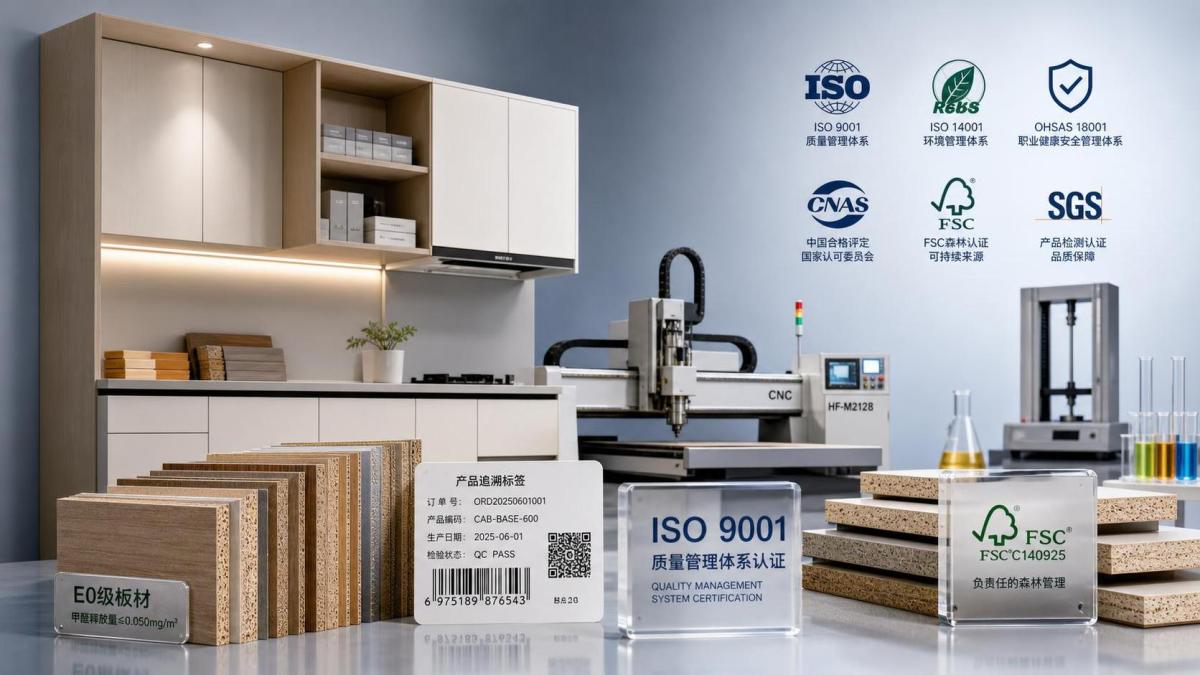
For office furniture, hospitality fit-out, children’s furniture, or kitchen and bath cabinetry, the decisive requirements often come from regional performance and safety standards rather than a universal ISO rulebook. That means a factory should not ask, “Which ISO do we need?” but rather, “Which ISO systems support the specific product compliance package our target market expects?” That is a more mature question, and usually a more profitable one.
Wood legality and chain of custody sit next to ISO, not inside it
In custom furniture, especially for export, timber legality and source traceability often become purchase conditions. Buyers may ask for FSC chain of custody, PEFC certification, or proof aligned with regulations such as the EU Timber Regulation’s successor framework and other due-diligence regimes depending on market. These are not ISO standards, but they frequently travel with ISO 9001 and ISO 14001 in supplier approval packages.
This is where many factories lose clarity. They build a decent quality management system, then assume it covers source claims. It does not. If you sell oak veneer wardrobes, walnut cabinetry, or plywood-based interiors into markets that scrutinize sourcing, the documentation path for raw material identity, supplier declarations, and segregation rules has to be explicit. In practice, the strongest exporters make their ISO procedures and chain-of-custody procedures reinforce each other, so purchase orders, warehouse labeling, ERP records, and production release documents tell the same story.
Where custom production changes the compliance logic
Custom furniture is not just “furniture with more options.” It changes the risk profile. A plant making standard cabinets may test a stable bill of materials once and monitor it. A whole-house customization factory is dealing with constant change in board thickness, edge solutions, drilling patterns, concealed hardware, decorative surfaces, and packaging configurations. That makes several control points much more important than they appear on paper.
One is design-to-production data integrity. If the front-end design software passes incorrect dimensions or hole maps into the CNC cell, no ISO certificate can rescue the output. Another is adhesive and edge quality control. Export complaints around edge peeling, swelling, and visible glue lines often come from process-window instability rather than obviously bad materials. Temperature, feed speed, panel condition, glue type, and storage environment all matter. A strong ISO 9001 system should make those variables measurable and reviewable, not tribal knowledge held by one shift leader.
The same is true for emissions control. Formaldehyde performance is often discussed as if it were only a board-supplier issue. In reality, the finished furniture result may depend on board class, lamination quality, edge sealing completeness, storage conditions, and any additional chemistry introduced during production. Quality managers who understand this tend to build incoming inspection, supplier qualification, and finished-goods verification into one chain instead of handling them as separate tasks.
A practical way to rank the standards
If the question is which standards matter most, the answer usually falls into four layers:
For most custom furniture factories, ISO 9001 is the anchor. ISO 14001 and ISO 45001 become increasingly important as customer audits grow stricter, chemical handling becomes more visible, and large retailers or project buyers review the plant as a long-term supplier. ISO 17025 matters whenever test evidence is part of the sales or compliance conversation. The rest depends heavily on product category and export destination.
What buyers and auditors usually notice first
Auditors rarely begin with abstract philosophy. They look for broken links. In custom furniture production, the weak points are often easy to recognize: supplier specs that do not match actual incoming materials, revision control gaps between design and machining, inconsistent in-process inspection records, no clear disposition for nonconforming parts, and laboratory reports that cannot be tied back to a current product configuration.
In highly automated plants using MES, barcode tracking, CNC nesting, drilling centers, and edge-banding lines, ISO systems become much more than certificate wall art. They shape how digital instructions, material identity, machine parameters, and finished-order records connect. For a factory selling into demanding export channels, that connection is often the real competitive threshold. Not because buyers love paperwork, but because customized production without traceable control becomes expensive very quickly when a complaint spans hundreds of project-specific components.
The useful question is not “Which certificate is easiest?”
A better question is which standards reduce your most expensive failure mode. If the plant struggles with dimensional inconsistency, rework, and field installation issues, ISO 9001 discipline around process control and corrective action usually deserves priority. If the pressure is coming from chemical compliance, wastewater, adhesive handling, and buyer ESG audits, ISO 14001 may move up the list. If accident exposure around routers, saws, dust, and maintenance tasks is still managed informally, ISO 45001 is no longer optional in practical terms even if a customer has not yet demanded it.
For export, the strongest custom furniture producers treat ISO as the operating backbone, not the finish line. The certificate tells buyers that the factory has a system. The harder question, and the one serious quality managers keep asking, is whether that system is tight enough to handle variation without losing product reliability, compliance evidence, or shipment credibility. That is the point where custom furniture production ISO stops being a label and starts becoming a production capability.
Related News
Get weekly intelligence in your inbox.
No noise. No sponsored content. Pure intelligence.
