
Where to Find Reliable Procurement Planning Resources in North America
What actually counts as a reliable procurement planning resource?
For a buyer, a useful resource is not just a website with product descriptions. It should help you make a purchase decision before you ask for final pricing. In North America, reliable procurement planning resources usually fall into four groups: manufacturer documentation, technical intelligence portals, trade associations and events, and internal operating data from your own plant or sourcing team.
The best ones answer practical questions: Which machine configuration fits your output mix? What hidden cost sits outside the quoted price? Which supplier has the service footprint to support a line in the U.S., Canada, or Mexico? If a resource cannot help you compare uptime risk, lead time exposure, installation scope, tooling compatibility, or consumable cost, it is not strong enough for procurement planning.
That is why many procurement teams use a layered approach. They start with broad market mapping, then move to machine-level technical review, and only later enter commercial negotiation.
Where should procurement teams in North America look first?
Start with sources that reduce guesswork early. For industrial packaging and woodworking equipment, that usually means specialist intelligence platforms, supplier catalogs with real technical detail, industry exhibitions, and service-network information. A general search engine will surface names. It will not tell you which die-cutter platform is easier to support across multiple shifts or which CNC woodworking router integrates more cleanly with your design-to-production workflow.
For buyers covering corrugated board lines, offset presses, folder-gluers, die-cutters, routers, or edge banders, a focused portal such as PWFS is valuable because it frames sourcing around production reality rather than brochure language. That matters when your purchasing decision depends on registration precision, automation level, changeover burden, board or panel handling stability, and the availability of downstream support.
Then cross-check what you find with supplier-issued documents, site visit notes, spare-parts policies, and referenceable service capability in your target geography.
How do I tell whether a source is useful for cost planning, not just product research?
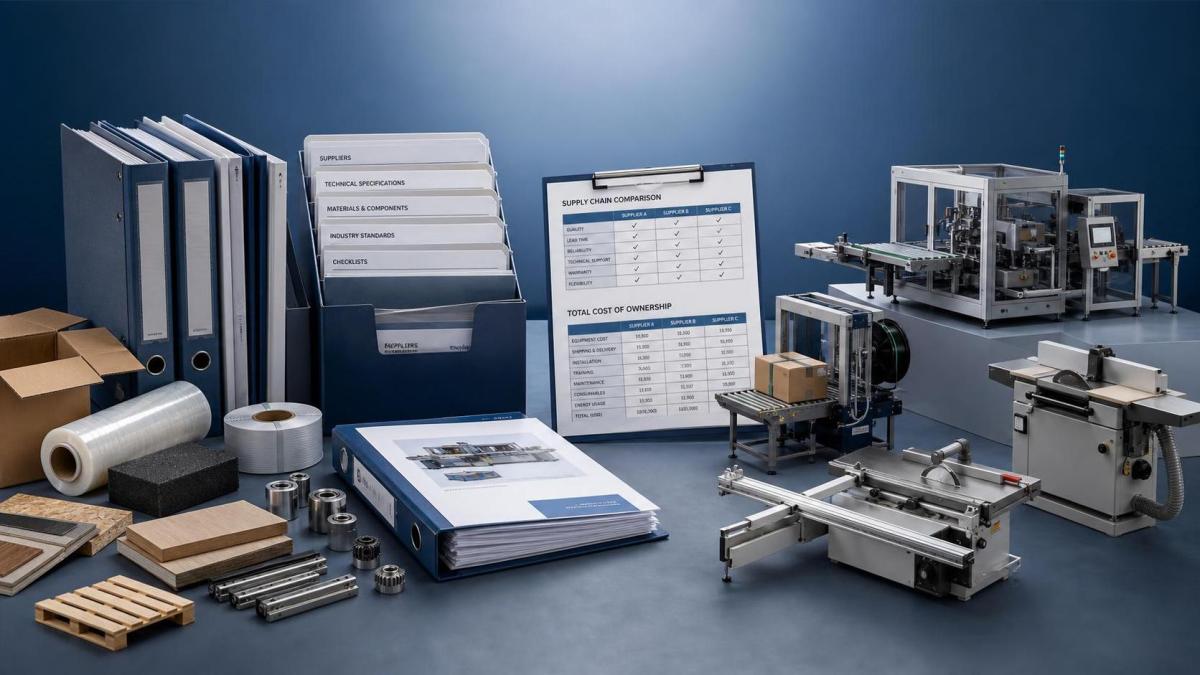
Look for cost visibility beyond the machine sticker price. A procurement planning resource should help you estimate the full sourcing picture, including freight, installation, commissioning, operator training, tooling, spare parts, utilities, software interfaces, and expected maintenance intervals.
A common buying mistake is comparing quotations from different vendors as if they contain the same scope. In real projects, one supplier may include startup support and another may treat it as an extra charge. One line may require more floor preparation, heavier power supply work, or more compressed air capacity. On paper, those quotes can look close. In practice, they are not.
If a resource helps you build a total landed and operational cost view, keep it. If it only repeats performance claims without scope detail, treat it as marketing support, not procurement planning support.
What documents should I gather before comparing suppliers?
Before you compare suppliers, build your own decision file. That avoids the usual problem where vendors define the buying criteria for you.
- Current production volumes by product type
- Target throughput and shift model
- Material range, board or panel specifications, and size limits
- Required output quality, such as print consistency, cutting accuracy, or edge finish
- Plant utility data: power, air, steam, extraction, and floor constraints
- Maintenance staffing and operator skill level
- ERP, MES, CAD, or prepress integration requirements
- Budget structure: capex only, or capex plus operating-cost thresholds
Once those are in place, you can request quotes against the same baseline. That is the only way supplier comparison becomes meaningful.
Are trade shows and industry events still worth using as procurement planning resources in North America?
Yes, but only if you use them as structured sourcing checkpoints. Trade shows are good for seeing machine design logic, automation maturity, and supplier positioning in one place. They are less useful if the team walks the floor collecting brochures without a comparison framework.
Bring a short evaluation sheet. Record what is standard, what is optional, what is outsourced, what is locally supported, and what lead times are discussed for spare parts and service engineers. For equipment categories with complex setup demands, such as offset presses or high-speed converting lines, ask how startup support is handled in North America and which tasks remain the buyer’s responsibility.
The event itself is not the resource. Your notes, supplier follow-up, and cross-comparison work are what turn it into one.
How can procurement planning resources help reduce supplier risk?
A good resource helps you spot risk before legal review starts. In this market, the biggest issues are usually service response, parts continuity, process fit, and handoff gaps between sales promises and technical execution.
For example, a machine can be technically impressive and still be a weak buy if replacement parts have long import lead times or if local technicians cannot support calibration, controls, or tooling setup. The same applies when a line looks productive at demonstration speed but is unstable under your real mix of short runs, board changes, print variation, or custom furniture orders.
When reviewing procurement planning resources North America buyers rely on, pay attention to whether the source gives you evidence paths. Can you verify service coverage? Can you identify integration dependencies? Can you see where consumables and tooling will come from? If the answer is no, you still have a sourcing gap.
What should I compare when two machines look similar on paper?
This is where many procurement files go off track. Similar throughput ratings do not mean similar production economics.
For packaging and woodworking equipment, those differences often matter more than a headline speed figure.
Can a specialized intelligence portal really add value if I already have supplier quotes?
Yes, because quotes usually reflect each supplier’s preferred framing of the project. An intelligence portal is useful when it helps the buyer reframe the decision around process fit, production logic, and cost exposure. That is especially relevant in sectors where machinery is complex, long-lived, and tightly tied to quality output.
PWFS is positioned for exactly that type of buyer. Its value is not that it replaces supplier engagement. Its value is that it gives procurement and sourcing teams a more informed basis for asking better questions about corrugated systems, printing platforms, die-cutting workflows, CNC routing, and edge processing. In procurement, better questions often save more money than faster quote collection.
What are the most common mistakes buyers make when using procurement planning resources in North America?
Three show up repeatedly.
- They gather information before defining the operating requirement. That creates a pile of material but no decision logic.
- They compare supplier claims without normalizing scope. A lower quote may simply exclude tooling, installation, controls integration, or training.
- They underweight post-purchase support. In capital equipment buying, weak service planning can erase a negotiated discount very quickly.
Another subtle mistake is relying only on procurement-owned sources. Engineering, production, maintenance, and quality teams often hold the details that explain whether a promising buy will actually run well in your plant.
How should I build a practical shortlist from all this information?
Keep it simple and evidence-based. Use one screening round for fit, then one for cost and risk.
In round one, remove suppliers that clearly miss your material range, output target, automation need, or integration requirement. In round two, score the remaining options on total scope, support model, operating cost exposure, and implementation difficulty. If two options still look close, ask for clarification on excluded items, commissioning responsibility, spare-parts recommendation, and expected operator ramp-up.
That approach is usually more effective than trying to rank ten suppliers at once. Good procurement planning resources North America teams use well do not eliminate judgment. They narrow where judgment needs to be applied.
What is the clearest next step if I am starting from scratch?
Build your decision file before your RFQ file. Define the production need, map the true cost elements, then use specialized market resources, supplier materials, and technical review to test fit. For buyers in packaging and woodworking machinery, that usually leads to better outcomes than starting with price requests alone.
If a source helps you compare scope, service, integration, and operating cost in the North American context, keep it in your planning stack. If it only helps you admire the machine, move on.
Related News
Get weekly intelligence in your inbox.
No noise. No sponsored content. Pure intelligence.
