
How to Evaluate Carton Printing and Converting Equipment for Corrugated Box Production
When technical teams evaluate carton printing and converting equipment, the mistake I see most often is starting with headline speed or the lowest quoted price. Neither tells you much about how the machine will behave on your board mix, with your artwork, under your shift pattern, and with your maintenance discipline. In corrugated box production, a line that looks impressive on paper can still create daily trouble through unstable print, flute crush, die-cut drift, glue misses, or long recovery after a stop. A useful evaluation has to follow the actual production path: what you print, what you cut, what you fold, how fast you change jobs, and what happens when something goes wrong.
That is the lens for comparing carton printing and converting equipment in a way that supports box quality, operating efficiency, and long-term return. The checklist below is built for technical evaluators who need to separate a good demo from a good fit.
Start with the jobs, not the machine brochure
Before reviewing any press or converting line, pin down the job family it must run. Not in general terms like “shipping boxes” or “retail cartons,” but in the combinations that actually stress the equipment:
- Board grades and flute profiles
- Sheet size range, including the smallest repeat jobs and the largest format orders
- Print coverage, solids, barcodes, fine reverse text, and registration-critical graphics
- Die-cut complexity, slotting patterns, hand holes, windows, and waste stripping needs
- Bundling, stacking, and downstream pack-out requirements
If you skip this step, every later comparison gets fuzzy. A machine that performs well on regular slotted containers may struggle when the mix shifts toward short runs with frequent artwork changes, or toward heavier board that punishes feed stability. Technical evaluation starts with a production truth table, not a sales presentation.
Check print quality where corrugated jobs usually fail
Print samples handed over at a trade show are rarely enough. Ask to review output that matches your board structure and artwork difficulty. If a live trial is possible, bring your own files and board. On corrugated work, the weak points are predictable:
- Registration consistency after speed changes and short stops
- Ink laydown on solids, especially near flute variation and board warp
- Edge definition on small text and line work
- Repeatability from first acceptable sheet to the end of the run
Do not judge only the best sample. Ask for the first sheets after setup, samples from the middle of the run, and sheets taken after a restart. Plenty of equipment can produce one clean sheet. The real question is whether it can keep doing it when the line is running like a factory, not like a showroom.
If your boxes carry retail-facing graphics, barcode readability, or color-sensitive branding, pay attention to how the machine manages repeatability rather than chasing abstract claims about precision. In practical terms, a stable machine reduces operator compensation and rework. That matters more than brochure language.
Look closely at feeding and board handling
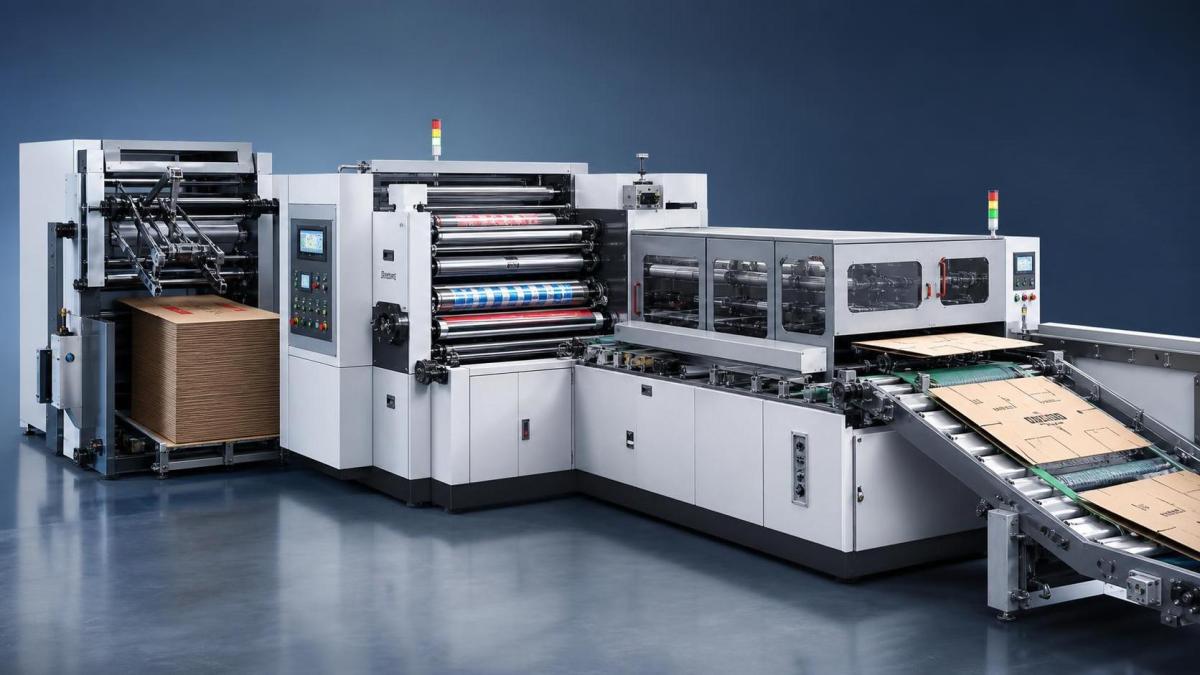
A surprising amount of print and die-cut trouble begins before the sheet reaches the process section. Feed accuracy, skew control, vacuum performance, sheet separation, and transfer stability are not secondary details. They are the base layer for everything else.
When reviewing a line, ask these questions during operation:
- How does the feeder react to warped board or mixed flatness?
- What adjustments are manual, and which are recipe-driven?
- How often do double feeds or misfeeds appear during normal acceleration?
- Does handling mark the board surface before printing?
This is one of those areas where speed claims can mislead. High rated speed is useful only if sheet control remains stable across the board range you actually buy. If your procurement team changes paper combinations over time, a machine with a narrower comfort zone can become expensive very quickly.
Evaluate die-cutting stability under real production conditions
For many technical evaluators, die-cut quality is where machine selection becomes very concrete. Poor die-cutting shows up fast: broken nicks, incomplete cuts, crushed flute, dimensional variation, weak fold performance, and downstream jams in folder-gluing or packing.
Do not limit the review to whether the blank “looks fine.” Inspect what happens at operating speed and after tool wear begins to build. Look for:
If the supplier cannot show stable die-cutting on patterns close to yours, treat that as a decision signal, not a paperwork gap.
Do not underrate setup and changeover time
This is where many investments win or lose their economics. A technically capable line with slow, operator-dependent setup can drag down utilization all year, especially in plants with mixed order sizes. Ask for the full changeover sequence, not just the shortest quoted number.
Watch how long it takes to move from one real job to another, including plate changes, slotting or die adjustments, print registration correction, feeder setting changes, and first-saleable-sheet approval. Then ask how much of that result depends on the most experienced operator being present.
A machine that stores repeat jobs, guides setup with recipes, and reduces manual touchpoints often creates more value than a faster line that needs constant fine-tuning. For short and medium runs, changeover behavior is production capacity.
Review automation as an integration question
Automation sounds attractive until it collides with existing workflow. For carton printing and converting equipment, you need to know whether the line will fit your prepress, job ticketing, quality control, maintenance planning, and downstream material flow.
Useful checks include:
- Can job parameters be imported from your current production planning system?
- How are recipes saved, edited, and protected from accidental overwrite?
- What production and alarm data can be exported for analysis?
- Can the line communicate clearly with inspection, stacking, bundling, or palletizing equipment?
The trap here is buying “advanced automation” that adds interface complexity without reducing variation. Technical evaluators should insist on a practical map of signals, operator screens, alarm logic, and handoff points. Integration is only valuable if it shortens decisions on the floor.
Ask what happens during the ugly hours
Good equipment selection is not just about output when everything is aligned. It is also about recovery. What happens after a jam, plate cleaning, board change, glue issue, or power interruption? How quickly can the line return to stable production, and how much scrap is created in the process?
This is where technical supportability becomes visible. Review access for cleaning, wear-part replacement points, lubrication demands, fault diagnosis screens, and spare-part logic. If a common adjustment requires awkward access or repeated trial-and-error, your downtime cost will not stay theoretical for long.
A simple rule helps here: the more a machine depends on tribal knowledge to recover, the higher the long-term operating risk.
Match the machine to your operator profile
Some lines are forgiving. Others are powerful but narrow, meaning they perform well only when run by highly experienced crews. Technical evaluators should be honest about plant staffing, training depth, shift turnover, and local service availability.
During evaluation, separate tasks into three groups: what a trained operator can handle, what needs specialist intervention, and what requires supplier support. Then ask how the supplier trains teams, documents preventive maintenance, and updates control software. The answer affects startup time, error rate, and how fast the plant becomes independent.
Check compliance through the actual packaging use case
Compliance should be tied to the box application, not discussed as a generic feature. If the output is used for food contact-adjacent packaging, export markets, branded retail work, or traceability-sensitive supply chains, the review needs to cover the relevant documentation path: substrate specifications, ink or coating suitability where applicable, traceability records, and process control points that affect consistency.
For technical teams, the practical question is not “Is the machine compliant?” A machine does not make the final packaging compliant by itself. The better question is whether the equipment supports controlled, repeatable production and whether the supplier can document the process conditions, consumable interfaces, and records your target market expects.
Compare total ownership cost in the places that usually get missed
By the time equipment reaches final comparison, most teams have purchase price, layout, and rated throughput on the table. That is not enough. Build your ownership view around the costs that actually move over five to seven years:
- Setup waste during changeovers
- Scrap created during restart and fault recovery
- Wear-part consumption and replacement intervals
- Operator headcount per shift
- Service response capability in your region
- Expected downtime from maintenance complexity
This is also the right moment to challenge assumptions in the quoted output model. If projected capacity depends on long runs, perfectly flat board, or expert-only setup performance, discount it. Conservative assumptions usually produce a better decision than optimistic averages.
A practical order for the final decision
When the shortlist is down to two or three machines, make the decision in this order: first, eliminate any option that cannot hold print and die-cut stability on your real work mix. Next, compare feeder behavior and changeover discipline, because those two factors shape daily production more than advertised top speed. After that, test whether automation and data functions fit your existing workflow instead of forcing workarounds. Only then should you weigh commercial terms.
A sound evaluation of carton printing and converting equipment is less about finding the most advanced machine and more about finding the line that stays stable, recovers quickly, and makes acceptable boxes with the least operator strain. If your team keeps the assessment tied to real jobs, real board behavior, and real recovery scenarios, the right choice usually becomes obvious before the final quote does.
Related News
Get weekly intelligence in your inbox.
No noise. No sponsored content. Pure intelligence.
