
How to Evaluate Tobacco Carton Machinery for High-Speed Folding Carton Lines
Meta Title: How to Evaluate Tobacco Carton Machinery for Folding Cartons on High-Speed Lines
If you are comparing tobacco carton machinery for folding cartons, the real question is not which machine has the highest headline speed. It is which machine can hold carton geometry, registration, glue quality, and stable output hour after hour on your actual line. A machine that looks fast in a brochure but struggles with warped blanks, frequent stops, or long changeovers will cost more than it saves. The right evaluation focuses on repeatable production, not peak claims.
In tobacco packaging, technical evaluation usually gets stuck between two extremes. One side looks only at nameplate speed. The other side gets buried in feature lists that may never matter in production. The useful middle ground is to test how the equipment behaves under realistic folding carton conditions: tight tolerances, visually sensitive print, strict pack consistency, and a production team that needs uptime more than fancy options.
Start with the line, not the machine brochure
Before comparing suppliers, define the job envelope. That means your board grades, blank sizes, pack styles, crease quality range, print finish, and target speed window. Tobacco cartons often look simple from a distance, but they punish inconsistency. Minor drift in squareness, panel alignment, or glue placement becomes obvious very quickly at cartoning, overwrapping, bundling, or downstream inspection.
A short answer many evaluators need is this: the best machine is the one that stays in control at your normal operating speed, across your actual SKU mix, with acceptable waste, reasonable changeover time, and clean integration into the rest of the folding carton line.
That sounds obvious, but many purchasing mistakes start when evaluation is done around an ideal sample rather than the factory’s real production variability.
What matters most when evaluating tobacco carton machinery for folding cartons
There are a few performance areas that deserve more weight than others.
First, carton handling stability. High-speed performance depends on how consistently the feeder, transport, folding section, and compression section control the blank. At speed, lightweight or highly finished carton stock can slip, mark, bounce, or misregister. Ask to see the machine run a representative blank, not just a supplier’s preferred format. If possible, include difficult samples: narrow widths, deep scores, glossy surfaces, embossed areas, or blanks with known warp tendencies.
Second, fold accuracy at speed. A tobacco carton line does not forgive loose folding discipline. You want repeatable panel positioning, clean crease activation, and reliable closing geometry. A machine may run fast on straight-line cartons but lose control on structures with tighter tolerances or more sensitive panel relationships. Watch the cartons after compression, not only during transfer. Poorly controlled folding sometimes appears acceptable until cartons relax after exiting the machine.
Third, glue application discipline. Glue quality is often discussed too casually. The question is not whether the machine has a gluing system. The question is whether it can place the right bead in the right position with stable volume across speed changes and product changes. Excess glue can contaminate packs or cause squeeze-out. Insufficient or wandering glue leads to open seams and downstream rejects. Glue verification, easy adjustment, and clean access for maintenance deserve close attention.
Fourth, changeover reality. Suppliers often quote optimistic changeover times based on trained demonstrators and ideal preparation. In practice, technical evaluators should break changeover into parts: recipe recall, mechanical adjustment points, tooling replacement, inspection confirmation, first-good-carton time, and time to regain stable rated speed. Those are not the same thing.
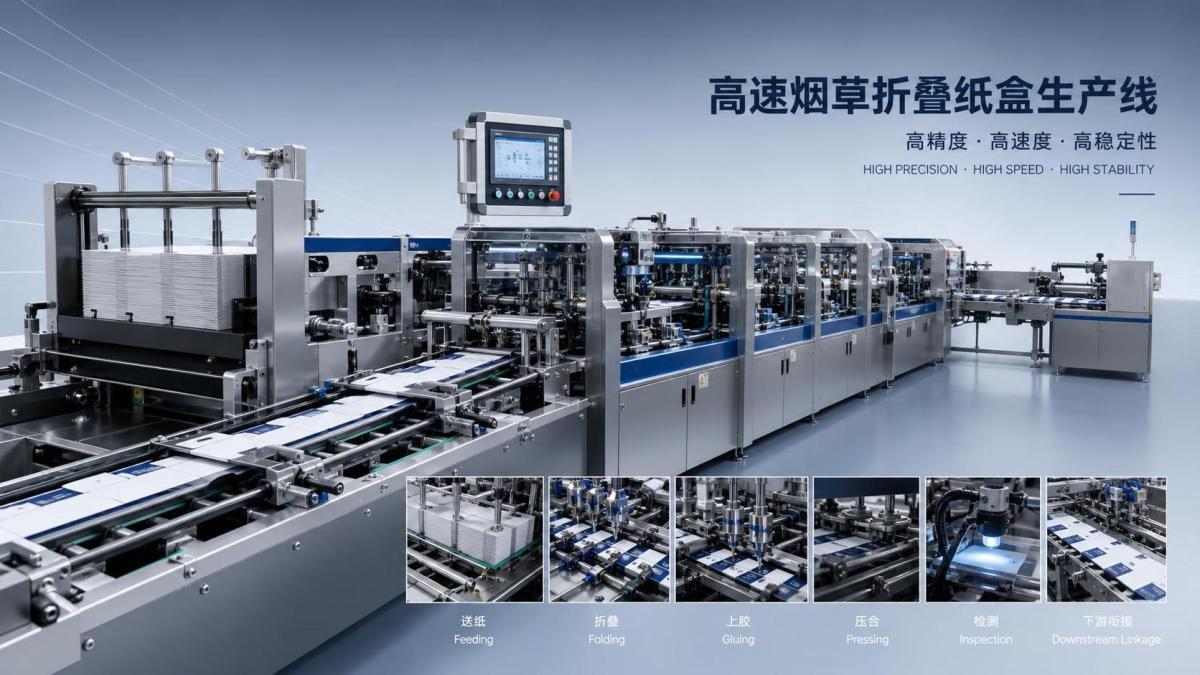
Fifth, integration readiness. Tobacco carton machinery rarely works in isolation. It must exchange speed signals, fault logic, and job data with upstream die-cutting, prefeeding, coding, inspection, and downstream packing systems. If the machine cannot integrate cleanly with your controls architecture, its mechanical quality will not be enough.
The biggest mistake: treating maximum speed as the main KPI
Many technical teams still anchor too heavily on top speed. That is understandable, but it is not a reliable purchasing metric.
A line rated for a very high speed may still produce less sellable output than a slightly slower machine with better blank control and fewer interventions. What you really need is the sustainable speed band where quality, waste, and operator workload remain acceptable. In other words, ask what happens at 70%, 85%, and 95% of rated speed, not only at the speed printed on the quotation.
This is where factory acceptance testing and site acceptance testing should be structured carefully. Do not limit the run to one SKU and a short burst. Ask for enough runtime to expose heat build-up, glue consistency drift, feeder sensitivity, and reject patterns. Intermittent instability is exactly what brochures hide.
Questions that separate serious suppliers from polished presenters
When the discussion gets technical, useful suppliers become very easy to spot. They can explain why the machine stays stable, not just that it does. They can discuss transport architecture, folding guidance, compression control, servo logic, glue system behavior, and access for preventive maintenance in plain engineering terms.
Ask questions such as:
- What blank tolerances can the machine realistically absorb before quality begins to drift?
- Which carton styles run at full speed, and which require derating?
- How does the machine manage board memory, curl, or variable crease quality?
- What are the most common wear parts, and how do they affect folding accuracy over time?
- How is repeatability maintained after multiple changeovers?
- What diagnostics are available to help operators identify the source of a reject?
If the answers stay at the marketing level, that is a warning. Good technical support starts long before installation.
Pay attention to the carton, not just the machine
Some evaluation problems are actually converting problems. A folding carton machine cannot fully compensate for poor blank consistency coming from upstream printing and die-cutting. Uneven creasing, dimensional variation, nick issues, edge roughness, or coating-related slip can all show up later as folding instability.
This is why cross-process thinking matters. Teams that understand offset print behavior, die-cutting discipline, and folder-gluer mechanics usually make better machinery decisions than teams evaluating only one machine center at a time. That broader view is also why industry intelligence platforms such as PWFS can be useful as a reference point. When a source follows corrugated lines, offset presses, die-cutters, and folder-gluers together, it becomes easier to judge whether a carton issue is really a machine limitation or a line-wide process mismatch.
That kind of context matters in tobacco cartons because print register, crease quality, and folding precision are tightly linked. If one part drifts, the rest of the line pays for it.
Where technical evaluators often underestimate risk
One common blind spot is operator dependence. A machine can look impressive in a demo because it is being run by the people who know every adjustment by memory. Your own plant may have a different staffing profile. So evaluate not only what the machine can do, but how easily an average trained crew can keep it in control.
Another is maintenance access. Tight layouts may save floor space but create longer stoppages when glue heads need cleaning, belts need replacement, or alignment checks are required. A machine with excellent accessibility often wins over time even if it looks less compact on paper.
The third is digital integration. Recipe management, reject tracking, production data capture, remote diagnostics, and fault history are no longer “nice to have” on high-speed lines. They affect troubleshooting speed and repeatability. Still, this area needs verification. Request details on supported protocols, alarm logic visibility, and what data can actually be exported to MES or plant systems. If integration is critical, confirm it with your automation team early.
How to structure a more useful evaluation process
A practical evaluation sequence usually works better than a feature-by-feature scorecard alone.
- Define the operating window: carton styles, substrates, target speeds, quality limits, and expected SKU changes.
- Rank failure costs: downtime, waste, glue defects, dimensional rejects, and downstream disruption.
- Prepare realistic test blanks, including difficult samples.
- Run a witnessed trial with enough duration to expose instability.
- Review changeover by task, not by headline minutes.
- Check spare parts strategy, service access, and local support capability.
- Validate controls integration and data exchange requirements before final approval.
This approach helps technical teams avoid a familiar trap: selecting a machine that wins the showroom comparison but creates hidden friction in production.
When a higher-spec machine is justified, and when it is not
Not every plant needs the most complex configuration. If your SKU range is narrow, blank quality is tightly controlled, and production planning limits changeovers, a simpler machine with strong mechanical stability may be the better investment. More automation is useful only when it solves a real bottleneck.
On the other hand, if you run frequent SKU changes, tight visual standards, or sensitive carton structures, higher-spec control systems, quick-setting features, and stronger inspection capability can pay back quickly. The key is to match the spec to your risk profile, not to the supplier’s premium package.
That is especially relevant for tobacco carton machinery for folding cartons, where quality failures tend to show up immediately and create disproportionate downstream disruption. Precision is not just a nice outcome here. It is part of line stability.
Final judgment should come from evidence, not confidence
When technical evaluators make a sound decision, the reasoning is usually very plain: the machine ran our cartons, at our target conditions, with acceptable waste, stable geometry, manageable changeovers, and credible support behind it. Everything else is secondary.
If you are narrowing options now, insist on proof in five areas: stable feeding, controlled folding, consistent gluing, realistic changeovers, and integration readiness. That framework will tell you more than most sales presentations ever will. For high-speed lines, the best tobacco carton machinery for folding cartons is the machine that protects output quality when production stops being ideal.
FAQ
Is rated speed a reliable basis for supplier comparison?
Not by itself. Sustainable speed with acceptable waste and quality control is more useful than peak rated speed.
How many SKUs should be included in a trial run?
Enough to represent your normal production mix, plus at least one difficult format. One easy SKU is rarely enough for a decision.
Should technical teams focus more on mechanics or controls?
Both matter. Strong mechanics create carton stability; strong controls improve repeatability, diagnostics, and integration.
Can a better folder-gluer compensate for poor die-cut blanks?
Only to a limited extent. Upstream blank consistency still has a major effect on folding quality and line efficiency.
Image Placeholder Notes
Suggested placement: after the section discussing core evaluation criteria
Suggested image content: annotated diagram of a high-speed folding carton line showing feeder, folding, gluing, compression, inspection, and downstream integration points
Suggested alt text: Technical checkpoints for evaluating tobacco carton machinery on a high-speed folding carton line
Internal Link Anchor Text Suggestions
- high-speed folder gluer evaluation checklist: link to a technical guide or checklist page
- how die-cut quality affects folding carton performance: link to an upstream process article
- offset printing accuracy in carton production: link to a print quality or registration article
- MES integration for packaging equipment: link to an automation or digital manufacturing page
- common causes of carton gluing defects: link to a troubleshooting article
External Authority Source Suggestions
- brand official technical documentation for folder-gluers, cartoners, and inspection systems
- industry association guidance on carton converting, packaging line efficiency, or machinery safety
- government or regulatory pages relevant to tobacco packaging compliance and production requirements
Related News
Get weekly intelligence in your inbox.
No noise. No sponsored content. Pure intelligence.
