
How to Choose Packaging Machinery for Corrugated Boxes by Box Size and Output
Choosing packaging machinery for corrugated boxes is fundamentally a sizing and throughput decision, but technical evaluators know the real task is broader. A machine that can physically run a given box format is not automatically the right investment if changeover time, feeder stability, glue accuracy, footprint, or downstream integration will limit usable output.
For most projects, the correct selection starts by defining the true box size range, the actual sellable output per shift, and the degree of product mix variability. From there, the machine choice becomes a structured comparison of line architecture, format flexibility, automation level, and long-term operating cost rather than a simple nameplate speed exercise.
What Technical Evaluators Need to Confirm First
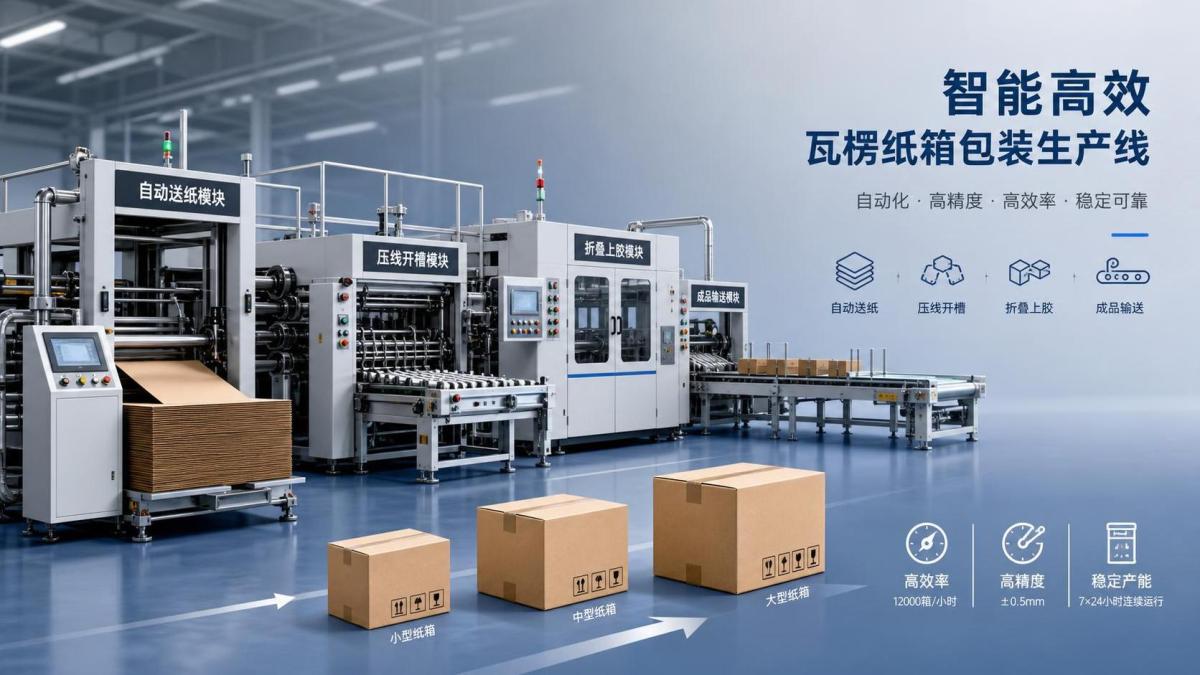
When buyers search for packaging machinery for corrugated boxes, they are usually not looking for a generic machine list. They want a practical method to match machine capability with production requirements while avoiding over-specification, bottlenecks, and unstable operation.
For technical evaluation teams, the first concern is whether the machine can sustain the required output across the full planned box size range, not just under ideal test conditions. The second is whether that performance remains consistent when order sizes shrink, box dimensions change frequently, or board grades vary.
That means the early evaluation stage should focus on four questions. What is the minimum and maximum box size to be processed, what is the target output in boxes per hour, how often will changeovers occur, and what upstream or downstream equipment will define the real line pace.
Start with Box Size Range, Not Catalog Speed
Box size range is the first filter because it immediately narrows the suitable machine platforms. Technical teams should define minimum blank size, maximum blank size, maximum box depth, flute profile range, and any special dimensional tolerances required by end customers.
It is important to work from actual production data rather than a broad sales forecast. Many operations buy around occasional oversized jobs, then discover that the resulting machine is inefficient for the high-volume mainstream formats that generate most annual revenue.
A better approach is to map current and expected orders into three groups: core running sizes, secondary flexible sizes, and exceptional formats. The machine should be optimized around the core group first, capable on the secondary group, and commercially justified if it must also cover rare extremes.
For corrugated applications, dimensional stability matters as much as nominal format capacity. Feeding, slotting, scoring, folding, and gluing performance can change significantly between small regular slotted cartons, large transport cases, and heavy-duty board structures.
Evaluators should therefore ask suppliers for running data by format family, not only a single maximum sheet dimension. A machine that handles large blanks may still show lower accuracy, reduced glue consistency, or more frequent handling interruptions at the edge of its claimed range.
Define Output by Usable Production, Not Theoretical Speed
Required output is often expressed as boxes per minute or sheets per hour, but these figures can mislead if they are detached from actual job structure. Technical teams should convert business demand into usable output per shift after setup losses, inspection pauses, and routine stoppages.
For example, a plant needing 120,000 boxes per shift across many short runs should not evaluate the same way as a plant producing a narrow SKU mix in long campaigns. The first case values fast changeover and repeatability, while the second may prioritize peak speed and low unit cost.
Nameplate speed should therefore be treated as only one indicator. More useful metrics include stable operating speed on common board grades, output loss during size changes, scrap rate during startup, and the ratio between installed capacity and consistently achieved daily production.
In many corrugated plants, bottlenecks also sit outside the main machine. Bundle handling, strapping, palletizing, print registration checks, and stack transfer can all reduce effective throughput. A balanced line often outperforms a faster standalone machine that regularly waits on downstream constraints.
When comparing packaging machinery for corrugated boxes, ask for a realistic performance window. Suppliers should explain what speed is achievable on your target formats with your expected board quality and your order profile, not simply the maximum mechanical cycle rate.
Match Machine Type to Product Mix and Conversion Complexity
The right machine category depends on the type of corrugated box you run. A simple high-volume regular slotted carton operation may favor a dedicated folder gluer or box making line optimized for speed, while mixed-format plants often need more flexible converting configurations.
If your product range includes die-cut boxes, retail-ready packs, crash-lock bottoms, multi-point gluing, or complex folding geometry, the decision criteria change quickly. In those cases, precision of feeding, folding control, glue application, and registration consistency become more important than raw output alone.
Technical evaluators should separate straightforward transport packaging from higher-value converted boxes during the assessment. One machine rarely delivers optimal economics across both extremes unless the specification and budget clearly support that level of flexibility.
This is where many projects become expensive. Companies buy advanced flexibility they will not use, or they underinvest and discover later that customer requirements for shelf-ready packaging or short-run variation exceed the machine’s practical capability.
The most reliable path is to build an application matrix. List box styles, board grades, dimensions, monthly volumes, setup frequency, and quality tolerances. Then compare candidate machines against that matrix instead of evaluating abstract feature lists.
Pay Close Attention to Changeover Time and Setup Stability
In modern corrugated operations, usable productivity is increasingly determined by how quickly the line moves from one order to the next. This is especially important where e-commerce packaging, regional assortment strategies, or customer-specific dimensions create frequent short runs.
Fast order change is not only about servo automation. It also depends on recipe recall accuracy, operator accessibility, feeder adjustment logic, scoring and slotting repeatability, and whether the first acceptable box after setup arrives quickly or only after extended fine-tuning.
Technical teams should request measured changeover scenarios between actual box sizes. A supplier demonstration that changes between similar formats may hide the delays involved when moving from small shallow boxes to larger deeper cartons with different board behavior.
Setup stability also affects waste. If the machine reaches nominal settings quickly but needs repeated adjustments to maintain squareness, glue position, or fold quality, the real cost of short runs becomes much higher than the purchase comparison suggested.
For many factories, better setup performance creates more value than a modest increase in maximum speed. Reduced downtime, lower operator dependence, and fewer startup rejects directly improve schedule reliability and cost control.
Evaluate Board Handling, Precision, and Quality Consistency
Corrugated conversion performance is heavily influenced by board condition. Warp, moisture variation, flute type, and paper quality all affect feeding stability and final box geometry. A technical review should therefore assess how the machine handles material variability, not only perfect samples.
Feeder design is one of the most important checkpoints. Poor sheet separation or inconsistent transfer can undermine everything downstream. Ask how the system performs with lightweight board, large-format blanks, recycled-content material, and orders with slight flatness variation.
Scoring, slotting, and folding precision also deserve detailed attention. If the operation supplies automated packing lines or major retail customers, box squareness and dimensional repeatability can be as commercially critical as throughput. A slightly distorted box may still look acceptable but fail in downstream automation.
Glue application must be evaluated in the same practical way. Consider glue line accuracy, control at higher speeds, access for cleaning, and compatibility with your adhesive strategy. Glue inconsistency often appears first during size changes or speed increases, where brochure claims are least useful.
Where customer standards are strict, technical evaluators should ask for sample measurement data, not only visual inspection. Compression performance, fold accuracy, joint strength, and dimensional tolerance should all be verified against the intended use case.
Check Integration with the Full Corrugated Line
A standalone machine can look impressive during evaluation but still underperform once installed if the plant layout and data flow are poorly matched. Packaging machinery for corrugated boxes should be assessed as part of a system that includes upstream board supply, printing, die-cutting, bundling, and end-of-line handling.
Line synchronization matters because local speed advantages disappear when transfer logic, buffering, or stack orientation create interruptions. Evaluators should study infeed consistency, downstream accumulation capacity, reject handling, and how the machine recovers after minor stops.
Digital integration is increasingly important as well. Recipe management, production reporting, maintenance diagnostics, and MES connectivity all contribute to repeatable performance. These functions are not cosmetic features; they reduce setup variation, troubleshooting time, and hidden labor cost.
Footprint and service access should be reviewed with equal seriousness. A compact installation may appear attractive, but poor maintenance reach, restricted blank flow, or difficult tool access can reduce uptime over the life of the machine.
The best technical selections usually come from layout-based evaluation, where machine capability is checked against actual plant conditions instead of being judged in isolation.
Calculate Total Cost of Ownership Before Final Selection
Capital price alone is a weak decision tool for this category. Technical evaluators should compare total cost of ownership across energy use, labor requirement, changeover waste, spare parts exposure, maintenance intervals, glue consumption, and expected uptime.
A lower-cost machine may become more expensive if it needs more operators, generates more startup scrap, or delivers unstable output on the formats that matter most. Likewise, a premium machine is not justified if its advanced flexibility will remain largely unused.
It helps to build a simple cost model around the real production mix. Estimate annual running hours, order frequency, target OEE, average setup loss, expected reject rate, and maintenance burden. This reveals whether value comes from speed, automation, precision, or reduced labor dependency.
Technical teams should also consider supplier support risk. Installation quality, commissioning depth, spare part lead times, remote diagnostics, and training quality have a direct effect on return on investment. The machine specification is only part of the buying decision.
For most buyers, the winning option is not the fastest or the cheapest. It is the one that delivers the most stable commercial output across the required box size range with manageable operating complexity.
A Practical Selection Framework for Technical Evaluators
A disciplined evaluation process reduces the chance of buying the wrong platform. Start by ranking all active and forecast box formats by volume, margin, and production frequency. Then identify the board grades and quality tolerances attached to each group.
Next, define the real throughput target at shift level, including planned setup frequency and acceptable waste. Compare this requirement with demonstrated, not theoretical, machine performance. Wherever possible, request trials that reflect your actual product mix.
Then review changeover method, feeder reliability, fold and glue consistency, and integration needs. Include maintenance access, operator skill sensitivity, digital reporting, and support availability in the same decision matrix so that operational risk is visible early.
Finally, weigh all candidates against total cost of ownership and strategic fit. If the factory is moving toward shorter runs, higher SKU count, and more automation, flexibility and data connectivity may be worth more than incremental top speed.
This structured approach gives technical evaluators a clearer basis for comparing packaging machinery for corrugated boxes and defending the recommendation internally.
Conclusion
Choosing the right machinery for corrugated box packaging is not about finding the highest advertised speed or the broadest catalog format. It is about matching box size range, usable output, product complexity, and line integration to the realities of your production environment.
For technical evaluators, the most effective decision comes from testing how a machine performs across common formats, frequent changeovers, variable board conditions, and full-line operating constraints. That is where long-term efficiency is won or lost.
If the machine can run your core box sizes reliably, sustain required output with limited setup loss, and integrate cleanly into the broader converting flow, it is likely the right investment. That standard is far more valuable than an impressive specification sheet alone.
Related News
Get weekly intelligence in your inbox.
No noise. No sponsored content. Pure intelligence.
