
How to Evaluate High Speed Folder Gluers CE Compliance for Safer EU Market Entry
Where should a technical evaluator start when reviewing high speed folder gluers CE compliance?
Start with a simple assumption: if the machine will be placed on the EU market, CE is not a label exercise. For a high speed folder gluer, it is a structured check of whether the machine is designed, built, documented, and controlled in a way that meets the applicable EU safety requirements.
For technical evaluators, the fastest way to get traction is to review four things together rather than one by one: the machine layout, the risk assessment, the electrical documentation, and the operator interaction points. Folder gluers run fast, with multiple infeed, folding, transfer, compression, and discharge zones. That means the real risk usually sits in moving interfaces, access during setup, and what happens when operators clear jams or change jobs under production pressure.
If those four areas already line up, most CE gaps become manageable. If they do not, the Declaration of Conformity and the CE mark themselves tell you very little.
Is a CE mark on the nameplate enough to clear EU market entry?
No. A CE mark without the supporting technical file is a warning sign, not a green light.
A credible evaluation should confirm that the manufacturer can provide, at minimum, a Declaration of Conformity, operating instructions, circuit diagrams, a risk assessment, and evidence that the relevant essential health and safety requirements were addressed. On high speed folder gluers CE reviews, one common mistake is accepting a generic declaration that covers “packaging machinery” broadly but does not identify the actual model, configuration, or safety-related options installed on the machine being assessed.
Also check whether the marking and the documents match the real machine. If the serial number, rated voltage, guarding layout, or control architecture differ, the paperwork may belong to a similar machine, not this one.
Which EU rules usually matter most for folder gluers?
For most standalone folder gluers, the core legal framework is the Machinery Directive 2006/42/EC during its period of applicability, together with other relevant legislation depending on the machine design, such as the Low Voltage Directive and the EMC Directive where applicable. The exact combination depends on how the machine is powered, controlled, and integrated.
In practice, technical evaluators usually spend more time on harmonized standards than on the legal text itself, because standards shape the engineering test points. Typical review areas include safety distances, interlocking, emergency stop functions, electrical equipment of machines, prevention of unexpected start-up, and information for use.
The point is not to recite standard numbers from memory. The point is to see whether the machine builder translated those requirements into actual guarding logic, wiring, stopping behavior, and operator instructions.
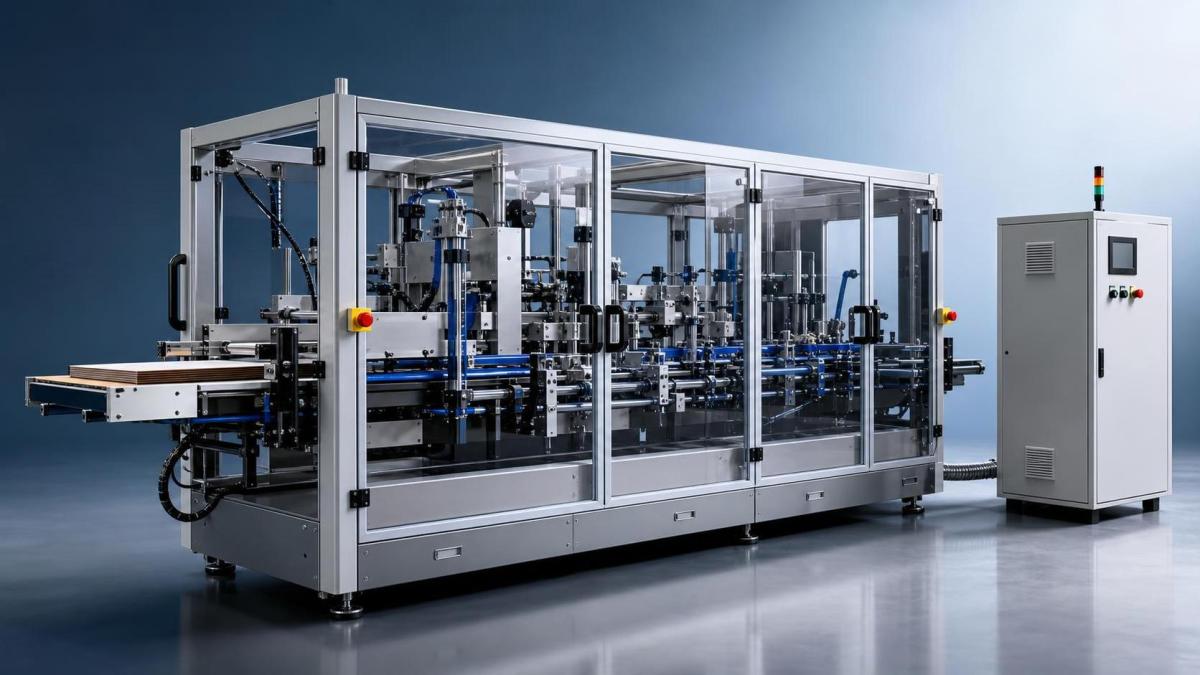
What are the highest-risk zones on a high speed folder gluer?
On these machines, risk is rarely evenly distributed. The danger usually concentrates where operators are tempted to reach in while the line is still moving or coasting.
Pay close attention to:
- Feeder and infeed sections, where hands may approach belts, rollers, and side guides during correction.
- Folding sections, where pinch points multiply as cartons change direction.
- Glue application and transfer zones, especially where cleaning or inspection is done frequently.
- Compression and delivery sections, where residual movement may continue after a stop command.
- Access doors or removable covers used during setup and maintenance.
A strong CE evaluation does not just ask whether guards exist. It asks whether the guard arrangement still works during realistic production events: skewed blanks, glue stringing, misfeeds, and short stoppages between batches.
How do you judge whether guarding and interlocks are genuinely adequate?
Look for alignment between physical access, stopping time, and reset behavior. That is where weak designs show up.
If a door opens into a hazardous zone, the interlock should trigger the right stop category for that risk, and the machine should not restart just because the door is closed again. Manual reset matters. So does restart prevention after power return or fault clearing.
A practical review table helps:
On a high speed folder gluer, “good enough” guarding usually fails under real operator behavior. Evaluate for the plant floor, not for a showroom demonstration.
What should be inside the risk assessment, and what usually goes missing?
The risk assessment should map the machine’s full life cycle: transport, installation, setup, normal production, cleaning, jam removal, maintenance, troubleshooting, and decommissioning. If it only covers routine operation, it is incomplete.
What often goes missing on folder gluer projects is intervention-based risk. Evaluators see a nice enclosure and assume the hazard is solved, while the real exposure happens when an operator opens a panel to remove crushed blanks, wipe glue nozzles, adjust side carriers, or inspect folding quality during slow run.
Another weak point is mode selection. If the machine has setup, inching, jog, reduced-speed, or maintenance modes, the risk assessment should explain what protective measures apply in each mode and how mode transitions are controlled. A single risk statement covering “operation” is not enough.
Does electrical compliance require more than checking cabinet neatness?
Much more. A tidy cabinet can still hide a poor compliance position.
Review the electrical drawings against the actual build. Confirm protective bonding, short-circuit protection, device identification, isolator function, and safe segregation where relevant. Verify that emergency stop circuits, guard interlock channels, and safety relays or safety PLC functions are documented and traceable.
For EU entry, EMC is also easy to underestimate. A folder gluer with servo systems, drives, sensors, glue controls, and HMI networks may behave differently once installed next to other equipment. Technical evaluators should look for evidence that the machine was designed and tested with electromagnetic compatibility in mind, not only assembled from compliant components.
How important are manuals and warnings in a CE review?
They matter, but they are not a substitute for design controls. A manual cannot fix an accessible nip point.
What the documentation should do is close the remaining gap after engineering protections are in place. For technical evaluators, that means checking whether the instructions actually match the machine delivered and whether they cover the tasks that create exposure. Look for lockout steps, safe cleaning methods, residual risk warnings, tooling or accessory limits, and instructions for fault recovery.
If the manual talks in generic terms while the machine has special modules, remote diagnostics, extra carriers, or integrated peripherals, the compliance package is not finished.
What documents should you request before approving a machine for EU placement?
Request the package early, not a week before shipment. That gives time to catch structural gaps.
- EU Declaration of Conformity for the exact machine or configuration
- General arrangement drawings and guarding layout
- Electrical schematics and parts lists
- Risk assessment tied to actual operating modes
- Operating and maintenance instructions in the required language scope
- Safety function description, including interlocks and stop behavior
- Test or verification records used to support the conformity claim
Then compare those documents against the machine build, not just against each other. Many compliance issues appear only when the line has been customized for a specific carton format range, speed target, or integration requirement.
What are the most common mistakes in high speed folder gluers CE evaluations?
Three mistakes show up again and again.
- Reviewing components instead of the machine. A compliant sensor, drive, or interlock switch does not prove the whole safety function is adequate.
- Ignoring operator intervention. The machine may look safe at full enclosure, but frequent jam access changes the risk picture completely.
- Accepting generic documentation. High speed folder gluers are often sold with options, add-ons, or line integrations. If the documents do not reflect that actual build, the evaluation is thin.
One more point: do not treat commissioning adjustments as minor. If guarding is cut, moved, muted, or bypassed during site installation, the original conformity position may no longer hold.
How should evaluators handle partially completed machines or integrated lines?
This is where many projects get messy. A folder gluer may arrive as one module inside a larger converting line with upstream feeders, pre-breakers, inspection systems, bundlers, or conveyors. In that case, the compliance question is no longer limited to a single machine boundary.
Check who is taking responsibility for the final assembly, the control integration, and the conformity of the combined line. Review interface hazards carefully: transfer points, emergency stop propagation, restart coordination, and access between linked machines. A machine that is compliant in standalone form can create new hazards once connected to upstream or downstream equipment.
For technical evaluators, the key is to define the machine boundary on paper before trying to judge conformity in the field.
When is a machine “ready enough” for safer EU market entry?
When the safety claim survives contact with the real machine.
That means the high speed folder gluers CE file is complete, the documents match the delivered configuration, the guarding and safety functions behave correctly in production and intervention modes, and the remaining risks are clearly controlled and communicated. If one of those pieces is missing, EU entry becomes slower, more expensive, and harder to defend.
A useful rule for evaluators is this: do not sign off when the paperwork looks convincing; sign off when the machine, the documents, and the operator reality tell the same story.
Related News
Get weekly intelligence in your inbox.
No noise. No sponsored content. Pure intelligence.
