
Process Optimization in Furniture Manufacturing: Where to Cut Setup Time First
Process Optimization in Furniture Manufacturing: Where to Cut Setup Time First
In furniture manufacturing, the fastest path to higher throughput is often not a new machine. It is a better setup strategy. Many factories looking to optimize process furniture industry operations focus first on spindle speed, feed rate, or an additional CNC router. Those items matter, but they rarely solve the problem when machines are waiting for programs, tools, panels, glue temperatures, or operator decisions.
This is especially visible in panel furniture and whole-house customization. A factory may own capable nesting CNCs, drilling centers, edge banders, and automated sorting equipment, yet still lose hours every day in short, scattered interruptions. The router finishes a nest but the next material batch is not staged. The edge bander is mechanically available, but the required edge tape has not been confirmed. A revised cabinet design reaches production after the previous program has already been released. None of these delays appear as a dramatic breakdown. Together, they can become the real production constraint.
For leaders responsible for capacity, delivery promises, and investment decisions, setup reduction should begin where changeovers interrupt the flow of custom work. In most furniture plants, that means looking closely at CNC preparation, tooling control, program verification, material handling, and edge-banding transitions before buying more cutting capacity.
The Setup Time That Usually Goes Unmeasured
A formal machine setup may be recorded as the time spent changing tools, adjusting guides, or loading a new program. That definition is too narrow for modern furniture production. The practical setup begins when the previous job is still running and ends only when the next job produces an accepted first piece.
Consider a typical custom cabinet order. Before cutting can start reliably, the factory may need to confirm the latest CAD/CAM file, check panel material and thickness, verify the nesting program, ensure the correct cutter is available, inspect vacuum zones, identify labels, and place finished panels into the right downstream route. If any one of these actions happens after the CNC becomes idle, the machine is waiting on a process rather than doing productive work.
The same pattern applies at the edge bander. Changing between white melamine, dark PVC, veneer tape, laser edge material, or PUR-compatible work is not just a matter of selecting a reel. Operators may need to inspect the edge tape, confirm glue compatibility, adjust pressure settings, clean the glue application area, verify trimming quality, and wait for the first acceptable sample. On a line with mixed finishes and frequent order changes, this can be more disruptive than the nominal changeover time suggests.
The useful question is not, “How long does the tool change take?” It is, “How long does it take before the next order can run without creating rework downstream?” That is the number management should make visible.
Start with CNC Cells, but Do Not Start by Tuning the Machine
CNC routing is often the first place to target because it sits near the front of the panel-furniture value stream. Every late program, missing tool, damaged sheet, or unclear barcode can hold up all later operations. Yet a common mistake is to begin with aggressive cutting parameters. If a plant has unstable preparation, faster machining only moves the queue from the router to sorting, drilling, or edge banding.
A better first move is to separate internal setup from external setup. Internal setup can only happen while the machine is stopped: changing a tool holder, cleaning a vacuum spoilboard, or making a physical correction. External setup should happen while the current job is still cutting: reviewing the next program, staging sheets, checking labels, confirming hardware notes, and preparing any special fixtures.
In practice, the CNC operator should not be the only person responsible for all preparation. That person must watch cut quality, chip evacuation, tool condition, vacuum hold-down, alarms, and safe loading. Asking the same operator to search for the next board stack, interpret unclear drawings, and chase a missing label printer almost guarantees idle time. Production support roles, material handlers, or digitally connected work instructions can absorb much of this external work.
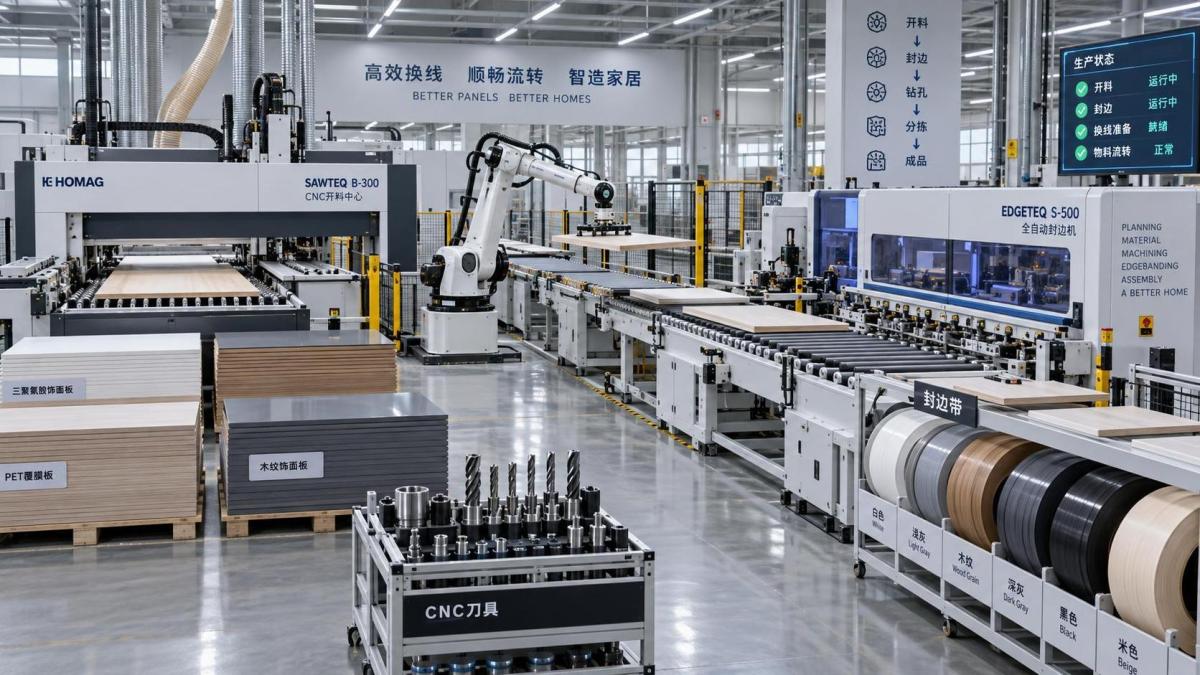
Tooling deserves particular attention. Furniture plants often own a large number of cutters because materials, profiles, drilling patterns, and product designs vary. The issue is not simply whether the required tool exists. It is whether its condition, remaining life, location, offset data, and approved application are clear before the job is released. A worn compression cutter may still appear usable, but poor edge quality on laminated particleboard can create problems that only surface at edge banding or final inspection.
Tool-life management does not need to begin with a complicated digital project. A controlled tool list, consistent naming, presetting discipline, and a practical rule for replacing tools based on observed cut quality can remove recurring uncertainty. Where automatic tool changers and offline presetting are available, the important point is to make sure the digital tool library matches the physical tool cabinet. Many setup problems start with a mismatch between those two realities.
Program Verification Should Move Upstream
Program errors are costly because they consume machine time and can damage expensive panels. They also create an uncomfortable operating habit: experienced operators start distrustfully checking every program at the machine. That caution is understandable, but it turns the CNC into a programming review station.
The stronger approach is to verify programs before they reach the shop floor. A pre-release check should confirm material code, thickness, grain direction where relevant, part orientation, machining operations, tool availability, labels, and revision status. For complex or newly introduced designs, a controlled first-off approval remains sensible. But this approval should be planned, not treated as an emergency response after a production interruption.
MES connectivity can help when it gives operators a single, reliable version of the job and links production status back to planning. It becomes less useful when the system adds screens, duplicate data entry, or unclear exception handling. Digitalization should remove decisions from the point of machining, not create more of them.
Edge Banding Is Often the More Fragile Bottleneck
Factories frequently treat the CNC router as the center of the operation because it is visibly sophisticated and capital-intensive. But an edge bander can become the real throughput limiter when the product mix includes many colors, thicknesses, edge materials, and quality expectations. This is especially true for kitchens, wardrobes, bathroom furniture, and retail fixtures, where a visible edge defect can make an otherwise accurate panel unacceptable.
Setup reduction at the edge bander starts with product-family logic. Grouping work only by sales order may create excessive switches between edge tape colors, panel thicknesses, glue requirements, and finishing specifications. Grouping everything into huge batches, however, can undermine delivery speed and make parts harder to match with the correct order. The right sequence is usually a compromise: enough family grouping to reduce disruptive changes, but not so much that urgent work and order integrity collapse.
A practical sequencing board can classify jobs by material family, panel thickness, edge type, color, glue method, and required finish. The goal is not to eliminate every changeover. In a customization business, that is unrealistic. The goal is to avoid avoidable switches, especially those that require cleaning, adhesive changes, extended warm-up, or significant trim adjustment.
PUR hot-melt systems and laser or zero-joint edge technologies can deliver demanding visual and moisture-resistance results when specified and maintained correctly. They also require disciplined operating conditions. Adhesive handling, cleaning procedures, tape storage, temperature control, and panel preparation should be built into standard work. A factory should not assume that premium edge technology automatically compensates for contaminated panels, worn cutters, unsuitable tape, or poor sequencing.
Material Flow Can Waste More Time Than Machining
Panels do not move through a factory as cleanly as a process map suggests. They wait at loading stations, accumulate near labeling, travel to a temporary rack, return because an edge is missing, and occasionally become separated from their matching components. In customized furniture production, the physical movement of semi-finished parts is inseparable from information flow.
Before investing in conveyors, robots, or automated storage, observe what happens during a real shift. Where do operators walk? Which panels are moved twice? Which jobs wait for a decision rather than a machine? Are labels applied early enough to preserve part identity after cutting? Do finished parts have a clearly defined destination, or do they enter a general “waiting area” that becomes a search area?
The most useful changes are often simple: defined staging zones for the next job, clear rack locations, barcode discipline, material kits prepared in advance, and visual escalation when a component is missing. Automation can then be evaluated against a known problem. Without that groundwork, automated handling may move disorganization faster.
Choose Setup Projects by Their Effect on the Whole Flow
Not every setup reduction effort deserves equal attention. A two-minute improvement on a machine with long uninterrupted runs may be less valuable than resolving a recurring ten-minute delay at a constrained cell. The decision should be based on frequency, impact on downstream operations, quality risk, and the degree to which the delay blocks customized orders.
This is where production data becomes valuable, provided it is interpreted carefully. Machine utilization alone can mislead. A high utilization figure may conceal excessive rework, overloaded operators, or downstream queues. Look at the full chain: released orders, first-pass quality, time to a complete kit of parts, edge-banding readiness, and how often work is re-routed. The best process improvement is not the one that makes a single machine look busiest; it is the one that makes reliable completed furniture move through the plant with fewer surprises.
A Practical Starting Point for Leaders
For a plant trying to optimize process furniture industry performance, begin with one representative product family rather than a factory-wide transformation. Follow several orders from design release to finished, edge-banded components. Record every period when a machine is ready but cannot run, and distinguish between technical stoppages, missing information, missing material, quality checks, and scheduling conflicts.
Then address the recurring causes in the order they appear. If programs are late, improve release discipline before installing another router. If tape changes dominate edge-banding downtime, revise the schedule and material preparation process before changing the entire line. If operators spend too much time searching for parts, stabilize routing and identification before specifying automated transport.
This way of thinking is central to the discussion around flexible paper-and-wood manufacturing: precision and speed are not separate ambitions. In the same way that high-speed printing depends on accurate registration and converting depends on controlled folding geometry, furniture automation depends on reliable handoffs between data, tools, panels, and finishing operations. PWFS follows these connected production realities because the most expensive delay is often not a failed machine. It is a capable machine waiting for the rest of the system to catch up.
The first setup-time target should therefore be the delay that repeatedly interrupts the constrained cell and creates downstream disorder. Find that point, make preparation happen before the machine stops, and protect the first-piece approval process. Only after those basics are stable is it possible to judge whether additional equipment is truly needed.
Related News
Get weekly intelligence in your inbox.
No noise. No sponsored content. Pure intelligence.
