
How to Specify Automatic Industrial Packaging Systems for High-Volume Lines
How to Specify Automatic Industrial Packaging Systems for High-Volume Lines
Specifying an automatic industrial packaging system for a high-volume line is not a matter of selecting the machine with the highest catalog speed. A corrugator, offset press, die-cutter, folder gluer, robotic packer, conveyor network, and MES layer may each perform well in isolation while the combined line still misses output targets. The weak point is usually where materials, data, or responsibility pass from one process to another.
For project leaders, the real specification task is to translate commercial demand into an operating envelope: product mix, peak order profile, board and substrate variation, permitted quality defects, labor availability, maintenance windows, and future changeover requirements. The phrase industrial packaging systems automatic is often used broadly, but the practical decision is far more specific. A system intended for stable, long-run e-commerce shippers should not be specified in the same way as a line producing short-run printed cartons for cosmetics, pharmaceuticals, or premium consumer goods.
The most reliable projects begin with a simple principle: specify the production result before specifying the equipment. “High volume” is not a useful engineering requirement unless it is defined by sellable output, not machine cycles.
Start with the real production profile, not the nameplate speed
A supplier may quote sheets per hour, boxes per minute, or linear metres per minute. Those numbers matter, but they are only part of the picture. A line rated for a fast, uninterrupted run of one format can perform very differently when it must handle frequent job changes, variable board moisture, complex die-cut geometry, color-critical print, or downstream pack-out constraints.
Before issuing a request for quotation, build a product-family map. Include the smallest and largest blank sizes, board grades, calipers, flute profiles, print coverage, coatings, glue patterns, carton styles, bundle formats, and pallet requirements. Mark which products account for most annual volume, but do not ignore difficult minority jobs. In many plants, the low-volume, high-complexity work determines whether automation is genuinely useful or becomes a bypassed asset.
It is also worth separating average demand from peak demand. A system designed only around average daily volume may look adequate until seasonal e-commerce surges, promotional packaging runs, or customer call-offs compress production into a narrow window. Conversely, designing every station for an exceptional peak can create an expensive line with unnecessary idle capacity. The better approach is to identify the required sustained output, the short-term peak, and the recovery rate needed after a stoppage or changeover.
This distinction is especially important in corrugated packaging. A corrugated board line can convert paper rolls into board at impressive speed, but the effective output of the plant is governed by how well converting equipment, material staging, waste handling, and finished-goods logistics keep pace. If the converting area cannot absorb board production, the corrugator’s speed becomes an inventory problem rather than a throughput advantage.
Locate the bottleneck across the whole packaging flow
High-volume packaging lines are systems, not collections of machines. The line should be assessed from incoming materials through to pallet discharge: paper or sheet supply, printing, drying or curing where applicable, die-cutting, stripping, blank inspection, folding and gluing, case packing, palletizing, labeling, and warehouse transfer.
The highest-risk interfaces are often less glamorous than the main press or folder gluer. A poorly designed buffer can damage printed sheets or create unstable accumulation. Inadequate blank orientation control can cause intermittent misfeeds. A palletizer may have sufficient nominal capacity but lack the recipe flexibility to handle frequent pallet-pattern changes. Even a conveyor transfer that is too abrupt can affect the squareness of lightweight cartons before packing.
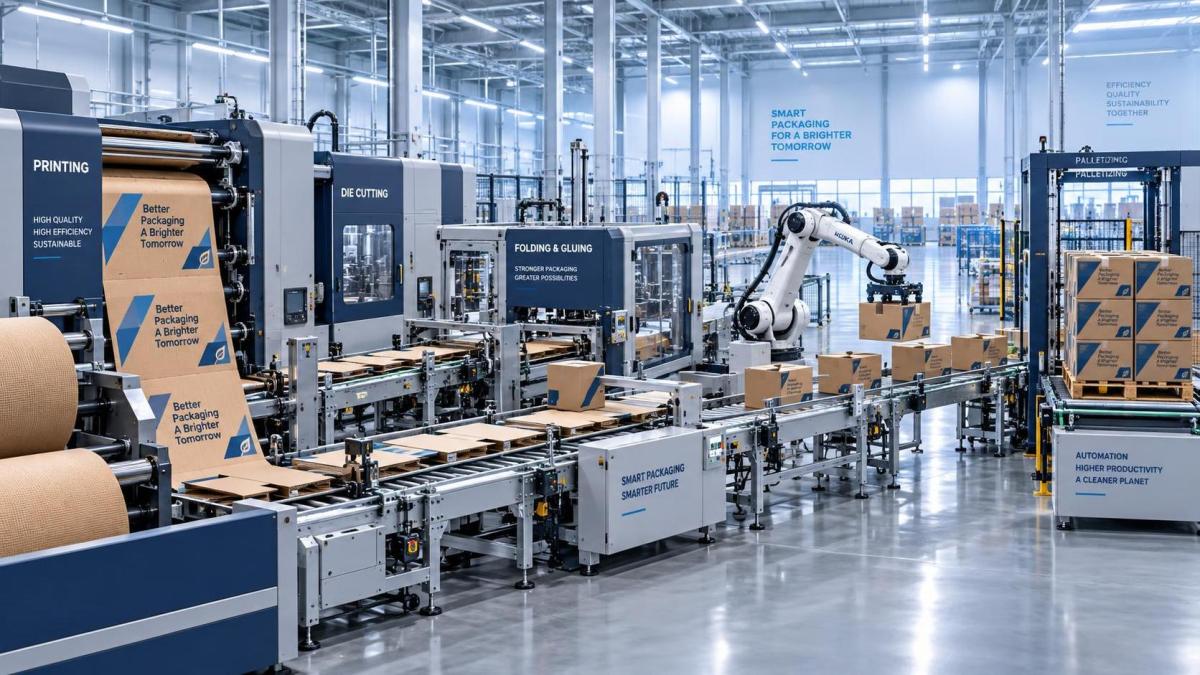
For this reason, equipment suppliers should be asked to describe their assumptions at each handoff. What product presentation is required at the infeed? How much accumulation is assumed? What happens during a downstream stop? Can the upstream machine continue briefly, slow down automatically, or must it stop immediately? Those answers reveal whether the proposed system has been engineered as an integrated line or merely assembled from standard modules.
A practical specification should define expected performance at the line level. Rather than accepting a single “maximum speed” figure, request a performance model covering representative product families, planned changeovers, expected waste during start-up, and the handling of normal micro-stops. Suppliers may need plant-specific data to develop this model, but the discussion itself is valuable: it forces both sides to identify hidden constraints before installation.
Match automation to variation, not just labor reduction
Automation earns its place when it removes repeated decisions, controls unstable processes, or makes material flow predictable. Labor reduction may follow, but it should not be the only business case. A packaging line with many formats, short runs, and frequent artwork changes needs automation that can preserve flexibility rather than simply move faster.
For printed folding cartons, this can mean automated job settings linked to stored recipes, camera-based verification of codes or print features, and closed-loop controls that help maintain registration and folding consistency. Offset presses running at high sheet rates require disciplined control of registration, ink-water balance, substrate condition, and delivery. The press itself may be capable of excellent output, yet downstream operations can expose defects that were not visible at the press delivery.
For die-cutting and folder-gluing, focus on the geometry of the actual carton portfolio. Intricate cutouts, narrow glue flaps, embossed features, windows, and unusual folding sequences change the tolerance stack-up. High-speed equipment can amplify small errors: a marginal blank may still pass at a low trial speed but become a jam source at production speed. Ask how the proposed controls detect misfeeds, missing blanks, glue deviations, and out-of-position products, and ask what the line does with a rejected unit. A rejection system that merely ejects the final carton may not prevent downstream contamination if the fault originated earlier.
Corrugated operations have a different set of sensitivities. Paper quality, moisture conditions, adhesive behavior, warp, and flute formation affect downstream print and converting performance. If a facility is integrating board making with high-speed converting, it is sensible to define board-quality communication between the corrugator and the converting schedule. Otherwise, the plant may discover quality variation only after value has already been added through printing and die-cutting.
Specify quality controls where defects can still be contained
Not every package requires the same inspection architecture. A plain transit case, a retail-ready display, a pharmaceutical carton, and a food-contact package may have very different acceptance criteria. The specification should therefore start with customer and regulatory requirements that apply to the specific market, then identify which characteristics must be verified in production.
Typical controls can include print inspection, barcode or code reading, glue detection, dimensional checks, presence verification, weight checks, and traceability labels. The decision is not whether more inspection is always better. It is whether a control catches a meaningful defect early enough to prevent costly rework, shipment risk, or a large batch of questionable output.
Food packaging and branded consumer packaging deserve particular care. Ink migration requirements, substrate declarations, coating compatibility, and traceability obligations depend on the application and destination market. These should be reviewed with relevant compliance specialists and material suppliers during specification, rather than treated as a commissioning detail. The same applies to forest-based material claims such as FSC chain-of-custody requirements: a machine can support identification and data capture, but the operational process behind the claim must be established separately.
Treat MES and data architecture as production equipment
In a modern automated plant, the data layer is as consequential as the mechanical line. MES connectivity can link production orders, recipes, material usage, quality records, downtime codes, and maintenance events. Yet “MES-ready” is not a sufficient specification. The project team needs to define the data that must move, who owns it, and what actions depend on it.
At minimum, clarify how job information reaches each machine, whether recipe changes require operator confirmation, how actual counts are captured, and how rejects are categorized. Determine whether machines can expose usable status and alarm data rather than only a generic run/stop signal. Also establish cybersecurity responsibilities for remote service access, user permissions, backups, and network segmentation. These details are difficult to add cleanly once machines are installed and production deadlines are close.
The objective is not a “dark factory” for its own sake. Skilled operators remain essential, especially when materials behave unpredictably or an unfamiliar job enters the schedule. Good digital integration gives those operators better visibility and reduces the time spent searching for the cause of a stop.
Evaluate maintainability before approving the layout
A high-speed line that cannot be safely cleaned, inspected, or serviced will not sustain its promised output. During layout review, look beyond the machine footprint. Verify access around glue systems, print units, die sections, cameras, drives, vacuum components, guards, electrical cabinets, and waste extraction points. Consider how rolls, plates, cutting tools, ink containers, adhesive drums, and spare parts will physically reach the point of use.
Maintenance access is often compromised when floor space is tight. That decision tends to resurface later as extended shutdowns for routine work. Ask suppliers for recommended preventive-maintenance tasks, consumables, lubrication requirements, critical spares, and the skills needed for electrical, controls, pneumatic, mechanical, and software support. Local service coverage and realistic lead times for critical parts matter more than a broad statement of global support.
Utilities deserve the same scrutiny. Steam quality and condensate handling matter on corrugated board lines. Compressed-air quality, power stability, dust extraction, temperature, humidity, and adhesive conditioning can all influence output and quality. In woodworking-linked packaging or furniture operations, dust and chip extraction must be designed alongside CNC routers and panel processing equipment, not added after cutting performance has been specified. A fast five-axis router is only productive if tools remain cool, chips clear reliably, and finished components move into the next operation without manual bottlenecks.
Make acceptance testing specific and commercially meaningful
Acceptance criteria should be agreed before purchase orders are finalized. Vague wording such as “system operates satisfactorily” offers little protection when an integrated line has several suppliers. Define the representative products to be tested, permitted defect categories, required operating duration, operator involvement, data capture, safety checks, and the boundary between supplier responsibility and site responsibility.
Factory acceptance testing can confirm mechanical operation and basic control logic, but it cannot fully reproduce plant materials, utilities, production scheduling, or downstream logistics. Site acceptance should therefore verify the integrated process under conditions that resemble normal operation. If the project depends on customer-supplied blanks, specialty adhesives, unusual board grades, or proprietary artwork, ensure these materials are available early enough for meaningful trials.
Do not overlook training. The best approach usually combines supplier instruction with plant-specific standard operating procedures. Operators need more than start and stop functions; they need to understand symptoms, escalation paths, safe adjustment limits, and the difference between a recoverable process variation and a condition requiring maintenance.
Choose the line that can live with tomorrow’s order mix
The strongest automatic industrial packaging systems balance stable output with controlled flexibility. They do not attempt to automate every exception, and they do not rely on heroic operator intervention to meet ordinary production plans. For packaging converters, the central question is usually not “How fast can this machine run?” It is “How consistently can this line produce saleable packs across our real mix of work?”
That question connects the physical realities of corrugated board formation, precision printing, die-cut geometry, folding accuracy, glue performance, and digital job control. PWFS follows these linked disciplines because packaging performance is created at the interfaces between them. A specification built around those interfaces will be more demanding at the start, but it is far less likely to deliver a fast machine inside a slow factory.
Related News
Get weekly intelligence in your inbox.
No noise. No sponsored content. Pure intelligence.
