
How to Evaluate High Speed Gluing Automation for Faster Throughput and Stable Bond Quality
How to Evaluate High Speed Gluing Automation for Faster Throughput and Stable Bond Quality
Evaluating high speed gluing automation is no longer just about boosting line speed. In most real plants, the harder question is whether the system can hold bond consistency when board quality shifts, operators rotate, ambient temperature moves, and the line is pushed beyond its comfortable range. Technical evaluators usually discover this late: the machine demo looked fast, but production stability depended on details that were not obvious during a short run.
If you are comparing equipment for cartons, folded packaging, or related converting work, this is the checklist that matters in practice. It is written from a selection point of view, not a brochure point of view. The goal is simple: faster throughput without trading away bond quality, downstream uptime, or operator control.
Start With the Failure Mode, Not the Speed Claim
Before comparing applicators, pumps, or motion systems, define what “bad” looks like on your line. In high speed gluing automation, failures rarely show up as a single dramatic event. More often you get creeping waste: open seams after packing, glue squeeze-out that contaminates downstream belts, warped cartons, weak adhesion on coated stock, or batch-to-batch variation that forces operators to slow the line just to stay safe.
A useful evaluation question is: what defect are we trying to stop at full production speed? If the answer is vague, the machine review will also be vague. Tie the project to real plant pain points such as rework rate, glue consumption instability, changeover losses, or customer complaints about carton integrity.
Check Adhesive Compatibility Early
This is where many evaluations go off track. A gluing platform may run well with one adhesive family and become temperamental with another. Do not treat glue as a minor consumable issue. It affects pump behavior, open time, viscosity stability, nozzle cleanliness, cure profile, and maintenance frequency.
- Confirm the system is proven with the adhesive chemistry you actually use: cold glue, hot melt, PUR, or specialty formulations.
- Ask what viscosity range the supplier has validated in production, not just in lab conditions.
- Check how the system handles coated, varnished, laminated, recycled, or dust-prone substrates.
- Review cleaning procedure and shutdown protocol. Some systems are acceptable in operation but expensive in daily housekeeping.
If you sell into food, pharma, or regulated consumer packaging, involve compliance and material teams early. Migration limits, substrate interactions, and adhesive approvals depend on the actual application and market. Those requirements are not interchangeable and should be verified against supplier documentation and local regulations【待核实】.
Do Not Separate Motion Precision From Glue Performance
People often review the glue unit and the transport system as two different topics. On a high-speed folder gluer or converting line, they are the same topic. Glue placement accuracy depends on carton registration, vibration control, acceleration behavior, and repeatability at speed.
Ask for measurable tolerances on glue placement under production conditions. Then ask how those numbers change when speed increases, blank size changes, or lightweight board replaces a more stable substrate. A vendor that only discusses nominal top speed without placement stability is leaving out the hard part.
Also pay attention to machine dynamics during starts, stops, and micro-jams. Many bond defects happen during transient events, not during steady-state running.
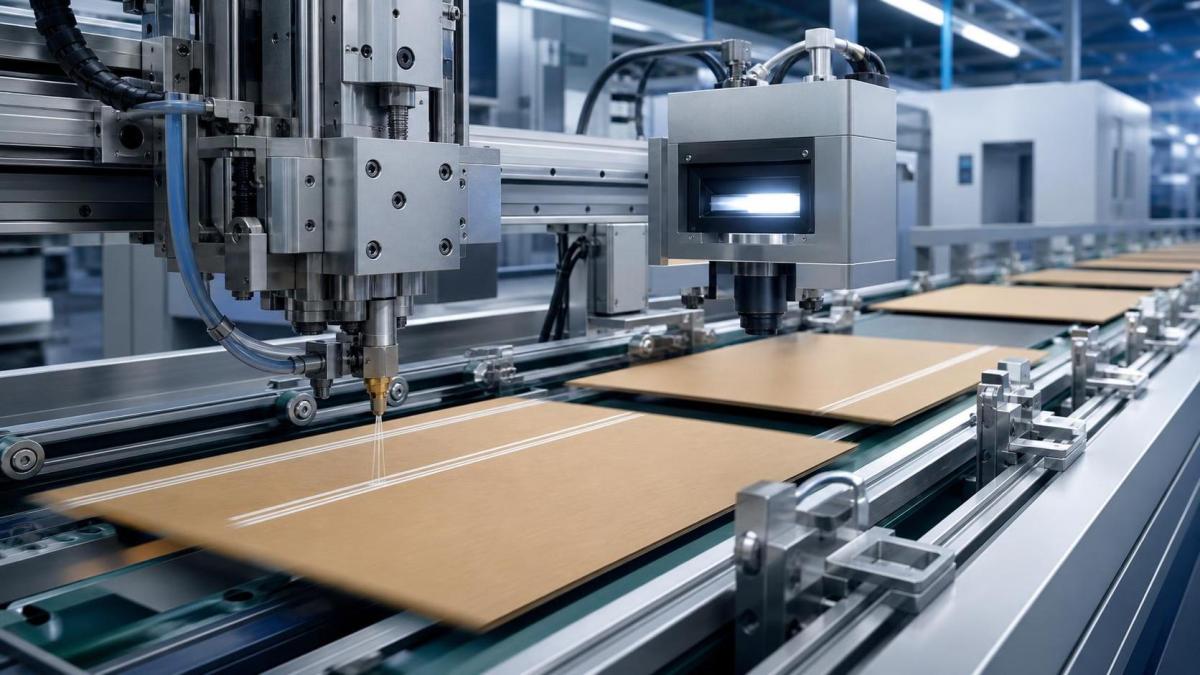
Look at Application Control, Not Just Nozzle Count
More heads and more channels do not automatically mean better automation. What matters is how precisely the system meters, starts, stops, and monitors adhesive delivery.
The practical checklist here is straightforward:
- Can the system maintain a stable bead or pattern across the full operating window, not just at one showcase speed?
- Is automatic compensation available for speed changes, line synchronization, or product length variation?
- Are missed shots, clogging, low pressure, or temperature drift detectable in real time?
- Can the operator adjust parameters recipe by recipe without relying on tribal knowledge?
The best systems make process control visible. You should be able to see what the glue circuit is doing before the defect reaches the packing area.
Changeover Time Deserves a Hard Audit
On paper, a line may offer excellent throughput. In mixed-SKU production, that advantage disappears if every job change forces extended setup, manual glue path adjustment, or trial-and-error fine tuning. This is especially relevant for short runs, promotional packaging, and customized box formats.
When reviewing high speed gluing automation, ask to see a real format change. Not a simplified demo. A real switch between different blank sizes or styles, with the same operator skill level you would expect in your own plant. Time the process. Watch where intervention is needed. Note whether recipes restore stable performance immediately or still require manual correction.
One common buying mistake is selecting for maximum speed in a factory that actually loses more hours to setup than to pure run time.
Test With Your Real Substrates
Demo-center performance is useful, but only to a point. Bond behavior changes with flute profile, surface treatment, moisture variation, recycled fiber content, and converting dust. If you work across corrugated, carton board, coated folding box board, or specialty laminated structures, bring your own samples and insist on representative runs.
This matters even more for operations linked to e-commerce packaging demand, where board mix and shipping stress can be less forgiving than showroom tests suggest. A bond that looks acceptable right after gluing may fail later under compression, vibration, or temperature exposure in distribution. If transit performance is business-critical, define your internal validation method before making the purchase decision.
Pay Attention to Inspection and Traceability
High speed production gets expensive when defects are discovered late. That is why inspection should be part of the automation conversation, not an afterthought. Depending on the line design, this may involve vision systems, presence detection, bead monitoring, temperature and pressure logging, or rejection logic.
For technical evaluators, the useful question is not “does it have inspection?” but “what failure can it actually catch in time?” Some systems are good at detecting absence of glue but weak at judging glue quality. Others record process values well but do not help containment on the shop floor. If you need lot traceability, recipe history, or integration with MES, confirm how data is stored, exported, and linked to production records.
Maintenance Burden Will Shape Real OEE
A fast gluing system that needs constant cleaning, nozzle replacement, recalibration, or adhesive-path intervention can quietly drag down OEE. Technical buyers usually understand this, but vendor discussions still tend to focus on rated output and automation features.
Review wear parts, preventive maintenance intervals, and fault recovery steps. Ask what daily, weekly, and monthly tasks operators must perform. Then ask maintenance staff whether those tasks are realistic during busy production periods. If spare parts availability is uncertain in your region, include that in the risk assessment. A sophisticated applicator with long lead times for service support may not be the right fit for a plant that runs tight schedules.
Operator Interface Matters More Than Suppliers Admit
Even highly automated gluing lines still depend on human judgment. If the HMI hides process drift, overloads the operator with alarms, or makes recipe control clumsy, performance will vary shift to shift.
During evaluation, watch an operator who did not help design the demo. Can they find the active glue parameters quickly? Can they identify which head has a problem? Can they recover from a stoppage without calling engineering every time? A clean interface is not cosmetic. It is part of bond stability.
Use a Practical Comparison Table
Watch for the Usual Selection Errors
A few mistakes show up again and again.
- Choosing based on peak speed while ignoring substrate variability.
- Assuming glue savings in theory will appear automatically in production.
- Treating operator skill as constant across all shifts.
- Underestimating how much changeover logic affects true throughput.
- Accepting generic references instead of validation on similar box styles and production demands.
If the supplier cannot connect performance claims to conditions close to your own process, keep the claim in the “unproven” category until tested.
What a Solid Decision Usually Looks Like
A good purchase decision on high speed gluing automation usually comes down to a narrow set of facts. The system should hold bond quality across your actual substrate range, maintain glue placement when production speed changes, recover cleanly from routine disturbances, and avoid turning changeovers into a hidden capacity drain. It should also give operators and maintenance teams enough visibility to keep the process under control without constant expert intervention.
That is the level to evaluate against. Not brochure speed. Not ideal samples. Not a perfect run supervised by the vendor’s best technician. If the line can stay stable under ordinary factory conditions, then faster throughput is real. If it cannot, the speed number is just marketing dressed up as engineering.
Related News
Get weekly intelligence in your inbox.
No noise. No sponsored content. Pure intelligence.
