
How to Select a Folder Gluer for Right-Sized E-Commerce Shipping Boxes
Right-sized e-commerce boxes look simple from the outside: a parcel should fit the product, protect it through distribution, and avoid shipping air. For a procurement team, however, the decision behind that box reaches much further. The folder gluer must handle changing order profiles, variable board calipers, retail-ready print requirements, demanding carrier networks, and the daily pressure to reduce material consumption without creating new production bottlenecks.
That is why selecting folder gluers for e commerce packaging should not begin with a brochure comparison of maximum speed. A machine that appears fast on a standard straight-line carton may be a poor economic fit if it requires long changeovers, struggles with short runs, applies inconsistent adhesive on recycled linerboard, or cannot reliably fold the structures used for mailer boxes and self-locking shippers.
The better question is: Which folder-gluer configuration can produce the box formats our customers will actually order, at the operating rhythm our plant can sustain? This guide helps procurement professionals turn that question into a practical selection process.
Begin with the shipping-box portfolio, not the machine class
“E-commerce packaging” is not one carton category. A cosmetics subscription box, a book mailer, a lightweight apparel shipper, and a small-electronics protective pack may all travel through the same fulfillment network while demanding very different converting behavior.
Before requesting quotations, build a representative job matrix from current orders and credible future opportunities. It should include more than dimensions. Record board grade and caliper, flute profile where applicable, print surface, glue locations, number of panels, locking features, blank size range, required compression performance, order length, and how often each format changes during a normal week.
For many right-sized shipping programs, the critical formats include:
- straight-line glued cartons for lightweight goods or inner packs;
- crash-lock or auto-bottom boxes where rapid erection matters;
- four- and six-corner structures for premium or fragile products;
- self-locking mailers with multiple scores, dust flaps, and tuck features;
- variable-size or short-run cartons supporting seasonal promotions and direct-to-consumer launches.
A folder gluer selected only around the most common, simplest carton can leave a converter outsourcing the profitable exceptions. Conversely, buying every available module “just in case” can burden the operation with cost and complexity that never earns its keep. The job matrix creates a disciplined middle ground: identify the formats that drive volume, margin, and strategic growth, then test the machine against those formats.
Right-sizing changes the production equation
In conventional packaging, a limited range of standard case sizes can justify long, predictable runs. E-commerce changes that pattern. Brands want less void fill, lower dimensional-weight exposure, a better unboxing experience, and packaging that can evolve as SKU assortments change. The result is often a wider family of carton sizes and more frequent changeovers.
This does not mean every operation needs a fully automated, maximum-specification line. It does mean that setup repeatability deserves nearly as much attention as running speed. If an operator needs extensive trial-and-error adjustments after each format change, a theoretically fast folder gluer may spend too much of its shift standing still.
Ask suppliers to demonstrate a realistic sequence rather than a single ideal run: one medium-size mailer, followed by a smaller carton with different glue patterns, then a larger board grade. Observe how settings are recalled, what mechanical adjustments remain manual, how much waste is produced during stabilization, and whether the finished cartons stay square after the transition.
For procurement, this is a useful distinction: quoted throughput is a machine capability; sustained sellable output is a production-system result. The latter is shaped by setup time, operator skill, blank quality, adhesive behavior, downstream packing, inspection, and maintenance discipline.
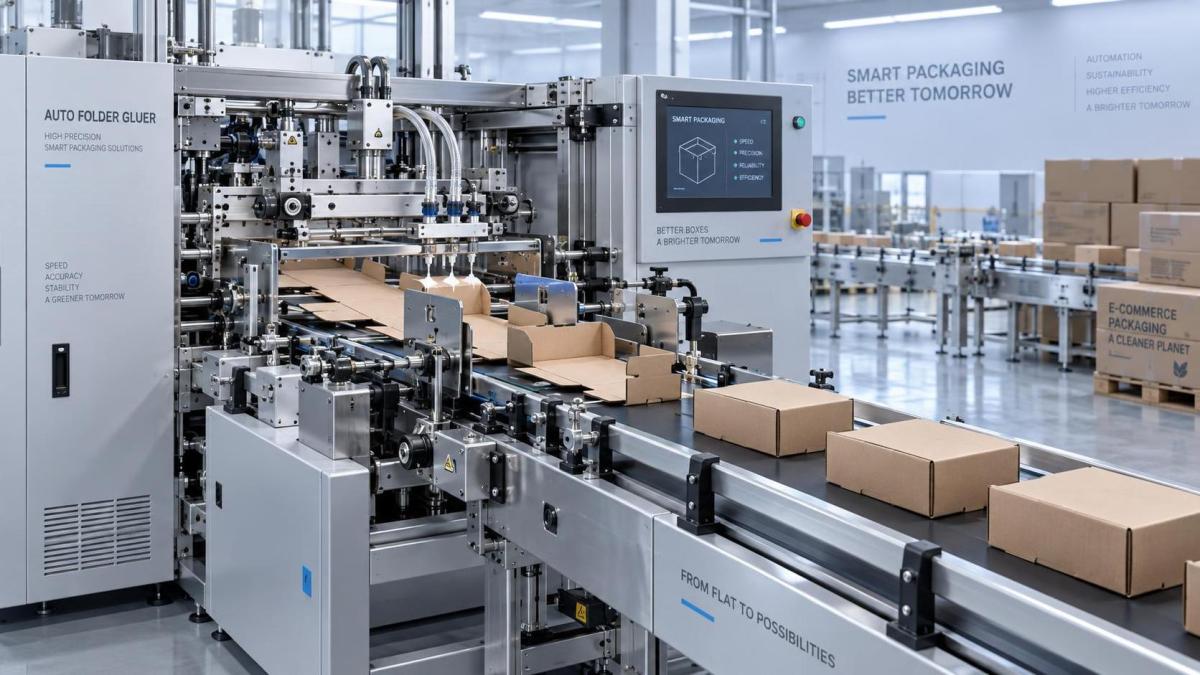
Match the feeder and carrier section to real blank behavior
The feeder is often underestimated until it becomes the source of inconsistent production. E-commerce shippers may use heavier stocks, coated surfaces, recycled-content board, or die-cut blanks with complex profiles. These materials do not always separate and travel like clean, flat standard cartons.
Evaluate whether the feeder can maintain stable blank separation across the full range of substrates in your matrix. Belt condition, vacuum assistance, side guides, adjustable carriers, and the accessibility of feeder adjustments all affect day-to-day reliability. A trial using only supplier-provided blanks is not enough. Where possible, provide blanks made with your own printing, die-cutting, and creasing conditions. That reveals issues created by curl, dust, score quality, warping, or varnish—not just by the folder gluer itself.
Carrier design also matters when handling narrow panels, long blanks, or cartons with sensitive printed surfaces. Procurement teams should ask how the machine controls the blank through folding, especially at higher speeds. A carton may emerge closed and glued yet still be unsuitable if it has scuffing, skewed panels, cracked scores, or inconsistent final dimensions that disrupt automated packing.
Glue control is a quality decision, not merely an adhesive choice
The adhesive system must fit both the carton structure and the fulfillment journey. Weak glue bonds can cause a box to open in transit. Excess glue can squeeze out onto printed surfaces, contaminate belts, or create a poor unboxing impression. In right-sized packaging, where designs may use narrow glue tabs or intricate locking areas, placement accuracy becomes even more important.
Discuss cold-glue and hot-melt compatibility in the context of your work, rather than treating one as universally superior. Consider the board surface, production speed, open time, ambient plant conditions, bond strength requirements, and whether cartons will be packed immediately or need time before downstream handling. If the line will use multiple glue patterns, confirm how quickly operators can switch recipes and how the system verifies that adhesive has actually been applied.
Vision-assisted glue detection, missing-carton detection, and reject capability can be valuable where a single failed bond creates customer claims or expensive manual inspection. Yet inspection technology should be sized to the risk. A high-volume direct-to-consumer operation with strict brand requirements may justify integrated verification; a lower-volume plant may gain more from dependable applicators, clear operating procedures, and disciplined sampling.
Do not assume every folder gluer is ready for corrugated e-commerce work
Many folder gluers are optimized for folding carton board. Right-sized shipping boxes may instead involve micro-flute corrugated material, heavier board, or structures that sit near the practical limits of a standard carton-gluing line. The distinction is essential.
When corrugated or micro-flute material is in scope, verify the approved flute profiles, caliper range, blank stiffness, minimum and maximum blank dimensions, and permissible score geometry. Ask specifically about pressure settings at folding points and compression-section behavior. The machine should create a stable bond without crushing flute, distorting graphics, or flattening the protective properties that make corrugated packaging valuable.
There is also an upstream connection. Corrugated board quality begins on the board line, while die-cutting and creasing determine how predictably a blank folds. A high-performing folder gluer cannot completely compensate for weak score definition, uneven moisture, poor registration, or inaccurate die-cut geometry. PWFS views these processes as one connected production chain: board formation, print, die cutting, folding, gluing, packing, and data feedback all influence finished-box yield.
Choose automation where it removes the most costly uncertainty
Automation is not an all-or-nothing purchase. The most useful investment is often the feature that reduces your plant’s specific source of variation.
If frequent format changes consume skilled labor, look closely at memory-based setup, servo-controlled carriers, motorized sections, and recipe management. If labor at the delivery end limits output, a packing or counting solution may have a stronger business case than another increment of top speed. If quality disputes are common, inspection and traceability functions may deserve priority. Plants handling short, varied runs may value operator-friendly access and guided setup more than a highly specialized high-speed configuration.
During evaluation, ask suppliers to separate standard features from options and explain the operational impact of each. “Automatic” can mean very different things: automatic adjustment of selected sections, semi-automatic setup supported by digital indicators, or fully stored recipes with synchronized machine movement. Clarifying that language avoids a common procurement disappointment—discovering that a line still depends on significant manual tuning after installation.
A practical factory-acceptance test for folder gluers for e-commerce packaging
The factory acceptance test should resemble the work your conversion plant intends to sell. Avoid approving a machine based only on clean, straightforward samples. Send a structured set of representative blanks and define acceptance criteria before the test begins.
Your criteria may include fold alignment, glue placement, bond integrity, carton squareness, absence of scuffing, acceptable setup waste, reliable counting, and delivery condition. Include both a routine production format and a difficult but commercially important format. If the line will connect with a packer, case packer, or inspection device, confirm interface responsibility and test the handoff where possible.
It is equally important to watch the people around the machine. Can operators safely reach cleaning points? Is the glue system understandable during a fault? Are routine adjustments visible and repeatable? Does the supplier provide clear electrical, pneumatic, adhesive, and spare-parts specifications? A folder gluer is purchased for years of operation, not for the hour of the demonstration.
Calculate total cost through usable output
Purchase price is visible; lost production is usually scattered across maintenance logs, overtime, rejected cartons, and customer-service complaints. A stronger total-cost-of-ownership model considers expected uptime, planned maintenance, consumable use, energy needs, spare-part availability, training, adhesive consumption, changeover labor, scrap during setup, and the cost of quality failures.
For right-sized e-commerce boxes, material savings should also be assessed carefully. A machine does not create right-sizing by itself; that begins with structural design and blank optimization. But a flexible, accurate folder gluer can make a broader range of optimized designs practical to produce. The financial benefit may come from lower board use, reduced void-fill requirements, better pallet utilization, fewer damaged shipments, or the ability to win smaller, more variable orders that a rigid line cannot serve efficiently.
Request assumptions behind every productivity estimate. Determine whether output is stated as machine cycles, blanks fed, or accepted cartons packed. Only sellable cartons should anchor the business case.
Questions procurement should settle before issuing the purchase order
- Which carton styles and substrate ranges are confirmed for production, and which are only anticipated?
- What is the expected mix of long runs, replenishment runs, and short custom orders?
- How are changeovers measured, including the time needed to reach acceptable quality?
- Can the supplier process our own die-cut blanks during a documented acceptance test?
- What glue technologies, monitoring methods, and cleaning procedures suit our board and box designs?
- Which critical wear parts should be held locally, and what service response structure is available in our region?
- Will the machine exchange useful production data with existing MES, quality, or maintenance systems?
- What safety guarding, operator training, and commissioning support are included in the final scope?
The best fit is a stable platform for changing demand
For e-commerce converters, the winning folder gluer is rarely the one with the most impressive maximum number on a specification sheet. It is the one that folds the required box family cleanly, applies adhesive consistently, changes formats without consuming the shift, and remains maintainable when order volume rises.
Approach the decision as a packaging-system investment. Align the machine with upstream board, print, and die-cut quality; validate it with real blanks; measure performance in accepted cartons rather than headline speed; and reserve automation spending for the constraints that truly limit your operation. With that discipline, folder gluers for e commerce packaging become more than end-of-line equipment—they become a practical tool for making right-sized shipping boxes dependable, scalable, and commercially sustainable.
Related News
Get weekly intelligence in your inbox.
No noise. No sponsored content. Pure intelligence.
