
How Transit Packaging Solutions Reduce Damage Across Multi-Stop Distribution Routes
Multi-stop distribution routes are unforgiving. A product may leave a production site in perfect condition, then pass through a regional hub, a cross-dock facility, a local delivery vehicle, and a final receiving area before anyone opens the carton. At every transfer point, it can be lifted, dropped, stacked, reoriented, exposed to vibration, or placed beside loads with very different shapes and weights.
For project managers and engineering leaders, damage prevention is not simply a packaging purchasing issue. It affects delivery schedules, replacement costs, customer confidence, warehouse labor, and the predictability of the entire project. Well-designed transit packaging solutions create a controlled protective system around the product—one that accounts for the real route, not just the distance between origin and destination.
The goal is not to use the heaviest box or the most material. It is to make the package strong in the places where the route creates risk, stable when handling becomes repetitive, and easy for operators to pack correctly at production speed.
Damage usually develops across the route, not in one dramatic event
When a shipment arrives damaged, teams often look for a single cause: a forklift strike, careless unloading, or a crushed pallet. Those events matter, but multi-stop damage is more commonly cumulative. A carton may lose a little compression strength after humid storage, loosen during several hours of truck vibration, and then fail when another load is stacked on top of it at the final hub.
That is why route-aware packaging engineering starts with a simple question: what happens to this unit after it leaves the packing line? The answer should include each handoff, dwell period, loading method, vehicle type, pallet configuration, and expected storage environment.
A compact electronics component in an oversized carton may survive the first shipment but shift enough to crack during the third transfer. Flat-pack furniture panels may have strong outer cartons yet suffer corner abrasion when pallet straps loosen. Printed retail displays can be structurally sound but become unacceptable because a scuffed surface or distorted graphic reduces their presentation value.
Different failure modes call for different controls. Treating every issue as “insufficient box strength” often leads to unnecessary material use while leaving the actual cause untouched.
Common stress points on multi-stop routes
- Repeated manual handling: More touches create more opportunities for impact, incorrect orientation, and short drops.
- Stacking compression: Cartons may carry changing loads as pallets are broken down, rebuilt, or stored in mixed freight areas.
- Vehicle vibration: Continuous movement can loosen closures, cause internal abrasion, and allow products to migrate inside the pack.
- Load shifting: Underfilled cartons and weak pallet containment can move laterally during turns, braking, and dock transfers.
- Moisture and temperature exposure: Corrugated material can lose performance in humid environments, while adhesives and protective films may respond differently to heat or cold.
- Mixed-load contact: Freight often encounters neighboring goods with incompatible weights, shapes, or edge profiles.
Project teams should map these risks before approving a packaging specification. A package designed only around a laboratory drop test may not reflect the combined compression, vibration, and handling forces found in a real distribution network.
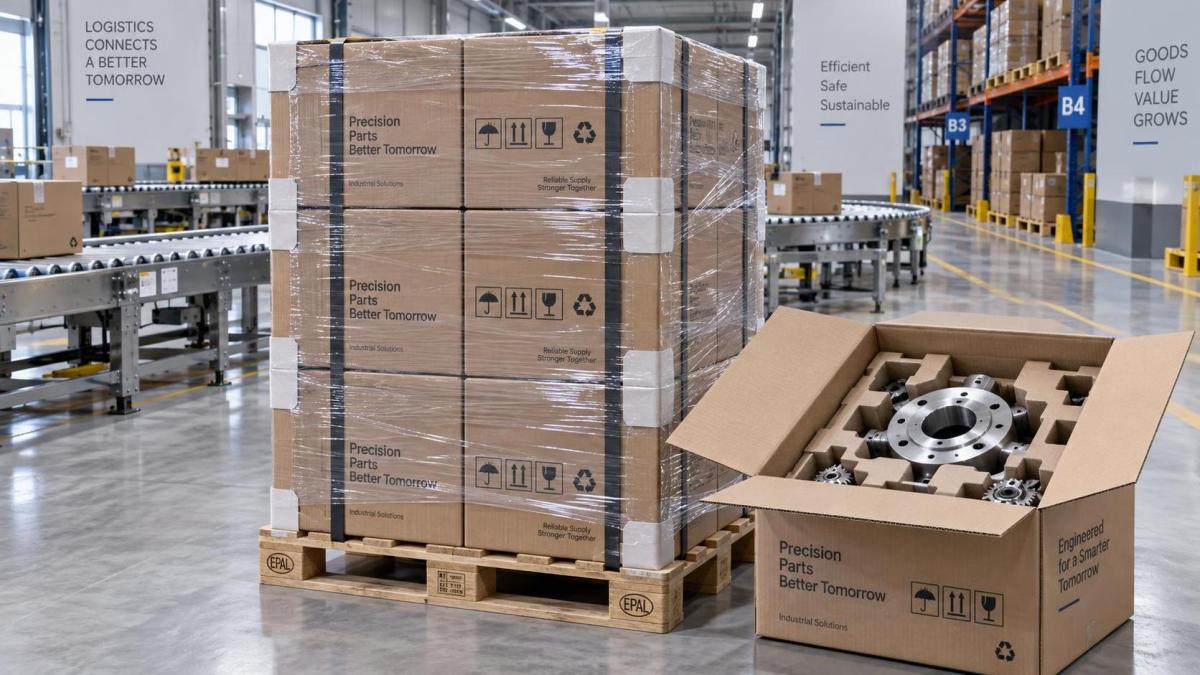
Build protection from the inside out
Reliable transit packaging solutions are layered. The product must be restrained inside the pack; the pack must retain its geometry under load; and the palletized shipment must remain stable through the route. If one layer is weak, the others are forced to compensate.
1. Product retention: stop movement before it becomes impact
Internal movement is one of the most overlooked causes of transit damage. Empty space is not automatically a problem, but unmanaged space is. During repeated movement, a product can gain momentum within the carton and strike the wall, another component, or a loose accessory.
Precision die-cut corrugated inserts, partitions, pads, molded supports, and engineered paper cushioning can hold products in their intended position. The right choice depends on product weight, fragility, surface sensitivity, pack-out variation, and recycling requirements. For example, a die-cut insert may be more appropriate than loose fill when a product must remain in a defined orientation during several transfers.
For project managers, the practical concern is repeatability. An insert that protects well only when an experienced operator positions it perfectly may not deliver consistent performance at scale. Good pack design makes the correct action obvious: components fit one way, cushioning seats naturally, and the closure cannot be completed if the product is misplaced.
2. Outer carton design: preserve structural performance
Corrugated board remains one of the most versatile protective materials in distribution because its structure can be tailored to the product and route. But “corrugated box” is not a complete specification. Board grade, flute profile, liner quality, box style, panel dimensions, score placement, and closure method all influence performance.
Box geometry is especially important. Long, shallow cartons may be vulnerable to panel bowing. Tall cartons can become unstable when stacked. Oversized boxes may need more internal reinforcement, yet excessive reinforcement can raise cost and slow packing. The strongest solution is usually the one that balances material selection with dimensions that work with the product’s natural load paths.
Industrial corrugated board lines play a quiet but decisive role here. Consistent bonding, moisture control, and board formation help packaging converters produce material with dependable compression behavior. If board quality varies from batch to batch, packaging engineers may find themselves solving the same damage issue repeatedly, even though the design drawing has not changed.
3. Pallet containment: protect the package as a unit load
A durable carton cannot fully compensate for an unstable pallet. During multi-stop distribution, unit loads may be partially unloaded, restacked, moved by different handlers, or placed in temporary storage. Once the original pallet pattern is disturbed, the remaining cartons face a new set of forces.
Effective palletization considers footprint utilization, weight distribution, stack pattern, edge protection, stretch wrapping, strapping, and top-load limits. Heavy items should not create concentrated loads on weaker cartons below. Overhang should be avoided because exposed carton edges are easily crushed by adjacent freight and handling equipment.
Where shipments are frequently broken down, project teams may need to design for “partial-pallet reality.” That can mean stronger individual cartons, clearer orientation marks, or pack quantities that are easier to handle without improvised restacking.
Use packaging data to match the route—not a generic shipping assumption
Many packaging specifications begin with a product drawing and an estimated shipping weight. That is necessary, but it is not enough for complex logistics. The distribution route should influence the design brief from the beginning.
Consider a project supplying equipment modules to several installation sites. Some shipments may move directly to a contractor, while others wait at a consolidation center before being delivered in mixed loads. The same product could require different pallet configurations, moisture protection, or handling labels depending on the route profile. A single universal pack may appear simpler, but it can create avoidable damage or unnecessary cost.
A route-based review should document:
- The number of anticipated handling points and whether goods are manually handled or mechanically moved.
- Typical storage duration at each hub and whether areas are climate-controlled.
- Maximum expected stacking conditions, including temporary warehouse storage.
- Whether parcels, cartons, pallets, or mixed freight systems are involved.
- Return logistics requirements for reusable containers or rejected materials.
- Final-site constraints, such as narrow access routes, limited unloading equipment, or the need for staged delivery.
This information turns packaging from a static bill of materials into an operational control. It also gives procurement, logistics, quality, and engineering teams a common basis for decisions.
Where converting precision makes a practical difference
Packaging protection is often decided in details that are invisible in a general drawing. A crease that is slightly inconsistent can affect carton squareness. A poorly placed die-cut feature can reduce compression strength. An inaccurate glue line can allow a tray or partition to open under vibration. These are production realities, not cosmetic concerns.
High-precision die-cutting and folder-gluing equipment helps converters produce repeatable packaging components at volume. Clean die-cut profiles allow inserts and partitions to fit as designed. Reliable folding and gluing maintain box geometry and reduce the chance of seam failure. For project leaders managing schedules, this consistency matters because packaging deviations can become a hidden source of line stoppages, repacking work, and field complaints.
Print quality also has an operational function. Clearly printed handling icons, assembly instructions, product identifiers, and location codes can reduce packing errors and improve receiving efficiency. On branded retail cartons, accurate color registration protects visual consistency; on industrial packs, readable information protects process consistency. Both have value, especially when a shipment changes hands several times.
Automation should reduce variation, not merely increase speed
Automated case packing, inline inspection, labeling, and pallet wrapping can improve transit performance when they are designed around the package’s critical controls. The benefit is not only output per hour. Automation can help verify that the correct insert is present, the carton is properly sealed, the label matches the destination, and the pallet is wrapped to a defined standard.
However, automation cannot rescue a packaging concept that is difficult to assemble or poorly matched to the product. A fast line that consistently creates underfilled cartons, misaligned inserts, or weak closures simply produces risk more efficiently.
Project managers should ask equipment and packaging partners to identify the points where variation is most likely to enter the process. It may be at material feeding, manual product placement, adhesive application, or pallet handoff. Sensors, vision systems, and traceable production data are most useful when focused on those known failure points rather than added as generic technology features.
A practical approval process before rollout
Before a new pack is released across a distribution network, it should be reviewed as both a protective design and a working process. A short, disciplined pilot often reveals issues that laboratory samples cannot show: awkward pack-out steps, unclear labels, excessive warehouse handling time, or poor fit with existing pallet patterns.
Start with representative products, actual packers, and a realistic route simulation where possible. Observe not only whether the product survives, but also whether operators can build the pack consistently under normal conditions. Review damaged samples carefully. The location and appearance of damage often indicate whether the problem comes from impact, compression, abrasion, vibration, or moisture.
It is also useful to track a small set of measures after launch: damage claims by route, repacking frequency, material consumption, packing time, and customer-reported condition on arrival. These indicators help teams separate isolated incidents from systemic design issues.
Choosing transit packaging solutions with long-term control in mind
The most effective transit packaging solutions are rarely the result of choosing a stronger board grade in isolation. They come from connecting product design, corrugated material performance, die-cut accuracy, pack-out ergonomics, pallet stability, and distribution data into one practical system.
For teams responsible for project delivery, that integration reduces uncertainty. Goods are more likely to arrive ready for installation, resale, or further processing; warehouse staff spend less time correcting preventable problems; and procurement decisions can be tied to route-specific risk instead of broad assumptions.
In a logistics environment defined by frequent handoffs, packaging is not just the outer layer around a product. It is part of the route’s engineering. When paperboard structure, converting precision, and operational discipline work together, each carton has a better chance of reaching the final stop in the same condition in which it left the line.
Related News
Get weekly intelligence in your inbox.
No noise. No sponsored content. Pure intelligence.
