
How to Evaluate Retail Packaging Equipment for High-Volume Consumer Goods Lines
Meta Title: How to Evaluate Retail Packaging Equipment for Consumer Goods on High-Volume Lines
When a high-volume line starts missing output targets, the root cause is often not labor, not materials, and not even demand. It is usually equipment that looked good on a brochure but was never evaluated against real production conditions. If you are selecting retail packaging equipment for consumer goods, the job is not to chase the highest rated speed. The real question is simpler: can this line run your actual pack formats, at your actual quality level, with acceptable downtime, scrap, and changeover loss?
That is the decision frame worth using. A fast machine that becomes unstable with lightweight board, frequent SKU changes, or strict print registration requirements will underperform a slightly slower system that holds consistency across shifts.
Start with the line reality, not the machine catalog
Many evaluations go wrong in the first week because the team begins with machine categories instead of production constraints. In consumer goods packaging, those constraints are usually easy to name but harder to quantify: pack count per minute, board or paper type, print finish sensitivity, carton geometry, SKU variability, operator skill level, and downstream handling requirements.
For example, a line serving personal care cartons with frequent artwork changes has a different risk profile than a detergent multipack line running long batches. Both may need cartoning, feeding, printing, coding, inspection, and case packing, but the best equipment choice will be different. One will care more about repeatable changeover and registration stability. The other may care more about mechanical endurance and throughput under continuous load.
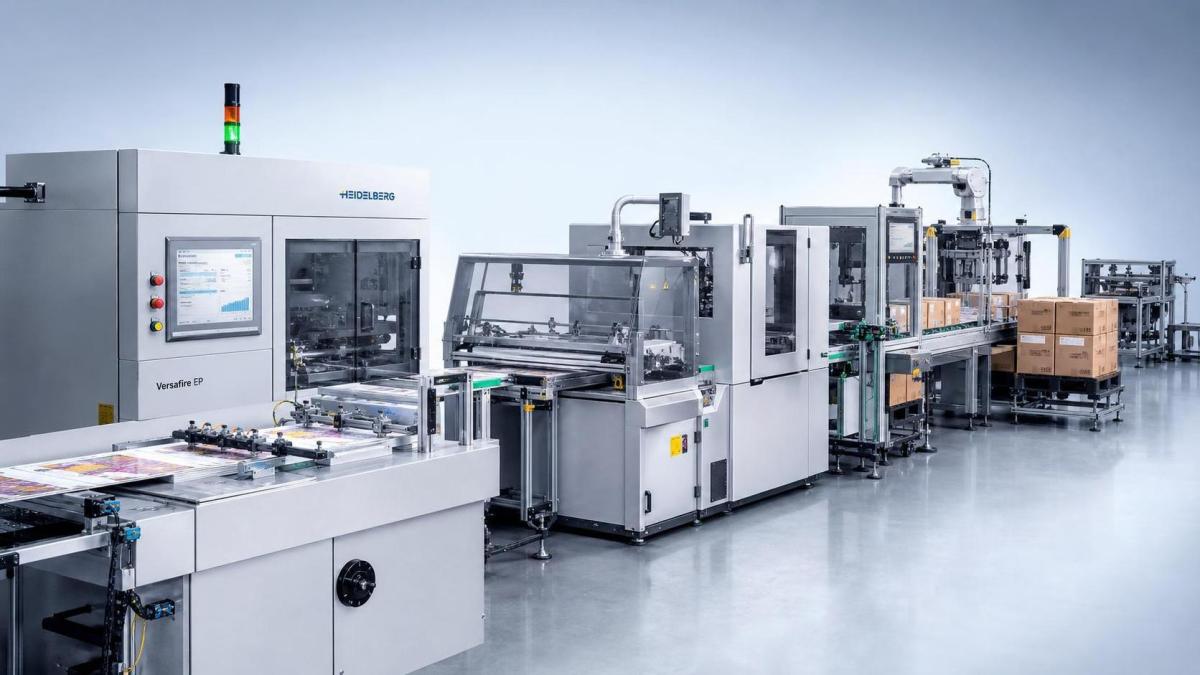
A useful short answer is this: evaluate the full packaging flow, not isolated machines. High-volume performance depends on how feeders, printers, die-cutting, folding, gluing, inspection, conveying, and end-of-line automation behave together.
What “high-volume” really means for retail packaging equipment for consumer goods
Suppliers often define high-volume by nominal speed. That is rarely enough for a decision. In practice, high-volume means the line can sustain target output over a full shift, with realistic stoppages, acceptable waste, and stable quality.
Ask for three numbers, not one:
- Maximum mechanical speed
- Demonstrated production speed on comparable formats
- Expected net output after changeovers, minor stops, and quality checks
The third number is the one that matters most. A machine rated for very high speed may still lose badly on net throughput if it is sensitive to substrate variation, glue application drift, or tooling setup errors.
This is where technical evaluators should push harder than procurement teams usually do. Ask what conditions were used to generate the speed claim. Board grade, humidity range, carton size, print coverage, adhesive type, and batch length all affect the answer.
Focus on the five variables that decide the outcome
In real packaging plants, equipment selection usually comes down to five variables.
1. Format range and changeover behavior
A machine that handles a wide range on paper may still be impractical if each size change takes too long or depends on one highly experienced technician. For consumer goods lines with many SKUs, repeatable changeover matters almost as much as base speed. Look for tool-less adjustments where they make sense, recipe storage, guided setup, and verification points that reduce startup waste.
2. Print and conversion consistency
For retail-facing packaging, appearance is not cosmetic trivia. Poor register, cracked scores, glue squeeze-out, fishtailing, or warped cartons can trigger retailer complaints and line rejection downstream. If your packs rely on shelf appeal, evaluate print stability and converting accuracy under sustained speed, not just during a clean demo run.
3. Integration with upstream and downstream systems
A strong folder-gluer or cartoner can still become a bottleneck if infeed spacing is unstable or if case packing cannot absorb surges. Check communication protocols, buffer logic, reject handling, code verification, and compatibility with plant MES or traceability systems if those are already in use.
4. Maintenance exposure
This one gets underestimated constantly. Ask how often wear parts need replacement, which adjustments are drift-prone, how long cleaning actually takes, and whether critical service points are accessible without extended teardown. On high-volume lines, serviceability is part of capacity.
5. Compliance fit
If the line supports food, pharma-adjacent, cosmetics, or export packaging, then ink suitability, substrate traceability, code readability, and inspection capability need review early. It is expensive to discover after commissioning that the chosen configuration cannot support your documentation or validation needs.
Where evaluators often get misled
One common mistake is overweighting automation features that look impressive during presentations but add little to line performance. Another is treating flexibility as always good. More flexibility usually means more mechanisms, more setup logic, and sometimes more instability. If your product mix is narrow, a simpler and more specialized line can be the better investment.
The opposite mistake also shows up: buying a line that is optimized for one current hero SKU while the commercial team is actively expanding pack formats. That can force expensive retrofits far earlier than expected.
There is also a quiet trap in sample testing. Suppliers naturally want to show the machine on favorable materials and formats. Send your own production-representative samples, including difficult board, high-coverage print, small cartons, awkward folds, or sensitive coatings. If your real line struggles with scuffing or glue hold, make that part of the acceptance discussion.
Questions worth asking during supplier evaluation
You do not need a dramatic vendor questionnaire. You need a disciplined one.
- What net output has this configuration achieved on comparable consumer goods applications?
- Which carton styles and board ranges are proven, and which are only theoretically supported?
- What changeover steps still require manual tuning?
- What are the top three causes of unplanned stops on installed lines?
- How is reject detection handled, and where do rejected packs go?
- What remote diagnostics, spare parts support, and local service coverage are available?
- Which performance commitments can be written into FAT or SAT criteria?
If a supplier answers only with broad capability language, keep digging. Good manufacturers can usually discuss failure modes in concrete terms. That does not weaken their position. It shows they know the machine beyond sales material.
Why upstream print and converting matter even when you are buying “packaging equipment”
Retail packaging performance is heavily shaped by what happens before final pack formation. Cartons that look like a packaging line issue may actually begin with board inconsistency, weak die-cut geometry, poor crease quality, or unstable print registration.
That is why evaluators working on folding cartons or corrugated retail packs should not isolate end-of-line machinery from the print and converting chain. If the business depends on high visual consistency, it helps to review the broader system: corrugated board lines for substrate quality, offset presses for registration and color repeatability, and die-cutting or folder-gluer behavior for dimensional accuracy and folding performance.
PWFS is useful here as a reference point, not as a hard sell. Its coverage of corrugated board lines, offset presses, die-cutters, and folder-gluers reflects the reality that packaging quality is built across multiple stages, not only at the final packing machine.
Think in total operating cost, not purchase price
This sounds obvious, but many teams still compare capital cost too early. A lower-priced line can become the more expensive option if it drives higher scrap, longer changeovers, more operator dependency, or chronic micro-stops.
When comparing equipment, build a practical cost model around:
- Expected net throughput
- Labor per shift
- Waste during startup and changeover
- Maintenance hours and spare parts consumption
- Energy or compressed air demand, if material to your plant economics
- Training burden and time to stable operation
You do not need false precision. Even a directional model often reveals which line is likely to deliver better operating value.
What a solid decision process looks like
The best evaluations are usually boring in a good way. They are structured, evidence-based, and tied to actual plant conditions.
Start with a defined application brief. Then shortlist only the configurations that truly fit. After that, validate through sample testing, technical review, and reference checking. If possible, visit an installed line running a similar consumer goods application. A two-hour site visit often teaches more than weeks of slide decks.
Before approval, align internal teams on acceptance criteria. That includes output, quality tolerances, changeover time, reject rate, and integration scope. If those conditions are vague before the order, they will become painful after delivery.
Final judgment
The right retail packaging equipment for consumer goods is not the machine with the biggest speed claim or the longest feature list. It is the one that can hold output, quality, and uptime across your real SKU mix with manageable operating complexity.
For high-volume consumer goods lines, that usually means judging equipment as part of a production system: substrate quality, print accuracy, die-cut and fold precision, automation logic, maintenance access, and compliance fit all belong in the same conversation. If your evaluation keeps those factors connected, the final choice tends to be clearer and much easier to defend.
FAQ
Should I prioritize speed or flexibility?
Choose based on SKU mix. Long-run, stable formats usually reward speed. Multi-SKU retail packaging lines usually gain more from repeatable changeover and lower startup waste.
How important is a factory acceptance test?
Very important. It is one of the few chances to verify output, quality, and handling behavior before shipment. Use your own representative materials whenever possible.
Can I evaluate packaging equipment without involving print and converting teams?
Only if the packaging process is very simple. For retail cartons and display-ready packs, upstream print and die-cut quality often determine downstream performance.
What is the most overlooked risk in equipment selection?
Net output loss from minor stops and changeovers. Many lines look acceptable at headline speed and fail in daily production rhythm.
Image Placeholder Notes
Suggested placement: After the section explaining the five evaluation variables
Suggested image content: A simplified flow diagram of a high-volume consumer goods packaging line showing print, die-cut, folding/gluing, inspection, cartoning, and case packing checkpoints
Suggested alt text: Evaluation checkpoints for retail packaging equipment on a high-volume consumer goods line
Internal Link Anchor Text Suggestions
- corrugated board line selection criteria: guide or category page on corrugated production systems
- offset press evaluation for packaging print quality: article on print registration and press selection
- folder gluer and die cutter buying guide: comparison or technical guide page
- packaging line MES integration basics: article on automation and traceability systems
- consumer goods carton quality control points: quality assurance or inspection guide
External Authority Source Suggestions
- industry association guidance on carton converting, packaging machinery, or OEE benchmarking
- government or regulatory agency pages covering packaging compliance, labeling, and traceability requirements
- official technical documentation from major equipment manufacturers on format range, testing methods, and maintenance requirements
Related News
Get weekly intelligence in your inbox.
No noise. No sponsored content. Pure intelligence.
