
What to Consider Before Investing in Custom Furniture Production Machinery
It usually starts with a very practical problem: orders are becoming more customized, delivery promises are getting tighter, and the workshop that once handled standard cabinets or simple panel work begins to feel slow, inconsistent, or expensive to run. A manager may notice that rework is creeping up, skilled operators are becoming harder to schedule, and design changes that look simple on screen take too much effort on the floor. That is often the moment when custom furniture production machinery moves from “future upgrade” to urgent discussion.
The difficulty is that buying machinery is not only a technical decision. It affects layout, staffing, maintenance routines, software flow, material planning, and cash pressure for years. Many equipment purchases go wrong not because the machine is bad, but because the buyer solves the wrong problem. A faster machine does not fix unclear order structure. A more automated line does not help if drawings, labels, and nesting data are still inconsistent. Before investing, it helps to slow down and define exactly where production is being constrained.
Start with the bottleneck, not the brochure
A common mistake in machinery selection is shopping by feature set before identifying the daily production pain point. In custom furniture, the pressure may come from several directions at once: too much manual cutting, unstable drilling accuracy, slow changeovers between orders, edge quality problems, poor compatibility with different board types, or too much dependence on a few experienced operators.
When people say they need better machinery, they may actually mean very different things. One factory may need more speed on panel cutting. Another may need tighter repeatability for hardware drilling. Another may need to connect front-end design data directly to machine execution because the real cost is not machining time but file preparation and correction.
Before comparing suppliers or machine models, it is worth mapping one week of actual production flow. Not in theory, but in the real order mix. Look at where jobs wait, where operators intervene, where scrap is generated, and where production stops because information is missing. This gives a more reliable basis for buying than any demo cut on ideal sample boards.
When “custom” changes the machinery decision
Standard furniture production and custom furniture production do not stress equipment in the same way. Repeated large batches usually reward pure output speed. Custom work often rewards flexibility, shorter setup time, stable data transfer, and the ability to switch quickly between panel sizes, hole patterns, and materials.
If your order book includes wardrobes, kitchen systems, office cabinetry, and mixed room packages, then the question is not only whether a machine can cut or drill accurately. It is whether it can handle variation without turning every change into a small disruption. That includes:
- reading production files cleanly from design or CAD/CAM systems,
- managing frequent job switching,
- maintaining cut quality across different panel finishes,
- keeping labeling and identification aligned with downstream steps,
- and reducing the amount of tribal knowledge needed to “fix” jobs manually.
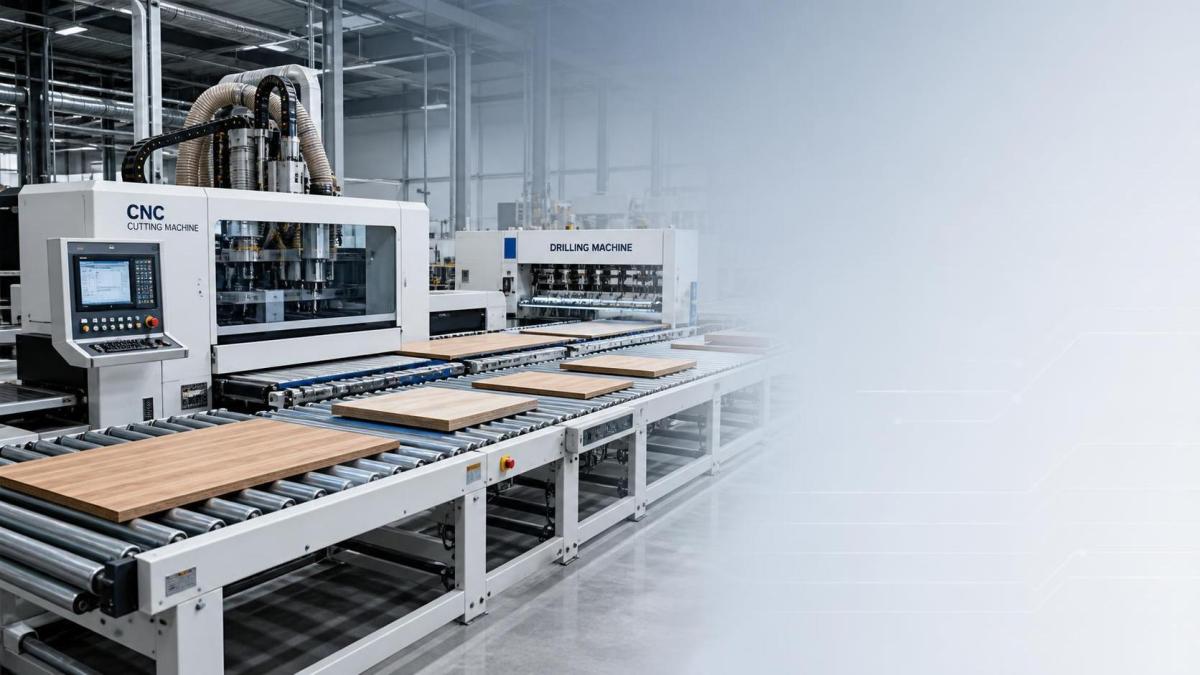
This is where CNC woodworking custom equipment often becomes central to the discussion. Not because it is automatically the best answer, but because in a high-mix environment, the machine’s ability to interpret digital instructions consistently matters almost as much as spindle power or feed speed.
Questions that matter more than headline speed
Machine specifications are important, but they should be read in context. A decision based only on top speed often leads to disappointment, especially in custom workflows where idle time, setup friction, and downstream imbalance can cancel out any theoretical gain.
Material range and edge conditions
Think through the boards you actually process: particleboard, MDF, plywood, laminated panels, moisture-resistant variants, or specialty decorative surfaces. Different materials behave differently under cutting, drilling, and edge treatment. If the machine performs well on one common board but struggles on another material you regularly sell, that mismatch will become expensive in rework and operator intervention.
Also consider edge expectations. In custom furniture, cut quality is not only a machining issue. It affects edge banding performance, visible finish quality, and whether downstream teams need to sand, trim, or correct parts manually.
Software and data flow
Some buyers focus heavily on the mechanical side and leave software questions until late in the process. That creates risk. If your business depends on design-to-production speed, then file compatibility, nesting logic, barcode integration, toolpath generation, and the handling of revisions deserve early attention.
A machine that looks strong mechanically but requires too much manual file cleanup may slow your operation in a less visible but more persistent way. This is especially relevant where front-end designers produce many one-off or near-one-off configurations.
Tooling and maintenance reality
Ask not only what tooling the machine uses, but how often tools need changing, how wear is monitored, and how sensitive output quality is to imperfect maintenance. A machine can be productive on day one and frustrating six months later if the maintenance model is too demanding for your actual team.
It helps to be honest here. If your plant already has disciplined preventive maintenance, advanced machinery may fit well. If maintenance is more reactive, then simpler robustness may outperform technical complexity.
Operator dependency
One of the hidden costs in custom furniture production machinery is how much performance depends on a few skilled people. Some equipment is forgiving and structured. Some delivers excellent results only with a highly experienced operator who knows how to compensate for variation. If labor continuity is uncertain, ease of operation and repeatability deserve extra weight.
Automation level should match the factory’s maturity
It is easy to overbuy automation. This does not mean automation is bad. It means automation works best when the surrounding process is ready for it. Loading systems, auto-labeling, digital order sequencing, and integrated production control can reduce handling and improve throughput, but only when upstream data and downstream routing are stable enough to support them.
If order information is often corrected at the last minute, or if panel identification is inconsistent, a highly automated machine may spend too much time waiting for clean inputs. In that situation, a more modest configuration with stronger process discipline can be a better investment than a fully loaded system.
On the other hand, if your workshop already experiences repeated strain from manual handling, labor availability, and rapid job turnover, then selective automation can be very sensible. The key is to identify which manual step is creating measurable disruption. Buying automation just because it appears modern usually produces uneven returns.
Scalability is not only about output
When people discuss future capacity, they often think only about volume. But for custom furniture, scalability can also mean handling more design variation, more connected software, more material types, or shorter promised lead times without chaos.
So when evaluating a machine, ask whether it can grow with your operating model. Can additional modules be added later? Can it integrate with more advanced MES or production management tools if your digital process matures? Can it support expanded product categories without constant workaround?
This is one reason many buyers look beyond a single standalone machine and think about whether the equipment fits a broader digital production path. In woodworking, especially where custom orders dominate, isolated machine performance matters less if it creates a data island.
The real cost is usually outside the purchase price
Capital cost matters, of course. But when evaluating custom furniture production machinery, purchase price is only one layer. The more useful comparison includes installation readiness, tooling cost, training demand, energy consumption, expected maintenance rhythm, spare parts access, software upgrades, and the cost of production disruption during commissioning.
Another overlooked area is layout impact. A machine may technically fit the floor but still create awkward board flow, inefficient loading paths, or downstream congestion. In custom environments, where part variety is high, handling logic can become just as important as machine cycle time.
It is also worth estimating the cost of underutilization. If a machine is selected for capabilities you are unlikely to use in the near term, the premium may take longer to justify. By contrast, if a simpler machine forces overtime, queue buildup, or subcontracting, then the lower price may be misleading.
Comparing machine options without getting lost
When several equipment options look similar, it helps to compare them against real production scenarios rather than generic specs. For example, consider how each machine would handle:
- a day with many small, unrelated custom orders,
- an urgent design revision after nesting has been prepared,
- a switch from standard laminated boards to a more sensitive decorative panel,
- a period when your most experienced operator is unavailable,
- or a production week where edge quality becomes more critical than raw cutting speed.
These practical tests often reveal more than catalog comparisons. A machine that is slightly slower on paper may fit the operation better if it handles transitions cleanly and requires less intervention.
Where specialist industry intelligence actually helps
For buyers working across packaging, printing, or woodworking environments, one challenge is separating impressive language from useful technical interpretation. In furniture production, especially with CNC-driven custom equipment, it helps to review machinery through the lens of kinematics, chip evacuation, cut stability, digital file transfer, and how the machine behaves in mixed-material production rather than in ideal sample runs.
This is where structured industry intelligence can be practical. Not as promotion, but as a way to connect machine mechanics, production software, and flexible manufacturing logic. For businesses comparing CNC routers, edge processing steps, or broader panel workflows, it is often useful to examine whether the equipment supports the shift from labor-heavy workshop methods toward more stable, digitally connected production. That kind of evaluation tends to be more valuable than broad claims about “smart manufacturing.”
Signs you should delay the purchase for a moment
Sometimes the smartest move is not to buy immediately. If your product mix is changing rapidly, your design software workflow is still unsettled, or your internal process ownership is unclear, postponing the decision can prevent an expensive mismatch.
Delaying does not mean doing nothing. It may mean standardizing file preparation, improving job coding, documenting maintenance expectations, or clarifying which product families should stay in-house. Those steps can make a later machinery investment much more effective.
Another warning sign is when different departments describe the problem in completely different ways. If sales says the issue is lead time, production says the issue is drilling capacity, and management says the issue is labor cost, then the buying criteria are not aligned yet. Equipment cannot resolve that confusion by itself.
A more reliable way to decide
If you are close to a purchasing decision, it helps to frame the investment around four grounded questions. First, which production constraint is causing the greatest recurring loss of time, consistency, or margin? Second, does the machine reduce that constraint under your real order mix, not an idealized one? Third, can your current team support the machine in daily use and maintenance? Fourth, will the equipment still make sense if your product variation increases before your volume does?
Those questions sound simple, but they shift the discussion away from surface-level comparison and toward operational fit. In custom furniture, the best machinery decision is rarely the one with the most dramatic specification sheet. It is usually the one that removes a known bottleneck, fits the digital maturity of the factory, and leaves room for more controlled growth instead of adding another layer of complexity.
Investing in custom furniture production machinery can absolutely improve responsiveness and precision. But the strongest buying decisions tend to come from careful diagnosis, not urgency. If the machine matches your material range, software flow, maintenance reality, and order structure, it has a much better chance of becoming a productive asset instead of an expensive workaround.
Related News
Get weekly intelligence in your inbox.
No noise. No sponsored content. Pure intelligence.
