
How to Evaluate Die-Cutting Equipment in North America by Material, Run Length, and Throughput
Choosing die-cutting equipment North America suppliers offer is rarely a simple brand comparison. The real question is whether a machine fits the substrate, the expected run profile, and the throughput target without creating hidden waste, unstable registration, or bottlenecks downstream.
That matters more now because North American packaging demand is pulling in different directions at once. E-commerce needs durable corrugated conversion, retail packaging needs visual precision, and shorter product cycles demand faster changeovers with less tolerance for downtime.
In that environment, equipment evaluation has become a production systems decision. It sits between printing quality, board conversion, folder-gluer performance, labor efficiency, and digital factory planning, which is exactly where PWFS tracks the paper and wood industries.
Why Material, Run Length, and Throughput Must Be Evaluated Together
A die-cutter may look impressive on a specification sheet and still perform poorly in a real plant. The common mistake is reviewing speed in isolation, while material behavior and job mix actually decide whether output is consistent.
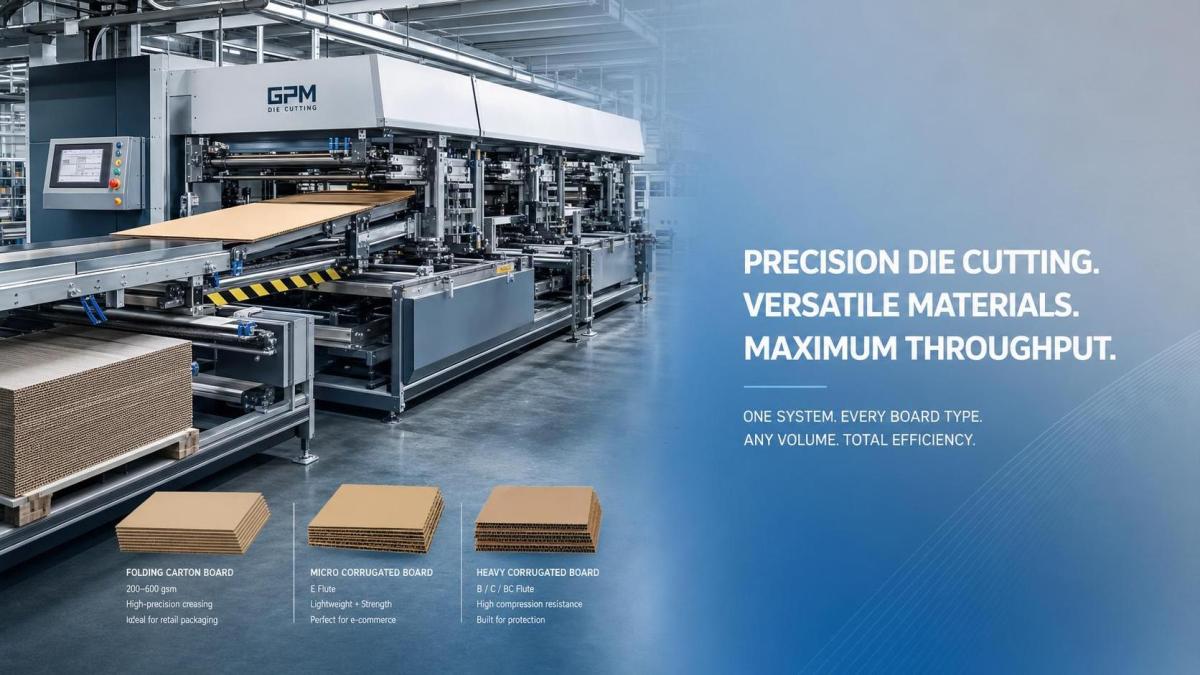
A folding carton converter cutting coated paperboard faces very different stress conditions from a corrugated plant processing E-flute or double-wall sheets. Pressure distribution, stripping behavior, sheet control, and waste removal all change with the material.
Run length adds another layer. Short jobs reward quick setup, repeatable job recall, and automated makeready. Long jobs shift attention toward sustained speed, tool life, feeder stability, and the machine’s ability to hold register over many hours.
Throughput then ties everything to business reality. A machine can reach a headline speed, yet still fail the line if blanking, stripping, inspection, or delivery handling cannot support actual production flow.
Start with the Substrate, Not the Catalog
When reviewing die-cutting equipment North America markets provide, the first filter should be substrate range. That means more than minimum and maximum thickness.
Cut quality depends on how the machine handles fiber structure, coating, flute profile, moisture variation, and sheet flatness. These factors affect edge cleanliness, nick control, crease integrity, and how well blanks move to folding and gluing.
Key material groups usually change the evaluation logic
This is where broader converting knowledge helps. PWFS often frames die-cutting as one link in a chain that begins with board making and print registration, then continues to folder-gluer accuracy and pack-out efficiency.
Run Length Changes What “Best Machine” Really Means
A machine optimized for long pharmaceutical carton runs may be the wrong investment for mixed retail jobs changing every hour. The better evaluation method is to map equipment to the plant’s real production pattern.
For short to medium runs
Look closely at setup time, preset functions, tooling exchange, and operator adjustments. Automated registration, memory-based job recall, and quick stripping setup often deliver more value than maximum rated speed.
In North America, this matters because SKU multiplication keeps reducing average order size in many packaging segments. More version changes mean the machine must recover productive minutes that older platforms lose during transition.
For long runs
Focus on stable mechanics, thermal consistency, wear behavior, and waste ratios over a full shift. A fast startup means little if cutting pressure drifts, sheets begin to scuff, or stripping waste builds up after several hours.
Review maintenance intervals as part of run-length economics. The strongest die-cutting equipment North America buyers select usually performs well because uptime is engineered, not because the brochure advertises a dramatic top speed.
Throughput Is More Than Sheets Per Hour
Throughput should be measured as saleable output through the entire cell. That includes feed reliability, cut accuracy, stripping, blank separation, transfer to folding or packing, and how much operator intervention is required.
A machine rated at high speed may still underperform if upstream printing cannot hold register, or if downstream folder-gluers need frequent stops because blank quality is inconsistent. Evaluation therefore needs line-level thinking.
- Compare rated speed with sustained production speed on your actual substrate mix.
- Ask for waste percentage during startup and after steady-state running.
- Measure labor needed per shift, including setup and quality checks.
- Review whether inspection, blanking, and stacking stay synchronized.
- Check OEE assumptions behind any supplier throughput claim.
This approach is especially relevant where labor availability is uneven. Automation in feeder settings, non-stop delivery, and digital diagnostics can change practical throughput more than a nominal speed increase.
North American Conditions Add Specific Evaluation Pressure
The phrase die-cutting equipment North America carries regional context. Facilities often need broad job flexibility, reliable service coverage, and compliance alignment across food packaging, retail display, healthcare, and transit packaging.
Service infrastructure matters because production interruptions are expensive and geographically dispersed plants cannot wait long for parts or specialist technicians. Local tooling support and response time should sit beside mechanical specifications in the scorecard.
Compliance also influences equipment value. Traceability expectations, food-contact packaging concerns, and sustainability reporting are pushing converters to monitor waste, substrate usage, and repeatability much more closely.
That is one reason intelligence platforms such as PWFS connect die-cutting analysis with print physics, corrugated processing, and digital manufacturing systems. Equipment no longer stands alone; it feeds data, quality, and planning discipline across the plant.
What to Check During a Practical Comparison
A useful review should move beyond generic demonstrations. Ask for trial conditions that resemble actual jobs, including difficult substrates and mixed run lengths.
The strongest comparison points are usually these
- Registration repeatability from first setup to repeat order.
- Pressure uniformity across the sheet and across long production windows.
- Time required for die change, stripping change, and delivery adjustment.
- Waste extraction performance on fragile or flute-sensitive materials.
- Data integration with MIS, MES, and maintenance monitoring tools.
- Availability of local parts, operator training, and remote diagnostics.
If two machines appear close, lifecycle stability often decides the better fit. Bearings, gripper systems, feeder wear points, and control architecture have a larger financial impact than small differences in purchase price.
A Clearer Way to Make the Next Decision
The best path is to build an evaluation matrix around three anchors: substrate family, run-length distribution, and verified throughput. Then connect those findings to waste, labor, downtime exposure, and downstream converting performance.
That keeps die-cutting equipment North America decisions grounded in production reality instead of marketing language. It also makes cross-functional comparison easier when printing, corrugated conversion, folding, and digital planning all influence final profitability.
A disciplined review should end with real sample trials, a service support check, and a five-year operating model. From there, the next step is not guessing which machine looks strongest, but confirming which one stays accurate, productive, and scalable in the jobs that actually matter.
Related News
Get weekly intelligence in your inbox.
No noise. No sponsored content. Pure intelligence.
