
How to Evaluate Folder Gluers in the Middle East for Carton Plant Expansion
How to Evaluate Folder Gluers in the Middle East for Carton Plant Expansion
For procurement teams planning carton plant expansion, evaluating folder gluers Middle East suppliers requires more than comparing speed and price. You need to look at line compatibility, box style flexibility, glue quality, uptime, after-sales support, and total cost of ownership under real regional operating conditions. In practice, the wrong machine usually does not fail on day one. It shows up later as unstable output, glue complaints, long changeovers, operator dependence, and a spare parts headache you did not budget for.
This checklist is written for buyers who need to make a decision that will still look sensible three years from now, when SKU counts are higher, labor is tighter, and customers are asking for shorter runs with cleaner finishing.
Start with the cartons you actually plan to run
A lot of folder gluer evaluations go off track because the machine is judged on brochure categories instead of the plant’s live mix. Before talking to suppliers, build a simple run profile:
- Current and expected box styles: straight-line, crash-lock bottom, 4/6-corner, specialty cartons.
- Board range and flute or paperboard grades you expect to process.
- Typical order lengths, not just your largest jobs.
- Tolerance expectations from end customers, especially in pharma, cosmetics, food, or premium retail packaging.
- Future work you are chasing but do not yet run.
That last point matters. Many plants buy for today’s volume and then discover the new machine is poor at short-run complexity, where margin may actually be better. If your growth plan includes more value-added cartons, ask suppliers to prove performance on those structures, not only on easy straight-line jobs.
Check line fit, not just standalone machine specs
A folder gluer is never really a standalone purchase. It has to fit the die-cutter output, stripping quality, pile condition, logistics flow, and final packing method. A fast machine that waits for poorly prepared blanks is just expensive idle capacity.
Ask these questions early:
- Can the feeder handle the blank quality your die-cutting department consistently delivers?
- Will pre-breaking, folding rails, glue application, and compression sections match your carton designs?
- How will finished cartons be counted, packed, bundled, or transferred downstream?
- Do you need vision inspection, barcode reading, ejection, or batch traceability integration?
If the supplier conversation stays at “maximum speed,” bring it back to line balance. Real output comes from the slowest stable point in the chain.
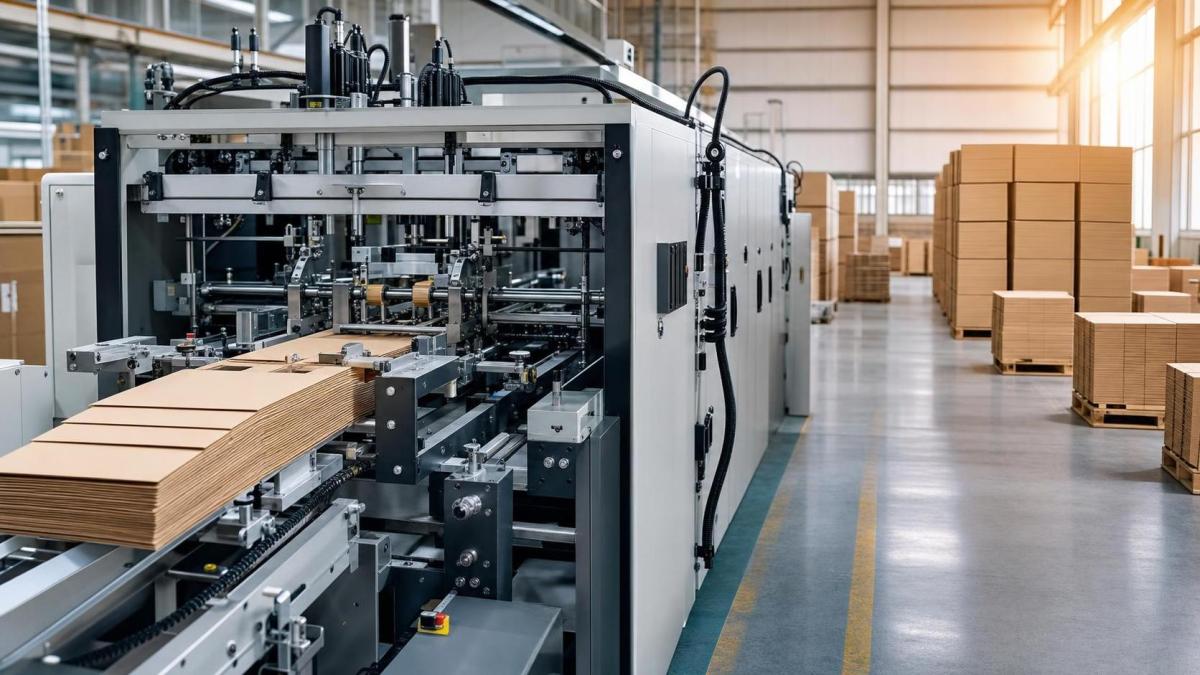
In the Middle East, operating conditions are part of the machine spec
This is where generic comparisons often break down. For folder gluers Middle East buyers, ambient heat, dust load, power stability, warehouse conditions, and maintenance discipline can affect performance far more than the brochure suggests. If your plant is in the Gulf, for example, summer conditions and HVAC limitations can influence glue behavior, carton flatness, and operator comfort around the line.
So ask for specifics:
- Recommended temperature and humidity window for stable gluing.
- Sensitivity of sensors and moving parts to dust contamination.
- Electrical requirements, protection logic, and tolerance to local power conditions.
- Lubrication and preventive maintenance intervals under high-utilization environments.
If a vendor cannot explain how the machine behaves outside a climate-controlled European showroom, that is a useful signal by itself.
Do not accept a speed claim without a setup story
High top speed sells machines. Setup time decides whether the investment earns its keep. If your order profile includes many SKU changes, ask the supplier to walk through a real changeover between two different carton styles. Not the ideal one. A meaningful one.
Watch for these details during demos or FAT discussions:
Experienced buyers usually ask for output per shift by job family, not headline speed. That conversation is much harder to fake.
Glue performance deserves its own review
Poor gluing is one of those problems that can damage customer trust quietly. Cartons may look fine when packed and fail later during filling, transport, or shelf handling. Evaluate the glue system with your real substrates and likely adhesive range. Not every issue is the machine’s fault, but the machine has to deliver repeatable application and controllable compression.
Useful checks include nozzle or wheel configuration, ease of cleaning, glue monitoring, consistency at different speeds, and whether the compression section supports bond development for your carton style. If the supplier claims broad adhesive compatibility, ask for the operating limits and approved combinations. If those are unclear, mark them as 【待核实】 and do not let them become hidden assumptions in the purchase decision.
Look hard at blank handling and quality stability
Some machines look excellent on clean, flat, perfectly stripped blanks and become unpredictable with the kind of material real plants produce on a busy week. Feed reliability, skew correction, pre-breaking quality, and folding symmetry matter more than polished sales language.
If possible, send production samples with normal variation: minor warp, mixed pile condition, difficult creases, and the board qualities your team complains about most. You are not trying to sabotage the demo. You are trying to remove fantasy from the buying process.
The supplier’s service model is part of the machine value
For expansion projects in the region, after-sales support often becomes the make-or-break factor. Ask where technicians are based, what parts are stocked locally, what response times are contractually offered, and what can actually be solved through remote diagnostics. “Support available” is not the same as “support that gets you running again on a Friday afternoon.”
A few practical questions:
- Is there a trained regional service team or only fly-in support?
- Which wear parts should be held on site, and what is the recommended inventory value?
- What training is included for operators, setters, and maintenance staff?
- Can they provide references in similar operating environments? If yes, verify them directly.
Do not treat training as a side issue. A capable machine with weak operator transfer can underperform for months.
Automation options should match your labor reality
Some plants need a robust semi-automatic setup with good accessibility and disciplined staffing. Others should move straight toward higher automation in feeding, packing, inspection, or recipe management because labor consistency is already a bottleneck. Neither choice is universally right.
The mistake is buying automation features that look advanced but do not solve your actual plant constraint. Ask which functions reduce setup dependence, scrap, or headcount in your specific workflow. If the answer remains generic, keep digging.
Compliance and market requirements cannot be added later by hope
If your cartons serve regulated sectors, check from the start whether the machine configuration supports the inspection, traceability, and process control you need. The exact requirement depends on product category and export market, so do not overstate this. But buyers should at least map the standards and customer audit expectations that apply to their own business, then test whether the proposed folder gluer setup can support them.
This is especially important when selling into multinational brand supply chains, where documentation discipline is often as important as mechanical output.
Build the cost model around uptime and waste
Purchase price is the easy number. The harder and more useful numbers are waste during setup, operator hours per shift, spare parts consumption, adhesive usage, energy needs, maintenance downtime, and saleable output across your normal job mix. That is where one machine starts to separate from another.
A practical comparison sheet should include:
- Quoted machine price and installation scope.
- Commissioning, training, and travel costs.
- Recommended spare parts package.
- Expected setup waste and running waste.
- Planned maintenance hours and critical consumables.
- Output assumptions by carton family, with the basis clearly stated.
If a supplier’s ROI story depends on best-case speed and perfect labor, treat it as a sales scenario, not a buying fact.
Before signing, force a real decision review
This is the step teams skip when schedules get tight. Run a final review with procurement, production, maintenance, and quality in the room. Put the unresolved points on one page: proven capabilities, assumptions, site requirements, excluded items, FAT/SAT criteria, training scope, spare parts list, and warranty boundaries.
If something important is still phrased loosely, it is still a risk. Clean it up before the PO is released.
The best folder gluers Middle East sourcing decisions usually come from teams that stay stubbornly practical: test with real cartons, question setup time, verify service depth, and model the machine under local conditions rather than showroom conditions. That approach takes longer in the buying phase, but it prevents the kind of expensive surprises that linger long after installation.
Related News
Get weekly intelligence in your inbox.
No noise. No sponsored content. Pure intelligence.
