
Why Whole-House Customization Is Reshaping Panel Furniture Manufacturing
The whole-house customization wave for panel furniture is changing manufacturing from a volume game into a speed-and-precision game. Buyers now expect coordinated kitchens, wardrobes, vanities, storage walls, and interior finishes to match personal layouts and arrive faster than traditional project cycles allowed.
That shift matters because it reaches far beyond product styling. It forces factories to rethink how designs move into production, how boards are cut and sealed, how orders are grouped, and how delivery promises are protected across a fragmented value chain.
For businesses tracking industrial change, this is where furniture, automation, software, materials, and logistics increasingly meet. It is also why platforms such as PWFS watch woodworking equipment with the same seriousness given to printing, die-cutting, and packaging systems.
From furniture category to manufacturing model
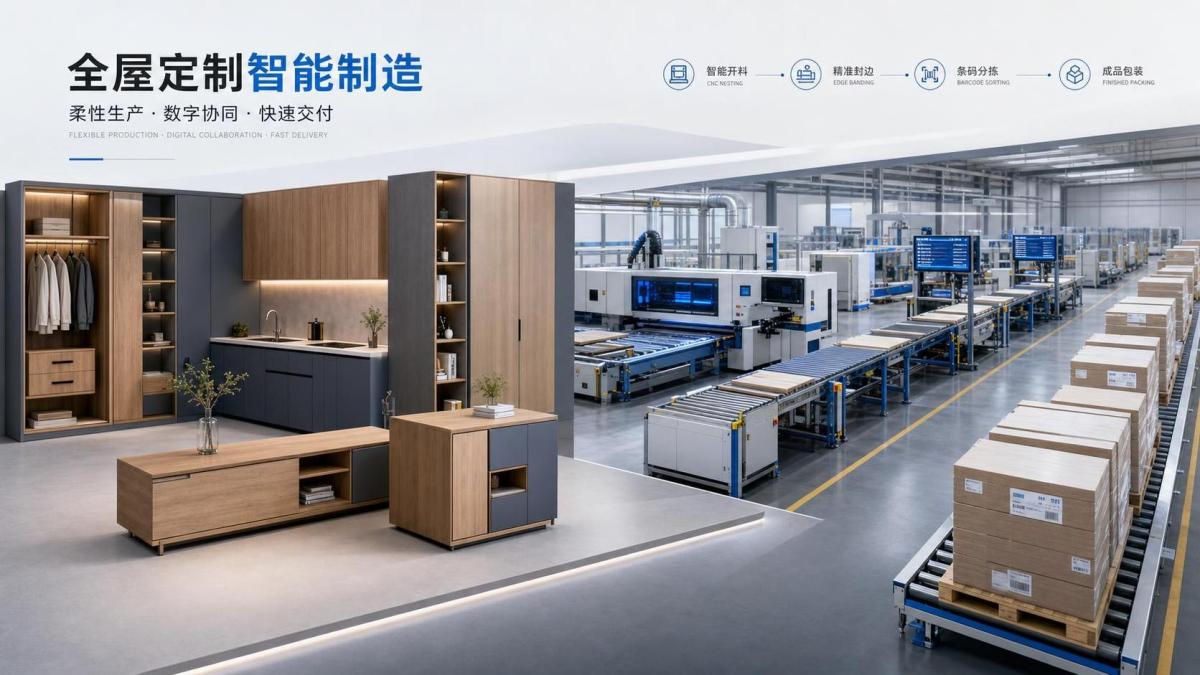
Whole-house customization once sounded like a premium design service. Today, it is better understood as a manufacturing model built around flexible response, digital coordination, and mass personalization.
In practice, one order may include different panel sizes, finishes, drilling patterns, edge treatments, and hardware requirements. Another order, placed minutes later, may share almost no dimensions with the first.
This is exactly why the whole-house customization wave for panel furniture is reshaping the factory floor. Standard batch logic struggles when every project carries its own geometry, material sequence, and installation deadline.
The winning factories are not simply adding more machines. They are building a connected process where design software, CNC routers, nesting optimization, edge banding, labeling, sorting, and packaging work as one production language.
Why the pressure has intensified now
Several market forces have converged. Residential expectations have risen, urban spaces are tighter, and consumers want storage solutions tailored to awkward walls, corners, ceiling heights, and lifestyle needs.
At the same time, delivery windows have compressed. Digital commerce trained end users to expect visibility, responsiveness, and reliable lead times. Furniture buyers now bring that mindset into renovation and interior furnishing decisions.
Material costs have also become less forgiving. When every board matters, waste from poor nesting, recuts, mismatched labels, or edge defects directly damages margin.
The whole-house customization wave for panel furniture therefore sits at the intersection of demand-side personalization and supply-side discipline. It rewards factories that can stay flexible without losing process control.
Where technology is doing the real work
The most visible change is CNC-driven production. A modern woodworking router can read digital design data directly, then execute cutting, drilling, grooving, and shaping with minimal manual interpretation.
That matters because interpretation is where many traditional errors begin. When dimensions are re-entered by hand, version control weakens, and custom orders become vulnerable to expensive mistakes.
Edge banding has become equally strategic. In panel furniture, the finish line is not decoration alone. It influences durability, moisture resistance, emissions performance, visual quality, and customer perception of workmanship.
Laser and PUR edge banding technologies support cleaner sealing and more consistent output. For customized production, consistency matters because replacement parts delay installation and complicate after-sales service.
The digital layer above the equipment is just as important. MES, barcode tracking, optimization software, and production scheduling tools help factories decide what should run together, what must ship first, and where bottlenecks are forming.
This is one reason PWFS links woodworking intelligence with adjacent industrial systems. High-speed manufacturing, whether in packaging or furniture, increasingly depends on data continuity as much as machine capability.
The business value is broader than customization
It is easy to view the whole-house customization wave for panel furniture as a response to style preferences. The deeper value lies in how it can restructure margin, inventory, and customer retention.
A factory that produces against confirmed digital orders can reduce slow-moving finished inventory. It can also carry a more rational raw material strategy, because design variation is handled through software and machine flexibility.
Customized projects often support stronger average order value. They also create more touchpoints across a home, which improves upsell potential between wardrobes, cabinets, shelving, wall systems, and supporting accessories.
More importantly, a well-run system turns complexity into a barrier to entry. Not every competitor can coordinate design data, board processing, finishing quality, installation sequencing, and delivery reliability at scale.
Operational gains often appear in these areas
- Lower recut rates through direct CAD-to-machine workflows.
- Better board yield from nesting optimization.
- Shorter order cycles through automated drilling and cutting.
- Higher finish consistency through advanced edge banding control.
- Stronger traceability for every custom component.
Typical scenarios shaping investment decisions
Not every factory enters the market from the same position. Some begin as batch furniture producers. Others start as cabinet specialists, interior fit-out suppliers, or regional workshops moving toward industrialized customization.
The operational priorities differ, but the pressure points are often similar. The table below shows how the whole-house customization wave for panel furniture tends to change decision criteria.
What should be evaluated before expanding capacity
A common mistake is to treat equipment investment as the first answer. In reality, the whole-house customization wave for panel furniture exposes process weaknesses before it rewards machine upgrades.
The first question is data quality. If front-end design outputs are inconsistent, even excellent CNC equipment will process flawed instructions with great efficiency.
The second question is production flow. Custom work fails when parts are cut correctly but arrive late, unlabeled, or unsorted for assembly and installation.
The third question is finish and compliance. Board performance, edge sealing, emissions standards, and material traceability increasingly affect brand trust, especially in export-oriented and quality-sensitive markets.
Useful checkpoints during evaluation
- How many order errors come from design translation rather than machining?
- What share of waste is caused by poor nesting or rework?
- Can every panel be traced to one order and one installation sequence?
- Does edge quality remain stable across different decors and materials?
- Is packaging planned as part of production, not after production?
Why adjacent industrial knowledge now matters
Panel furniture no longer operates in isolation. Packaging, labeling, traceability, and logistics increasingly shape the economics of customized delivery.
That is where PWFS brings a useful perspective. Its focus on corrugated lines, offset printing, die-cutting, folder-gluers, CNC woodworking routers, and edge banders reflects one connected industrial story.
A custom cabinet is not finished when machining ends. It still needs protective packaging, accurate marks, efficient shipment handling, and often a presentation standard that supports premium positioning.
Seen this way, the whole-house customization wave for panel furniture is not only about making unique parts. It is about building a coordinated manufacturing and delivery system around unique orders.
The next move should be disciplined, not dramatic
Factories do not need to transform everything at once. The stronger approach is to map the current order path, find where customization causes friction, and measure the cost of each breakdown.
From there, priorities become clearer. Some operations need better CAD-CAM consistency. Others need faster CNC throughput, stronger edge banding stability, or tighter MES visibility between cutting and delivery.
The whole-house customization wave for panel furniture will continue to reward businesses that treat flexibility as a system capability rather than a sales promise. That makes careful process diagnosis, equipment matching, and data discipline the most practical starting points for the next decision cycle.
Related News
Get weekly intelligence in your inbox.
No noise. No sponsored content. Pure intelligence.
