
Technical Comparison Framework: How to Evaluate Specs, Performance, and Total Cost
A reliable technical comparison framework is no longer optional when industrial equipment decisions shape throughput, quality stability, labor structure, and long-term capital efficiency. In sectors tied to packaging, print, and woodworking, the gap between an attractive specification sheet and real production value can be wide. A sound technical comparison helps translate machine claims into measurable operating reality, especially when evaluating corrugated board lines, offset presses, die-cutters, folder-gluers, CNC routers, or edge banders across demanding production environments.
Why technical comparison matters more now
The current market puts unusual pressure on both paper and wood processing systems.
E-commerce keeps pushing box volume higher, while brand packaging demands better print precision and faster changeovers.
At the same time, whole-house customization is changing woodworking from batch repetition to flexible, data-driven production.
That combination makes equipment selection less about headline speed and more about dependable output under changing job conditions.
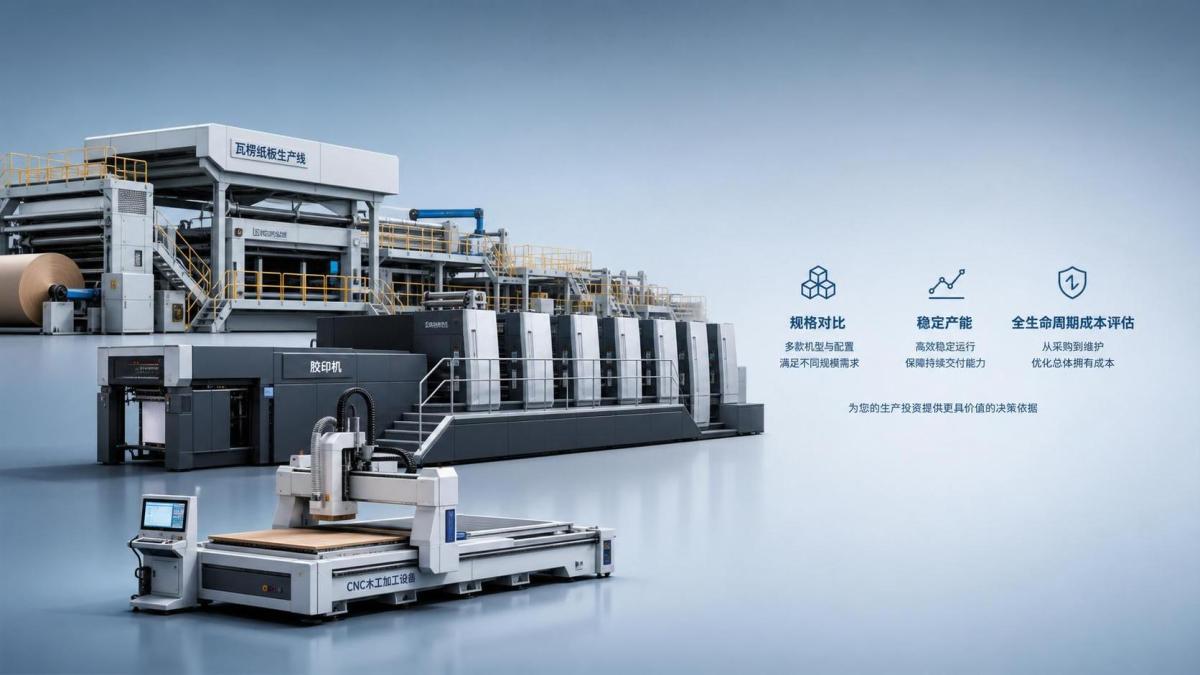
PWFS follows this shift closely because the equipment itself sits at the center of physical manufacturing value.
A corrugated line protects logistics flow. An offset press turns board into shelf appeal. A die-cutter or folder-gluer converts flat substrate into finished geometry. A CNC router and edge bander convert design data into livable furniture components.
When these systems are compared poorly, plants often inherit hidden downtime, unstable quality, and expensive process bottlenecks.
What a technical comparison framework should actually do
A useful technical comparison does not stop at naming parameters.
It connects four layers of judgment: machine capability, production behavior, integration fit, and total lifecycle cost.
That means asking not only what the machine can do, but under which conditions it can keep doing it.
For example, a press rated at high hourly output may only sustain that level on standard stock, with experienced operators, and limited color complexity.
A CNC router may advertise fast spindle movement, yet lose practical productivity through poor nesting logic, tool-change delays, or chip evacuation problems.
In other words, technical comparison should reduce ambiguity, not decorate it.
Looking beyond nominal specifications
Nominal specifications still matter, but they need interpretation.
Speed, pressure, width, spindle power, registration tolerance, glue system type, and automation level are only the starting point.
The more decisive question is how those specifications behave under real product mix.
Typical gaps between data sheets and factory reality
- Maximum speed may be unreachable during frequent order changes.
- Precision may drift when substrate quality varies or ambient temperature changes.
- Energy figures may exclude warm-up, idle running, or auxiliary systems.
- Automation claims may depend on optional modules, not the base machine.
- Maintenance intervals may look favorable on paper but require costly parts availability.
This is why technical comparison should always pair supplier data with observed production evidence.
Core dimensions that deserve close attention
Across PWFS focus sectors, several comparison dimensions recur regardless of machine category.
A disciplined technical comparison weighs these dimensions together, because weakness in one area often undermines strength in another.
How the framework changes by equipment type
The same framework should not be applied blindly.
Different machines create value in different ways, so the emphasis must shift.
Corrugated board lines
Focus on flute quality, adhesive stability, warp control, steam system efficiency, and output consistency across paper grades.
Offset printing presses
Registration accuracy, color repeatability, makeready time, waste sheets during setup, and substrate flexibility usually matter more than top speed alone.
Die-cutters and folder-gluers
Look closely at cut precision, feeding reliability, crease quality, glue application control, and speed retention on complex box designs.
CNC woodworking routers
Spindle power is only part of the story.
Tool-path efficiency, vacuum stability, chip removal, software nesting, and repeatability across customized orders can decide real value.
Panel edge banders
Seam quality, corner treatment, adhesive performance, cleaning effort, and long-shift reliability often define the result more than nominal feed speed.
Performance must include the system around the machine
One frequent mistake in technical comparison is evaluating the main machine in isolation.
In practice, peripheral systems often decide whether the asset performs as promised.
For print lines, ink management, drying, inspection, and stacking can limit output.
For woodworking, dust extraction, labeling, panel flow, and software connectivity may define throughput more than spindle rating.
That is where PWFS intelligence is especially relevant, because the strongest decisions usually come from understanding process chains, not isolated hardware.
Total cost means lifecycle economics, not purchase price
A technical comparison that ignores cost structure is incomplete.
The acquisition price may be visible, but lifecycle cost is where many wrong decisions become obvious.
Total cost should include installation, commissioning, training, energy, consumables, tooling, spare parts, software updates, maintenance labor, scrap, and lost production during downtime.
For highly automated equipment, licensing, remote support, and integration work also deserve explicit review.
A lower-price machine can become the more expensive option if it generates unstable yield or slower order turnover.
That is especially true in sectors where quality loss can trigger customer claims, reprints, rejected furniture parts, or packaging delivery delays.
A practical method for decision-stage evaluation
A workable technical comparison process is usually built in stages rather than done in one meeting.
- Define the product mix, tolerances, order frequency, and target output first.
- Separate essential requirements from desirable options.
- Ask for performance evidence under conditions close to actual production.
- Score machines across technical, operational, and financial dimensions.
- Test integration assumptions with MES, CAD/CAM, or traceability tools.
- Model three-year to five-year ownership cost before final ranking.
This approach creates a clearer audit trail for decisions and reduces dependence on sales narratives.
Where to go next with the framework
The best next step is usually to turn the framework into a comparison matrix linked to actual production priorities.
For some operations, uptime and spare parts response will rank above maximum speed.
For others, automation compatibility, traceability, or rapid changeover will dominate the decision.
A mature technical comparison does not chase the most impressive machine. It identifies the machine most likely to deliver stable output, controlled cost, and strategic fit over time.
In packaging and woodworking, where every crease, print register, cut path, and sealed edge affects commercial results, that discipline is worth building carefully.
Related News
Get weekly intelligence in your inbox.
No noise. No sponsored content. Pure intelligence.
