
How to Choose Woodworking Automation for Doors: Key Machines, Throughput, and ROI
How to Choose Woodworking Automation for Doors: Key Machines, Throughput, and ROI
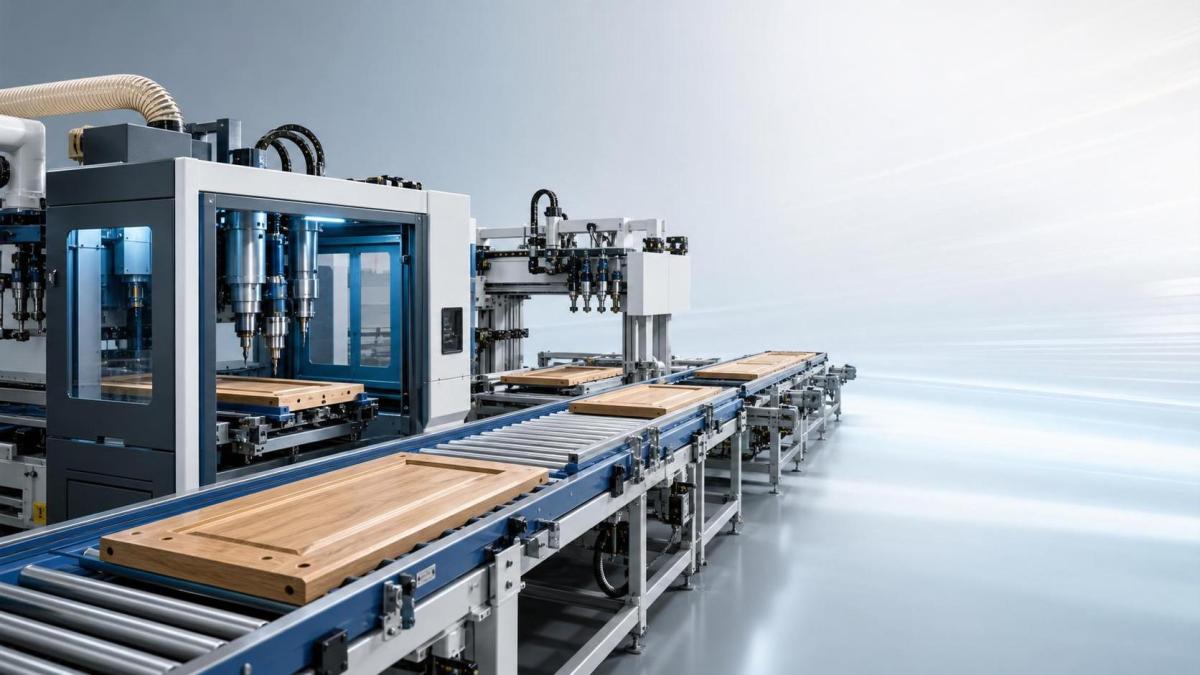
Choosing woodworking automation for doors is no longer a simple equipment purchase. It directly affects output, quality stability, labor structure, and cash return over time.
In door manufacturing, speed alone rarely solves the real bottleneck. The better question is how each machine supports flow, repeatability, and profitable customization.
That is why woodworking automation for doors should be evaluated as a system. CNC routing, edge treatment, drilling, handling, and software must work together.
From a strategic view, the goal is clear. Build a door line that can deliver consistent panels, shorter lead times, and measurable ROI without adding hidden complexity.
Why woodworking automation for doors is changing now
Recent market signals are hard to ignore. Door orders are becoming more fragmented, while delivery expectations keep getting tighter.
At the same time, labor availability remains uneven. Skilled operators are expensive, and training cycles are getting longer in many regions.
This makes woodworking automation for doors less of a technology upgrade and more of a risk-control move. Automation protects output when labor and order patterns fluctuate.
Another shift is product mix. Flush doors, engineered doors, decorative grooved designs, and custom dimensions all require flexible process control.
In practical terms, buyers now need equipment that handles standard runs efficiently and still switches quickly for short batches.
Start with the production target, not the machine brochure
The best woodworking automation for doors begins with production math. Without that, even premium equipment can be badly mismatched to the factory.
Define three numbers first: daily door output, average lot size, and target changeover time. These shape almost every downstream decision.
Then map the product structure. Solid wood doors, MDF doors, laminated doors, and hollow-core doors do not create the same processing load.
A factory with high SKU variation usually needs flexible CNC cells and digital job scheduling. A standard-volume plant may prioritize line balance and lower unit cost.
It also helps to define the acceptable scrap rate early. Throughput numbers look attractive on paper, but yield often decides the real economics.
Key machines in woodworking automation for doors
A modern door line is usually built around several core machine groups. Each one carries a different effect on capacity, quality, and labor dependence.
1. CNC routers or machining centers
These are often the heart of woodworking automation for doors. They cut profiles, grooves, lock areas, hinge pockets, and decorative features with repeatable accuracy.
Key decision points include spindle power, tool-changing speed, vacuum hold-down performance, and software compatibility with design files.
2. Drilling and hinge-processing centers
When door hardware preparation is frequent, dedicated drilling centers can remove pressure from the main CNC station. This improves takt time and process stability.
3. Edge banders or edge finishing units
For engineered or composite door panels, edge quality is a visual and functional requirement. Good edge treatment improves finish consistency and reduces rework.
Laser or PUR solutions may carry a higher upfront cost. Still, they can improve moisture resistance and premium appearance in demanding applications.
4. Sanding and surface preparation equipment
Surface consistency matters before painting, laminating, or veneering. Automated sanding reduces manual variation and supports more predictable downstream finishing.
5. Conveyors, robots, and handling systems
Handling is often underestimated. Yet poor loading, unloading, or buffering can erase the benefit of faster core machines.
In many cases, woodworking automation for doors reaches the next performance level only after material flow is automated around the machine, not just inside it.
How to evaluate throughput without being misled
Supplier output figures are useful, but they are not enough. Real throughput depends on the full cycle, not the peak speed of one unit.
A more reliable review looks at effective hourly output. That means actual finished doors after setup, tool changes, operator intervention, and rework.
Ask for data under product conditions close to your own. Door thickness, material density, groove depth, and hardware preparation all affect cycle time.
Also examine the slowest link. In woodworking automation for doors, bottlenecks often come from stacking, barcode scanning, or edge finishing instead of machining.
A simple framework can help:
- Planned output per shift
- Average setup time per batch
- Unplanned stoppage minutes
- First-pass yield rate
- Labor touches per door
This approach gives a more grounded picture than headline speed claims. It also makes supplier comparisons much cleaner.
The software layer matters as much as the hardware
Woodworking automation for doors becomes far more valuable when software connects order entry, nesting, machining, and production tracking.
Without digital integration, operators spend too much time correcting files, entering dimensions manually, or chasing production status across stations.
Look closely at CAD/CAM compatibility, MES integration, barcode workflows, and machine-level reporting. These features usually influence scalability more than expected.
For custom door manufacturing, recipe management is especially important. Reusable programs shorten setup time and reduce dependence on a few experienced technicians.
ROI for woodworking automation for doors: what to calculate
ROI should be broader than labor savings. Strong projects usually create value across output, quality, lead time, and order flexibility.
Start with direct gains. These often include fewer operators per shift, lower scrap, lower rework, and better material utilization.
Then estimate indirect gains. Faster delivery can improve win rates, while stable accuracy can reduce warranty claims and customer complaints.
A practical ROI model for woodworking automation for doors should include:
Most buyers should model base, optimistic, and conservative scenarios. This prevents approval decisions from depending on one aggressive assumption.
Common selection mistakes in woodworking automation for doors
The first mistake is buying for maximum speed while ignoring upstream and downstream balance. One fast machine cannot fix a broken flow.
The second is underestimating job variation. If your market demands custom sizes, a rigid line can become expensive very quickly.
Another common issue is weak data integration. Hardware looks impressive during demos, but missing software links create daily production friction.
Service support also deserves scrutiny. In woodworking automation for doors, downtime costs can exceed the savings gained from a lower purchase price.
Finally, some teams skip operator adoption planning. Even a strong automation package needs training, process discipline, and realistic startup milestones.
A practical decision framework
A structured shortlist keeps the selection process focused. It also helps internal teams compare proposals using business criteria instead of sales language.
- Define door types, output targets, and customization ratio.
- Identify the present bottleneck in machining, edging, drilling, or handling.
- Check software compatibility with ERP, CAD/CAM, and MES workflows.
- Request real production references using similar door products.
- Run ROI scenarios with conservative uptime and yield assumptions.
- Validate service coverage, spare parts access, and training depth.
This method keeps woodworking automation for doors tied to measurable business value. It also reduces the risk of buying isolated equipment that cannot scale.
Final takeaway
The right woodworking automation for doors is rarely the most complex setup. It is the one that fits your door mix, your throughput target, and your digital maturity.
When machine choice, material flow, and software integration are aligned, automation starts to deliver what matters most: stable output and predictable ROI.
For any factory assessing woodworking automation for doors, the strongest next step is a line-level evaluation built on real product data, not generic capacity claims.
Related News
Get weekly intelligence in your inbox.
No noise. No sponsored content. Pure intelligence.
