
How to Use Product Specification Resources to Compare Industrial Equipment Before Buying
How to Use Product Specification Resources to Compare Industrial Equipment Before Buying
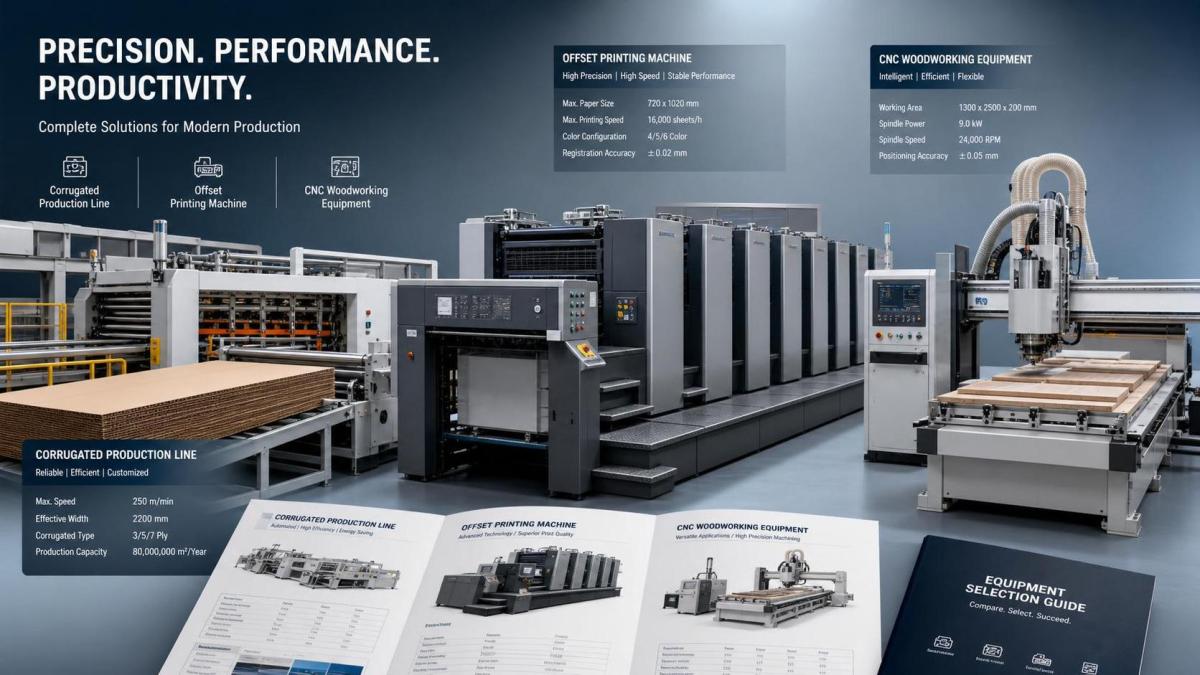
Before investing in corrugated lines, offset presses, die-cutters, folder-gluers, or CNC woodworking systems, buyers need more than glossy brochures.
They need trustworthy product specification resources that show real capacity, accuracy, automation, energy demand, and compliance performance.
That matters even more when capital budgets are tight and output targets keep rising.
A smart comparison process helps prevent overspending, underbuying, and painful integration problems after installation.
In practical terms, product specification resources turn equipment selection from a sales conversation into a fact-based decision.
For industrial packaging and woodworking lines, that shift can protect production stability for years.
Why Product Specification Resources Matter More Than Sales Claims
Most vendors present performance at ideal conditions.
Product specification resources help reveal what happens under actual workload, material changes, staffing limits, and shift pressure.
A corrugated board line may look similar on paper, yet steam efficiency, glue control, and flute stability can differ sharply.
The same pattern appears in offset presses, where registration tolerance and makeready waste drive real operating cost.
Reliable product specification resources also help compare equipment across regions, standards, and machine generations.
That becomes essential when evaluating imported systems, retrofitted models, or hybrid automation platforms.
Good intelligence platforms such as PWFS are useful because they connect technical data with operational and financial consequences.
Which Product Specification Resources Should Be Compared First
Not every data sheet deserves equal attention.
The best product specification resources focus on the variables that affect throughput, labor, quality, maintenance, and compliance risk.
1. Capacity and speed under usable conditions
Check rated speed, but also ask for stable production speed with typical substrates and common order sizes.
For folder-gluers and die-cutters, changeover time often matters more than peak speed.
2. Precision and repeatability
Offset presses need clear data on registration, color consistency, and waste during startup.
CNC routers need spindle accuracy, repeat positioning, and tool-path consistency over long runs.
3. Automation and software integration
Modern product specification resources should cover MES links, barcode workflows, job recipe storage, and remote diagnostics.
This is where many machines separate themselves in daily operations.
4. Energy use and consumables
Power load, steam demand, air consumption, glue usage, and tooling life should all appear in product specification resources.
These numbers shape cost per unit more than many first-time buyers expect.
5. Compliance and safety data
If a line supports food, pharma, export packaging, or eco-certified furniture, compliance cannot be an afterthought.
Request CE data, emissions details, ink or adhesive compatibility, and traceability support.
How to Build a Side-by-Side Comparison That Actually Helps
Raw specification sheets rarely make decisions easier on their own.
The useful approach is to convert product specification resources into a structured comparison table.
Each vendor should be measured with the same categories, units, and operating assumptions.
Once the table is built, scoring becomes far more objective.
It also exposes where one supplier is strong in speed but weak in lifecycle cost.
Common Mistakes When Reading Product Specification Resources
Many buying errors come from reading specifications too literally.
- Assuming peak speed equals daily throughput.
- Ignoring tooling cost and wear-part replacement cycles.
- Comparing machines with different substrate ranges.
- Missing utility requirements such as compressed air, steam, or floor loading.
- Treating automation claims as equal without checking software compatibility.
- Overlooking local service response time and spare parts availability.
From recent market shifts, the clearer signal is that buyers now need deeper operational proof.
That includes sample runs, maintenance logs, and references from plants with similar order structures.
In other words, product specification resources should start the evaluation, not finish it.
How PWFS Intelligence Improves Equipment Comparison
For complex sectors like packaging print and woodworking, comparison quality depends on comparison depth.
PWFS is built for that depth.
Its product specification resources cover corrugated board lines, offset presses, die-cutters, folder-gluers, CNC routers, and edge banders through a practical industrial lens.
That means technical indicators are connected to yield, labor structure, compliance exposure, and margin impact.
This is especially useful when comparing highly engineered systems that look similar in brochures.
For example, micron-level print registration, die-cutting stress balance, or chip evacuation dynamics can all influence long-term output consistency.
That level of detail helps buyers avoid decisions based only on headline price.
A Practical Buying Checklist Before Final Approval
Before signing, run every shortlisted machine through a final review based on product specification resources and plant reality.
- Confirm target products, daily volumes, and future expansion needs.
- Standardize all vendor data into one comparison format.
- Validate utilities, floor space, and installation conditions.
- Request sample performance on your actual materials.
- Check service network, spare parts lead time, and training support.
- Model total cost over three to five years.
- Review compliance fit for export, safety, and environmental requirements.
This process takes longer upfront, but it saves far more time and money later.
The best purchase decision usually comes from the best comparison discipline.
Final Takeaway
When industrial equipment budgets are large, guessing is expensive.
Strong product specification resources give buyers a clearer view of performance, cost, fit, and risk before money is committed.
They also make supplier conversations sharper, because questions become specific and measurable.
For corrugated, print, converting, and woodworking investments, that discipline often separates a productive asset from a costly compromise.
Use product specification resources early, compare them consistently, and test every claim against real production needs.
That is the most reliable way to buy with confidence and protect long-term return.
Related News
Get weekly intelligence in your inbox.
No noise. No sponsored content. Pure intelligence.
