
Flexible Wood Cutting Low Waste: Which Cutting Methods Reduce Scrap on Mixed Panels?
Why mixed panels change the waste equation
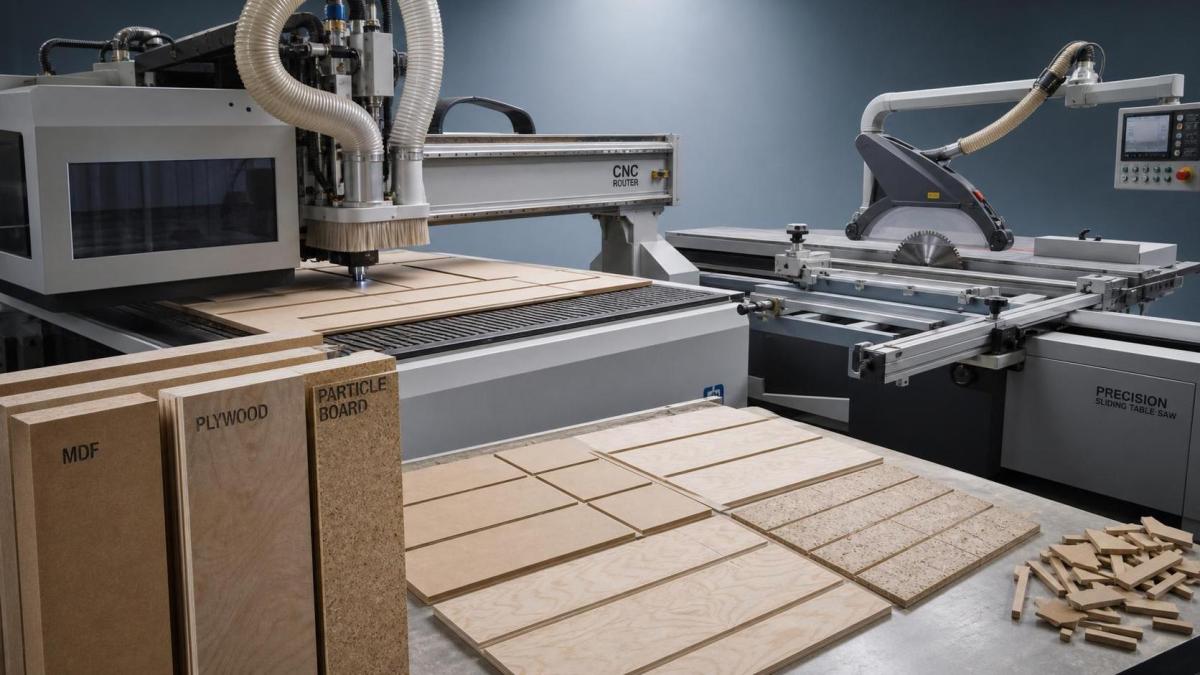
Flexible wood cutting low waste is not one method. It is a decision framework for unstable material conditions.
In mixed-panel production, MDF, plywood, and particleboard behave differently under the same layout, feed speed, and cutting sequence.
That is why scrap often rises even when machine uptime looks acceptable.
A nesting file that works on dense MDF may leave unusable islands on plywood. A saw program optimized for rectangles may struggle once custom parts dominate.
PWFS follows this issue from the same industrial logic that shapes corrugated lines, die-cutting cells, and CNC woodworking routers.
In each case, yield depends on how digital planning matches physical behavior.
For wood panels, the practical question is simple: which cutting method reduces scrap without damaging throughput, edge quality, or downstream edge banding stability?
The answer changes with order mix, panel variability, and how much geometry changes from batch to batch.
Actual production usually starts with three different realities
Flexible wood cutting low waste decisions are clearer when production is divided by order structure instead of machine brand.
The most common difference is whether the job is repeatable, semi-custom, or highly variable.
When rectangular parts dominate
Beam saw optimization usually wins where cabinets, shelves, and side panels repeat in large volumes.
The reason is not only speed. Saw-based breakdown creates predictable strips, stable handling, and easier remnant planning.
In this setting, flexible wood cutting low waste depends on cut sequencing, trim allowances, and whether leftovers are reusable by thickness and decor code.
When order variety grows but shapes stay manageable
This is where hybrid planning becomes valuable. Saws process straight rectangular families, while CNC cells handle exceptions and drilling-intensive parts.
Many operations lose material here because they force everything into one process.
A mixed strategy often cuts scrap more effectively than chasing theoretical nesting percentages on every sheet.
When true customization drives the schedule
Full-sheet CNC nesting becomes more attractive once curved pieces, special cutouts, and changing dimensions are routine.
In these projects, flexible wood cutting low waste is tied to software intelligence, toolpath order, and part labeling discipline.
A high nesting rate on screen means little if fragile narrow parts chip, shift, or delay edge processing.
Different panel materials demand different cutting logic
Mixed panels are not just different colors in inventory. They create different waste risks.
In practical terms, flexible wood cutting low waste improves when software separates material rules instead of nesting all panels under one generic template.
That separation matters even more when edge appearance affects downstream assembly or visible furniture surfaces.
Choosing between saw optimization and CNC nesting
This comparison is often framed too simply. The better question is what kind of waste matters most in the current flow.
Saw optimization usually reduces processing waste in straight-cut families. CNC nesting often reduces design waste in irregular layouts.
They are not interchangeable just because both produce parts from a panel.
- Use saw optimization when parts repeat, grain direction is simple, and remnants can be cataloged reliably.
- Use CNC nesting when custom geometry, drilling integration, and label-driven sorting are more valuable than strip-based throughput.
- Use hybrid routing when rectangular volume supports saw economics, but exceptions would otherwise inflate scrap and handling steps.
PWFS often tracks the same manufacturing principle across print and wood systems: the fastest line is not the most productive if format change destroys usable yield.
Flexible wood cutting low waste follows that principle closely.
Toolpath control becomes critical once variability increases
Many low-waste discussions stop at nesting software. That misses where scrap actually appears during cutting.
Tool entry points, onion-skin strategy, tab placement, cutter diameter, and sheet hold-down all change final usable yield.
For high-mix furniture work, flexible wood cutting low waste often depends on preventing micro-failures rather than finding one more part on the sheet.
A nested layout may look efficient, yet parts can still become scrap if vacuum weakens around narrow components.
The same applies when aggressive feeds reduce cycle time but damage laminated edges, creating hidden rework before edge banding.
This is why advanced CNC woodworking routers matter inside broader flexible manufacturing systems.
They do not just cut shapes. They translate CAD intent into repeatable physical accuracy under changing material behavior.
Where waste judgments often go wrong
Several common misreadings distort flexible wood cutting low waste decisions.
- Focusing only on nesting percentage while ignoring breakage, rework, and sorting delays.
- Comparing machines without separating material-specific rules for MDF, plywood, and particleboard.
- Treating custom orders like batch orders, then wondering why saw plans generate unusable leftovers.
- Choosing the cheapest tooling plan without calculating edge quality losses and replacement frequency.
- Ignoring downstream constraints such as edge bander tolerance, labeling logic, and assembly sequence.
In actual production, low scrap and fast throughput only stay together when cutting, handling, and finishing are planned as one chain.
That systems view is familiar in packaging lines as well, where print registration, die-cut stress, and folding accuracy cannot be optimized separately.
A practical way to match method to scenario
A useful flexible wood cutting low waste review starts with four checks.
- Map order mix by rectangular share, irregular share, and drilling complexity.
- Separate panel rules by density, face quality, thickness, and edge performance requirement.
- Measure real scrap causes, including breakage, rejects, and remnant non-reuse.
- Test one material family at a time before changing global nesting or saw parameters.
From there, the right method usually becomes clearer.
If orders are stable, saw optimization may deliver the best material control.
If customization is accelerating, CNC nesting with disciplined toolpath control will often protect both yield and lead time.
If the business sits between those conditions, a hybrid cell is often the most realistic low-waste path.
The next step is to build a scenario-based rule set, not a single universal program.
That is how flexible wood cutting low waste becomes measurable, repeatable, and compatible with faster custom manufacturing.
Related News
Get weekly intelligence in your inbox.
No noise. No sponsored content. Pure intelligence.
