
Furniture Production Line System Selection: What to Check Before Layout and Capacity Planning
Furniture Production Line System Selection: What to Check Before Layout and Capacity Planning
Choosing the right furniture production line system is the first step toward a factory that can scale without losing control.
Before layout drawings or capacity calculations start, the evaluation has to be sharper than many teams expect.
A weak decision here usually creates bottlenecks that no later optimization can fully remove.
A strong furniture production line system should match product mix, process logic, labor strategy, and future expansion.
That is especially true in panel furniture, custom cabinetry, and whole-house projects where variation is constant.
In practical terms, system selection is not about buying faster machines. It is about building a stable manufacturing flow.
Start with the real product mix
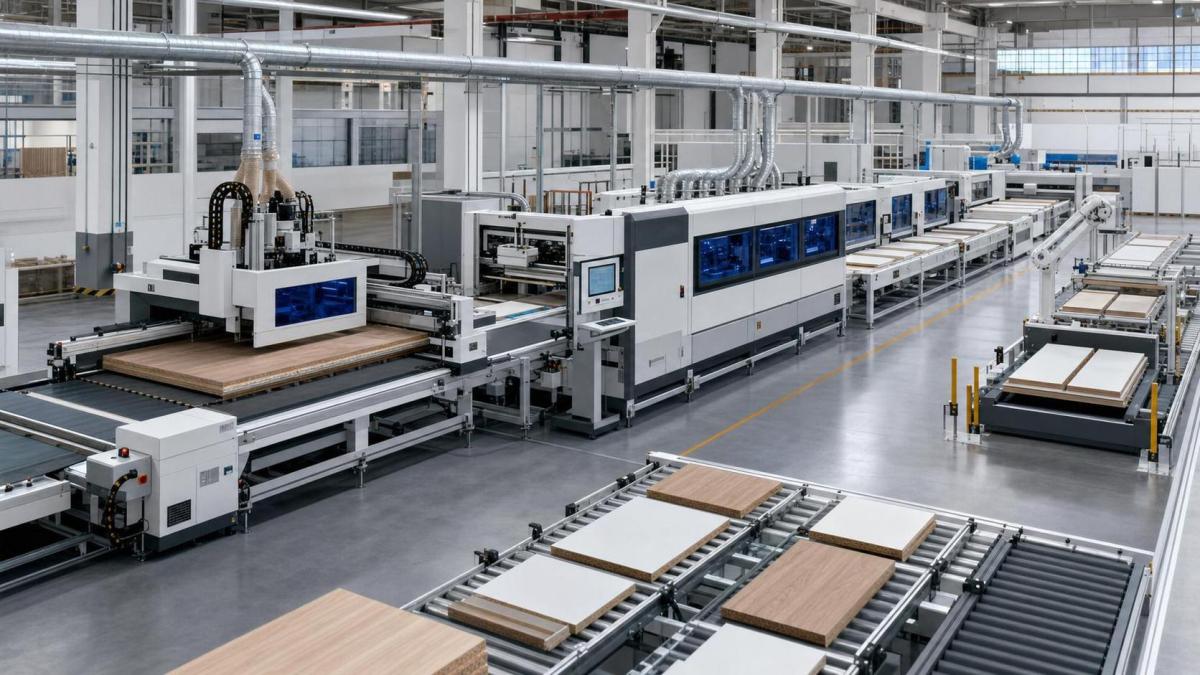
The first checkpoint in furniture production line system selection is product structure, not machine brand.
Many projects fail because planning assumes standard cabinets, while orders later shift toward mixed-size customized units.
That changes drilling patterns, edge banding frequency, material handling rhythm, and sorting requirements.
A useful review should answer a few basic questions before any line layout is frozen.
- What percentage of output is standard, semi-custom, and fully custom?
- How many board thicknesses, finishes, and edge materials are involved?
- What is the average order size and SKU count per batch?
- How often do urgent orders interrupt normal production flow?
These answers define whether the furniture production line system should prioritize throughput, flexibility, or a balanced model.
From recent market shifts, the clearer signal is that flexibility now carries more value than peak theoretical speed.
If the factory serves dealers, real estate projects, and direct customization together, one rigid line usually struggles.
Map the process before comparing equipment
A furniture production line system should be evaluated as a connected process, not as isolated machines.
The normal route may include cutting, labeling, drilling, routing, edge banding, sorting, assembly support, and packaging.
Every handoff between these stages can create waiting time, quality variation, or traceability loss.
This is why process mapping should happen earlier than supplier quotation comparison.
A practical review usually covers the following points.
- Identify each process step and required cycle time.
- Mark manual loading, transfer, inspection, and rework points.
- Check where barcode, MES, or ERP data must enter the line.
- Confirm which process can run in parallel and which cannot.
Once the process is visible, furniture production line system selection becomes more objective.
For example, adding a faster CNC may do little if edge banding or sorting remains the real constraint.
In actual operations, the slowest stable step defines capacity more often than the most expensive machine.
Check automation depth, not just automation labels
Automation is one of the most misunderstood parts of furniture production line system evaluation.
A line can look highly automated in a showroom and still depend heavily on manual intervention.
That usually appears in board loading, part buffering, exception handling, labeling correction, or finished-part sorting.
So the better question is not whether the furniture production line system is automated.
The better question is where people still have to step in, and how often.
- Can the system handle mixed order sequencing automatically?
- Does software reschedule when boards or tools are unavailable?
- Can labels and part IDs stay traceable through the full process?
- How are rejects, remakes, and urgent inserts managed?
This also means software matters almost as much as mechanics.
A furniture production line system without strong data logic often becomes a fast machine island with poor coordination.
For factories aiming at Industry 4.0 readiness, that gap becomes expensive very quickly.
Validate layout with material flow and space use
Layout planning should begin only after the furniture production line system logic is confirmed.
Otherwise, the factory may look organized on paper but perform poorly in live production.
The key is to follow material flow, operator movement, forklift access, maintenance clearance, and buffer positioning.
Space utilization is not only about fitting machines into a building shell.
It is about preserving flow consistency under normal and abnormal conditions.
When reviewing a furniture production line system layout, check these areas closely.
A good furniture production line system layout reduces crossing traffic and unnecessary returns.
That sounds basic, but it often decides whether the line stays stable during peak order weeks.
Use realistic capacity planning, not supplier peak numbers
Capacity planning is where many furniture production line system decisions become distorted.
Supplier data usually reflects ideal conditions, stable orders, trained operators, and limited product variation.
Real factories deal with changeovers, maintenance, remakes, breaks, software delays, and inconsistent batches.
That is why furniture production line system capacity should be modeled with effective output, not maximum speed.
A realistic capacity review should include these variables.
- Shift pattern and actual available working hours
- Average changeover time by product family
- Tooling wear and maintenance downtime
- Yield loss, rework rate, and scrap assumptions
- Seasonal peaks and order volatility
This approach makes capital decisions more credible.
It also helps compare two furniture production line system options that seem similar in price but differ in output stability.
In most cases, consistent daily throughput matters more than occasional top-speed demonstrations.
Assess integration, utilities, and future upgrades
A furniture production line system is a long-life investment, so future compatibility has to be checked early.
This includes software integration, power supply, compressed air, dust collection, data interfaces, and spare parts support.
The question is simple: can this system grow without forcing a second full rebuild?
That matters even more for companies expecting higher customization or multi-site replication later.
Important checks usually include:
- Whether MES, ERP, and design software can connect smoothly.
- Whether utility loads match present and future machine counts.
- Whether spare parts, remote service, and local support are dependable.
- Whether later modules can be added without stopping the full line.
This is where a cheaper furniture production line system can become more expensive over five years.
Limited interfaces, weak service response, or closed software architecture often create hidden operating risk.
Make the final decision with a risk-based checklist
The best furniture production line system decision usually comes from disciplined comparison, not from presentation quality.
By this stage, the shortlist should already reflect product fit, process stability, automation depth, layout logic, and realistic capacity.
The final step is to rank each option against operational risk and business direction.
- Will this system support today’s order mix without excessive manual work?
- Can it maintain quality under mixed-batch customized production?
- Does the layout leave enough room for service and expansion?
- Is the projected capacity achievable in normal operating conditions?
- Will software and utilities support future upgrades?
A furniture production line system should make the factory more predictable, not just more impressive on paper.
When selection is done carefully, layout and capacity planning become faster, cleaner, and far less risky.
That is the point where investment decisions start supporting long-term margin, delivery reliability, and scalable customization.
Related News
Get weekly intelligence in your inbox.
No noise. No sponsored content. Pure intelligence.
