
Heavy-Duty Corrugator Machines: Core Specs, Line Speed, and Board Grades to Evaluate
Heavy-Duty Corrugator Machines: Core Specs, Line Speed, and Board Grades to Evaluate
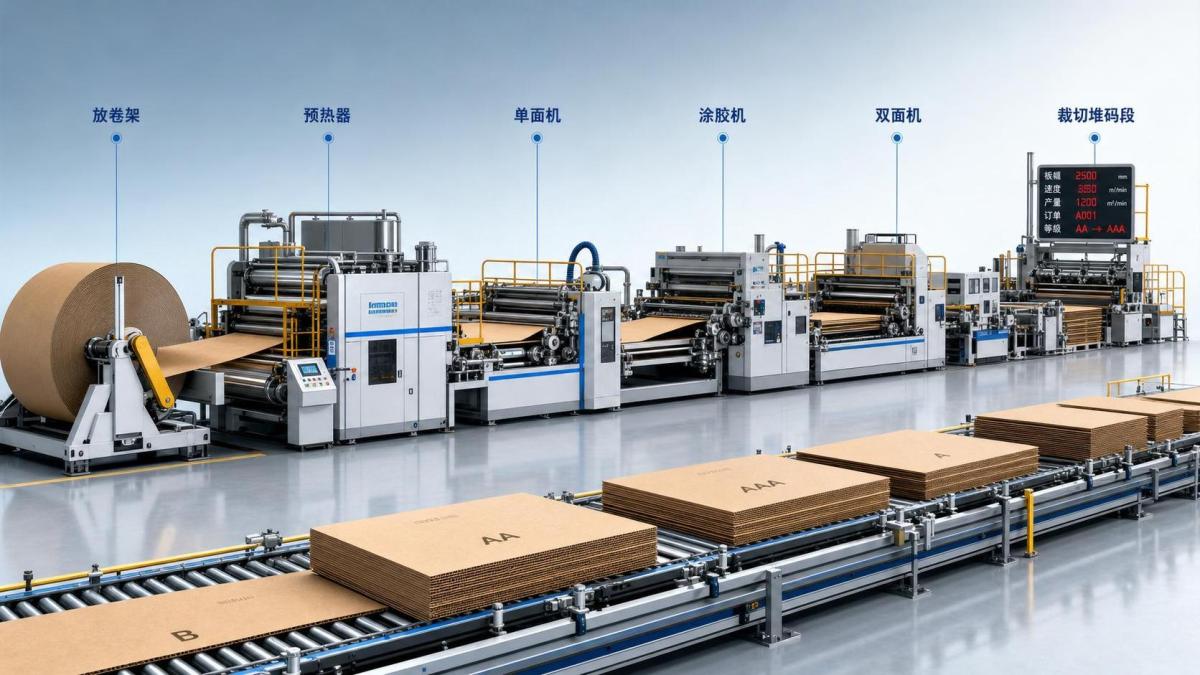
Choosing corrugator machines heavy duty for a new line or upgrade demands more than headline capacity claims.
Real evaluation starts with machine architecture, steam stability, glue control, and board quality under load.
That matters even more when production targets include mixed orders, higher flute variety, and tighter delivery windows.
For technical assessment, the best approach is practical.
Compare what corrugator machines heavy duty can sustain, not just what suppliers advertise in ideal conditions.
This guide focuses on the specifications, line speed factors, and board grades that usually decide long-term performance.
Start With the Core Machine Configuration
The first checkpoint is line structure.
A heavy-duty setup should be reviewed as a complete production system, not as isolated units.
Typical modules include mill roll stands, preheaters, single facers, bridge control, glue machine, double facer, slitter scorer, cutoff, and stacker.
The question is not whether these modules exist.
The question is how well they are matched for continuous high-load production.
- Working width, such as 1800 mm, 2200 mm, or 2500 mm
- Design speed versus stable operating speed
- Single facer quantity and flute change flexibility
- Heating plate length and thermal efficiency
- Automatic splicing, reel handling, and tension control
- Glue kitchen consistency and dosing accuracy
- Automation depth across the full line
In real projects, corrugator machines heavy duty often fail to meet targets because one section becomes a bottleneck.
That bottleneck may be poor web alignment, weak steam response, or unstable glue application at speed.
A balanced line usually outperforms a faster-looking one.
How to Judge Line Speed Under Production Conditions
Line speed is the most abused number in corrugated equipment discussions.
A supplier may quote 250 m/min or 300 m/min.
That figure alone says very little about useful output.
For corrugator machines heavy duty, assess three speed layers.
- Design speed: the engineering ceiling under controlled conditions.
- Running speed: the speed reached during live production.
- Effective speed: saleable board output after waste, stops, and order changes.
Effective speed is the number that matters for ROI.
A line running slower but with fewer stoppages can deliver more board per shift.
Ask for production data by flute type, paper basis weight, and board format.
More specifically, request stable speed records for common commercial mixes, not just lightweight test papers.
This is where corrugator machines heavy duty separate into two groups.
Some are built for brochure numbers.
Others are built for saleable tonnage, shift after shift.
Board Grades and Flute Range Need a Closer Look
Board grade capability should never be treated as a footnote.
It defines whether corrugator machines heavy duty fit your order structure today and your product mix tomorrow.
Most evaluations should cover single wall, double wall, and possibly triple wall requirements.
Also confirm support for flute profiles such as A, C, B, E, and common double combinations like BC or BE.
In practical purchasing, the issue is not only flute compatibility.
It is the quality consistency when switching between light and heavy paper grades.
- Minimum and maximum liner and medium gsm range
- Compression strength targets for shipping applications
- Moisture profile control across board width
- Warp performance on coated and recycled papers
- Edge crush and flat crush consistency
- Bonding performance at high-speed double wall output
This has become more important as e-commerce packaging keeps splitting into lighter, stronger, and more application-specific grades.
A line that handles only a narrow paper window may limit future business flexibility.
That is a hidden cost many teams spot too late.
Automation, Controls, and Quality Assurance
Modern corrugator machines heavy duty are no longer judged only by steel, rolls, and horsepower.
Control logic now has a major influence on uptime, waste, and operator dependency.
A strong control package should reduce manual intervention while keeping process visibility high.
Look closely at these areas.
- Recipe management for flute, paper, and speed combinations
- Automatic gap, pressure, and temperature settings
- Real-time moisture and warp monitoring
- Production data capture for waste and downtime analysis
- Remote diagnostics and spare parts traceability
- MES or ERP connectivity for order-driven production
In actual operations, automation is valuable when it shortens the path between problem detection and correction.
That includes glue drift, web wander, overheating, score inaccuracy, and moisture imbalance.
The better corrugator machines heavy duty provide stable process windows, not just alarms.
Questions That Expose Real Performance Risk
A technical review improves quickly when the right questions are asked early.
This is especially true for corrugator machines heavy duty, where underperformance usually appears after installation, not before purchase.
- What board grades were used to validate the quoted speed?
- How much waste is generated during order changes?
- What is the stable speed for double wall output?
- How does the line perform with recycled papers of variable moisture?
- Which modules are locally supported for service and spare parts?
- What acceptance tests define board quality and throughput?
- How much operator skill is required to maintain target quality?
These questions move the discussion from catalog language to measurable operating reality.
They also reveal whether a supplier understands demanding corrugated board production or only machine assembly.
A Practical Evaluation Framework
A useful selection process keeps the scoring model simple and evidence-based.
For corrugator machines heavy duty, five criteria usually give a reliable comparison.
- Board quality across the target paper range
- Effective output on the real order mix
- Energy, steam, glue, and waste efficiency
- Maintenance access and service responsiveness
- Automation maturity and future upgrade path
Weight each category according to business priorities.
A plant focused on export cartons may rank board consistency first.
A plant chasing short-run e-commerce demand may rank order change speed and automation higher.
Either way, the best corrugator machines heavy duty are the ones that fit the production model with the least operational friction.
Before final approval, compare trial data, acceptance terms, and lifecycle support in one decision sheet.
That final step often prevents expensive surprises and keeps the investment tied to real manufacturing results.
Related News
Get weekly intelligence in your inbox.
No noise. No sponsored content. Pure intelligence.
