
Why Corrugator Southeast Asia Buyers Compare Heat Efficiency, Speed, and Service Coverage
Why corrugator Southeast Asia comparisons have become more demanding
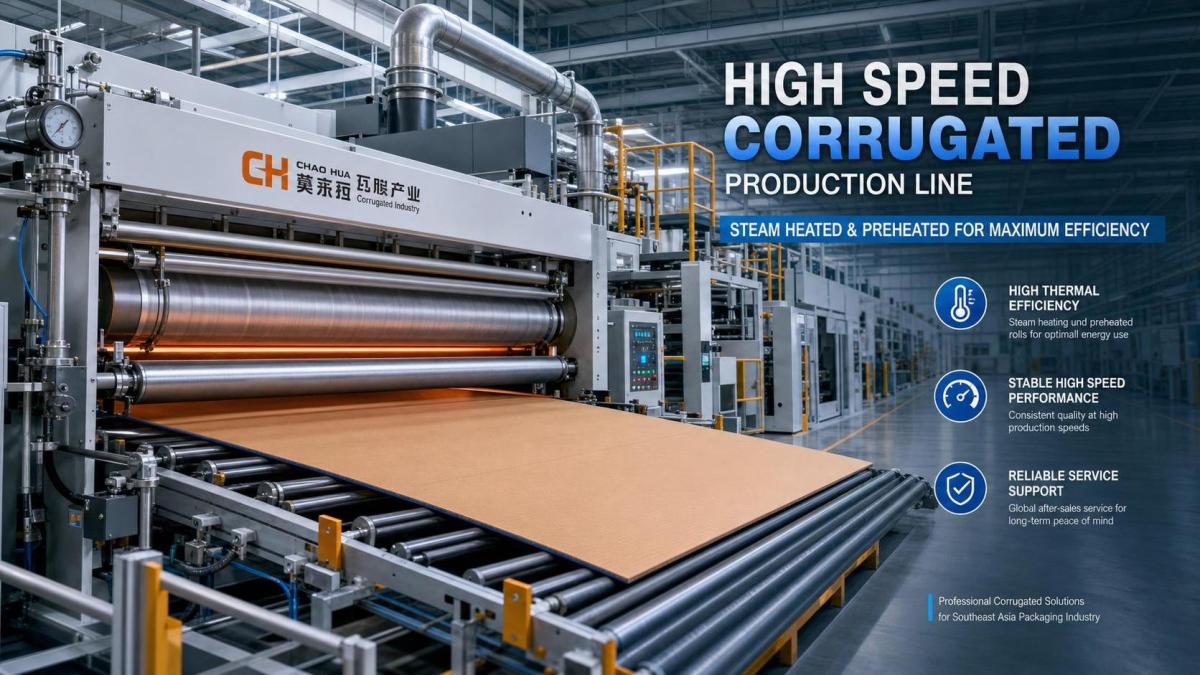
The corrugator Southeast Asia market is no longer judged by installed width or top speed alone.
Recent investment reviews show a sharper focus on operating resilience, not just machine ambition.
That change reflects a regional packaging economy under pressure from e-commerce volume, mixed order structures, and tighter utility costs.
In this environment, heat efficiency affects both steam consumption and board consistency.
Production speed influences whether capacity planning remains credible during demand spikes.
Service coverage determines whether a short stoppage becomes a scheduling issue or a margin problem.
For a corrugator Southeast Asia project, these three variables increasingly move together.
A line that runs fast but wastes heat can erode savings quietly.
A line with strong thermal design but weak service support can still miss delivery windows.
This is why evaluation has shifted from headline specification to system behavior over time.
PWFS has tracked this pattern across paper converting, printing, finishing, and digital manufacturing equipment.
The same logic appears everywhere: stable output now matters more than isolated machine performance.
The regional signal is clear: throughput matters, but energy discipline matters more
From recent market movement, Southeast Asian converters are balancing growth optimism with harder cost control.
Board demand is supported by export packaging, consumer goods flows, and fast-moving parcel networks.
Yet electricity pricing, boiler efficiency, fuel exposure, and maintenance labor are shaping project assumptions earlier.
That is why corrugator Southeast Asia buyers are asking deeper questions about thermal architecture.
They want to know how heat is transferred, retained, monitored, and recovered across changing paper grades.
This is not a narrow utility issue.
Poor heat control can show up as warp, bond instability, moisture imbalance, and downstream converting friction.
That creates hidden stress for printing registration, die-cutting precision, and box forming stability.
Seen through the broader PWFS lens, corrugation quality now affects the full packaging chain.
What happens at the hot plate can influence color presentation, folding accuracy, and final pack appearance.
Why this shift is happening now
- Order mix is becoming less predictable, with shorter runs and more frequent changeovers.
- Regional packaging plants are under pressure to raise uptime without overbuilding labor.
- Export and domestic brands expect stronger box performance with tighter waste tolerance.
- Capital reviews are more cautious, so lifetime operating cost receives closer scrutiny.
- Digital management systems make losses easier to measure, exposing weak thermal and service assumptions.
Heat efficiency is now a board quality issue, not only an energy issue
In many corrugator Southeast Asia discussions, heat efficiency used to be treated as a utility line item.
That view is becoming outdated.
When lightweight papers, recycled content, and humid conditions combine, thermal control becomes a production variable.
Efficient heat use supports more than fuel savings.
It supports adhesive bonding rhythm, sheet flatness, and speed stability under real operating conditions.
A corrugator Southeast Asia line working across mixed flute profiles cannot rely on nominal design claims.
It needs controllable preheating, responsive steam sections, and monitoring that operators can trust quickly.
More advanced plants are also judging insulation, condensate handling, and heat loss pathways.
These details rarely dominate brochures, but they shape daily conversion cost.
They also shape how consistently the board feeds into offset printing, die-cutting, and folder-gluing stages.
Speed is being redefined by usable output, not brochure velocity
Another visible change in corrugator Southeast Asia selection is how speed is discussed.
The headline meters per minute still attracts attention, but it no longer settles the comparison.
What matters more is usable output across the actual production mix.
Can the line maintain stable speed during grade shifts, order fragmentation, and operator transitions?
Can it preserve board quality while moving from volume runs to more customized packaging demand?
Those questions are becoming central because Southeast Asia is not a single-format market.
It serves export manufacturers, local retail chains, food distribution, electronics, and fast parcel traffic at once.
That diversity punishes lines that look fast only under ideal test conditions.
A strong corrugator Southeast Asia candidate therefore needs stable tension control, clean order transitions, and dependable automation logic.
In practical terms, usable speed is the speed that survives the weekly schedule.
Where speed pressure is coming from
E-commerce remains a major driver, but the story is broader than parcel volume.
Promotional calendars are denser, SKU diversity is higher, and packaging refresh cycles are shorter.
That pulls corrugation closer to the responsiveness already expected in offset printing and digital woodworking.
Across industrial systems, the market increasingly rewards flexible output with predictable quality.
Service coverage has moved from after-sales detail to investment logic
The third comparison point has gained weight faster than many expected.
Service coverage is now part of project logic from the earliest evaluation stage.
This is especially true in corrugator Southeast Asia projects spread across multiple countries and support conditions.
A technically capable line loses appeal if spare parts lead times are long or diagnostic support is remote in name only.
More buyers are checking local engineering presence, commissioning depth, training continuity, and response escalation routes.
They are also asking whether software, controls, and maintenance practices can be integrated into MES planning.
That is a sensible shift.
In automated packaging and woodworking systems, downtime now spreads beyond one machine.
It disrupts converting, dispatch timing, labor allocation, and customer confidence.
For corrugator Southeast Asia installations, service reach is increasingly judged as production insurance.
- Check where trained field engineers are actually based, not only where offices are listed.
- Compare critical spare parts stocking policy for heaters, rollers, drives, and control modules.
- Review remote support capability for diagnostics, parameter recovery, and update management.
- Examine whether training covers operators, maintenance teams, and process optimization separately.
The most useful comparison is the interaction between all three factors
Heat efficiency, speed, and service coverage should not be reviewed as separate scorecards.
Their interaction is where the real project risk sits.
A faster line often raises expectations for thermal consistency and maintenance discipline.
A thermally efficient line still needs service responsiveness to protect those gains under heavy scheduling pressure.
This combined view is increasingly visible across the PWFS intelligence scope.
High-speed offset presses, die-cutters, folder-gluers, CNC routers, and edge banders all show the same pattern.
The best assets are rarely the ones with the loudest single parameter.
They are the ones that convert technical design into repeatable output under variable demand.
For a corrugator Southeast Asia decision, that means reviewing how the machine behaves in a real regional operating context.
Climate, utilities, paper sourcing, labor structure, and support networks all belong in the final judgment.
What to prioritize in the next round of evaluation
The next useful step is not collecting more generic specifications.
It is building a comparison framework that reflects real operating exposure.
For any corrugator Southeast Asia review, start by mapping production targets against utility assumptions and downtime tolerance.
Then test whether thermal efficiency claims still hold across the expected paper mix.
Ask for speed evidence based on stable commercial output, not exceptional trial conditions.
Finally, validate service coverage with local response pathways and spare parts reality.
That sequence usually reveals more than a broad technical presentation.
The corrugator Southeast Asia market is still expanding, but the stronger decisions are becoming more selective.
The lines most likely to protect project schedules and operating margins are those matched to regional conditions, not abstract benchmarks.
In the months ahead, continue tracking energy behavior, usable throughput, and support readiness as one connected decision set.
That is where the clearest signal now sits for corrugator Southeast Asia investments.
Related News
Get weekly intelligence in your inbox.
No noise. No sponsored content. Pure intelligence.
