
Industrial Packaging Intelligence for Box Plants: How Data Improves Yield, Waste, and Downtime
Why box plants are turning to data now
Industrial packaging intelligence for box plants has moved from a technical upgrade to an operating discipline.
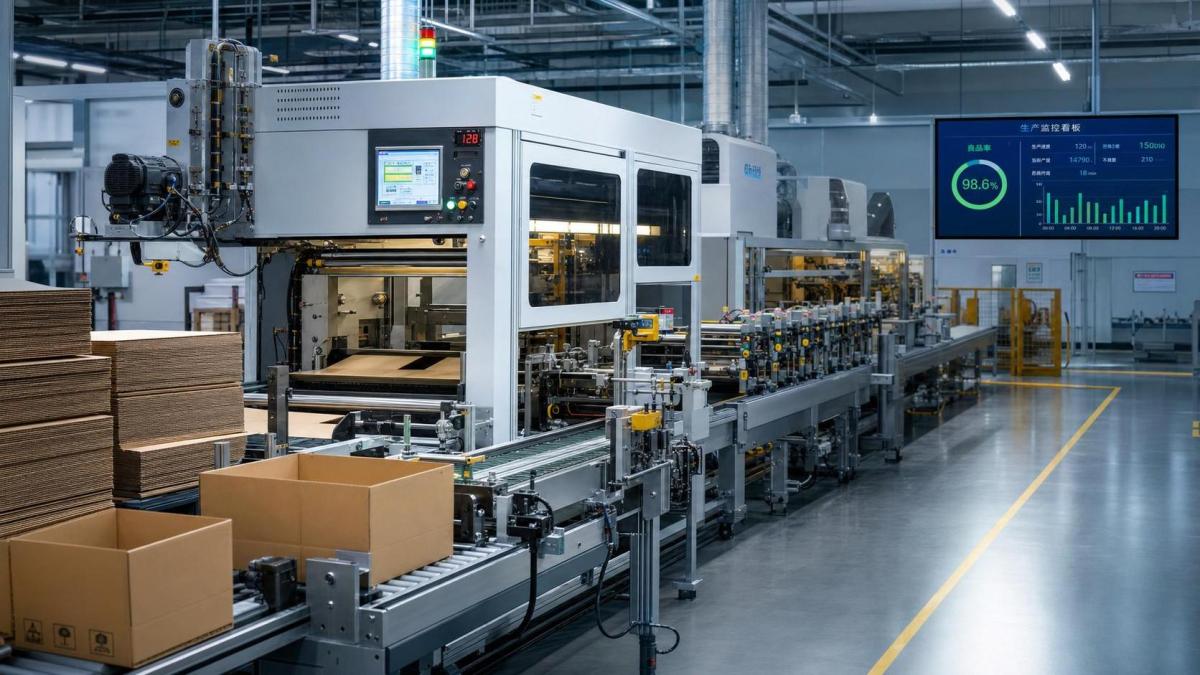
Demand volatility, shorter lead times, and tighter board specifications leave less room for hidden losses.
What used to be absorbed as normal trim, setup scrap, or unplanned stops is now a visible margin problem.
That is why line data matters.
When corrugation, printing, die-cutting, and gluing are measured as one connected flow, yield improves faster.
Waste becomes traceable to a cause, not just reported as a percentage.
Downtime also changes shape.
Instead of being treated as an unavoidable maintenance issue, it can be linked to moisture variation, registration drift, knife wear, glue behavior, or changeover discipline.
In packaging operations influenced by e-commerce growth, the pressure is even sharper.
Plants must deliver high volume and high mix at the same time, often under strict quality and traceability rules.
Seen in that context, industrial packaging intelligence for box plants is really about making physical production measurable enough to improve consistently.
What industrial packaging intelligence actually includes
The term sounds broad, but its practical meaning is specific.
It combines machine data, process context, operator actions, and business targets into a usable decision layer.
For box plants, that usually starts with three connected questions.
- Where is material being lost?
- Why is speed dropping below planned capacity?
- Which events are creating avoidable downtime?
A useful intelligence layer does not stop at dashboards.
It links board grades, flute profiles, steam balance, print registration, die pressure, glue application, maintenance logs, and order mix.
That is especially relevant in environments observed by PWFS, where corrugated lines, offset presses, and high-speed converting systems interact under tight tolerances.
A hundred-meter corrugator can create efficiency or create systemic waste.
A micron-level print issue can trigger downstream rejects.
A folder-gluer running fast with unstable feeding can turn apparent throughput into expensive rework.
Industrial packaging intelligence for box plants connects these events before they become monthly surprises.
Where yield is won or lost
Yield is often discussed as a top-line KPI, but it is built from small, repeated conditions.
Some are mechanical. Some are process-related. Many sit between departments.
At the corrugator
Warp, bonding inconsistency, moisture imbalance, and splice events can all reduce usable output.
If those events are only logged manually, patterns stay hidden.
When they are timestamped against speed, steam, paper grade, and order sequence, the loss map becomes much clearer.
At printing and converting
Registration drift, color mismatch, feeding instability, cracked scores, and glue misses are not isolated defects.
They usually reflect upstream variation or setup inconsistency.
That is why strong plants compare defect rates by order family, board structure, shift, and machine condition.
Across the schedule
Yield also changes with production sequencing.
Frequent grade changes, urgent inserts, and small-lot complexity can consume capacity even before production begins.
Industrial packaging intelligence for box plants helps separate unavoidable mix complexity from poor planning logic.
Waste is a process signal, not just a cost line
Scrap is usually measured in tons, sheets, or percentage of throughput.
That matters, but it is not enough.
Useful analysis asks what kind of waste is appearing, where, and under which operating conditions.
This is where industrial packaging intelligence for box plants becomes commercially useful.
It turns scrap from a monthly report into an engineering problem with traceable drivers.
That makes corrective action faster and investment decisions less speculative.
Downtime usually starts before the machine stops
Most lost time is reported after the event.
The better question is what changed beforehand.
On corrugated and converting lines, slow deterioration is common.
Temperature drift, vibration, glue viscosity, feeder alignment, blade wear, and dust accumulation can all reduce stability before alarms appear.
Plants that rely on static maintenance intervals often miss these early signals.
Plants that trend condition data against performance losses can schedule intervention closer to actual need.
This is one reason intelligence models are spreading beyond single machines.
PWFS tracks this broader shift across print, packaging, and woodworking systems.
The same logic applies whether the asset is a corrugator, an offset press, a die-cutter, or a CNC cell.
When process physics and operating data are read together, downtime becomes more predictable and less disruptive.
How to apply industrial packaging intelligence without overbuilding
A common mistake is starting with software architecture instead of production pain.
A stronger approach begins with a narrow operational target and expands from there.
- Choose one critical loss area, such as setup scrap or recurring feeder stops.
- Define a small set of trusted signals from machines, quality checks, and maintenance logs.
- Standardize downtime codes and defect categories before building reports.
- Compare planned conditions with actual run behavior by order family.
- Review findings weekly with production, maintenance, and quality together.
That cross-functional rhythm matters.
Many losses in box plants appear mechanical but are rooted in scheduling, substrate selection, artwork complexity, or setup discipline.
Industrial packaging intelligence for box plants works best when the data model reflects that operational reality.
What to evaluate next
The next step is rarely a full digital transformation program.
It is usually a sharper diagnosis of where value can be captured first.
Start by checking whether current reporting explains yield loss by cause, not just by department.
Then confirm whether downtime records distinguish chronic micro-stops from major failures.
Finally, review whether quality, maintenance, and production data can be aligned at order level.
If those basics are weak, adding more dashboards will not solve much.
If those basics are strong, industrial packaging intelligence for box plants can support better OEE, lower conversion cost, and more reliable delivery.
In practical terms, the most useful move is to build a fact base around one line, one loss pattern, and one measurable improvement cycle.
That creates the operating evidence needed for broader decisions across corrugated packaging systems and connected finishing assets.
Related News
Get weekly intelligence in your inbox.
No noise. No sponsored content. Pure intelligence.
