
Flexible Manufacturing for Mass Customization: How Furniture Plants Improve Output
Why Output Gains Depend on the Production Context
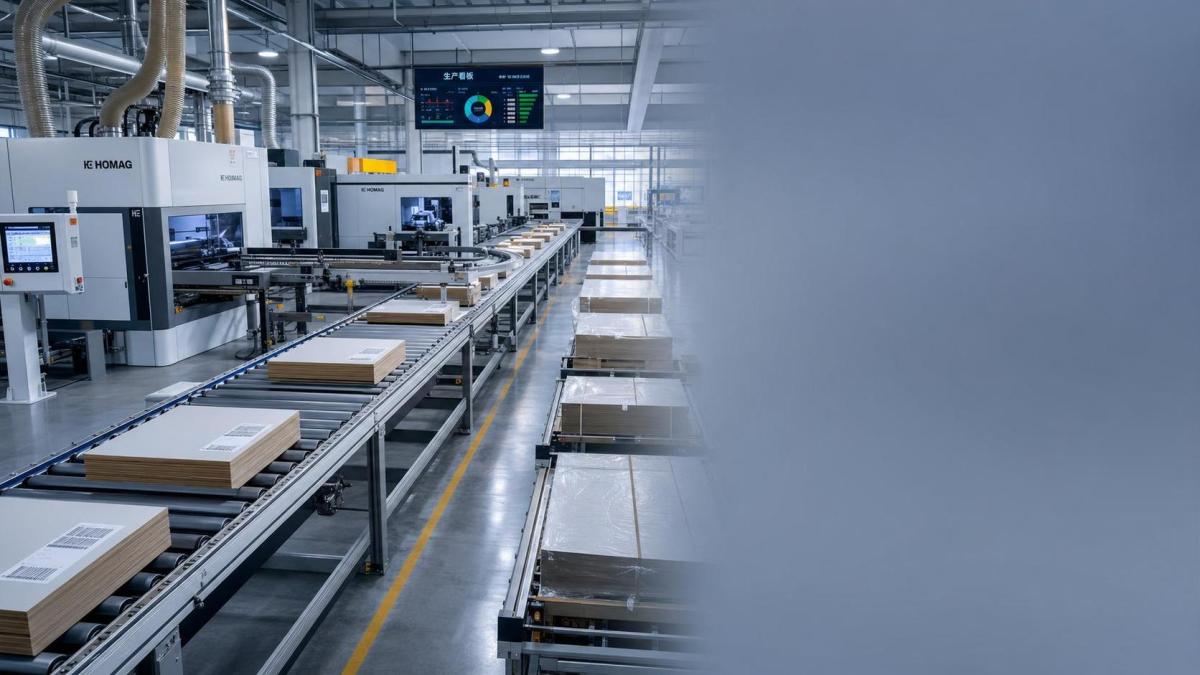
Furniture plants no longer compete on volume alone.
Order mix changes faster, delivery windows keep shrinking, and finish options multiply across the same product family.
That is why flexible manufacturing for mass customization has become a practical operating model, not a theory.
In real factory conditions, better output comes from handling variation without losing line rhythm.
A plant producing wardrobe panels faces different constraints than one building mixed kitchen, office, and retail fixtures.
The machines may look similar, yet the judgment points are not.
Flexible manufacturing for mass customization works best when CNC routing, edge banding, drilling, labeling, and scheduling are treated as one connected flow.
That broader view is central to PWFS coverage.
Its intelligence lens links woodworking automation with packaging, printing, and plant-level digital control.
The point is straightforward: output improves when each process understands the next one.
When Repetitive Orders Still Need Daily Variation
A common scenario is the semi-standard furniture program.
Cabinet dimensions stay within a narrow range, but colors, hole patterns, door styles, and hardware details shift every day.
Here, flexible manufacturing for mass customization should reduce changeover friction rather than chase extreme machine speed.
The useful question is whether the line can move from one valid variant to the next without manual resets.
Plants in this situation benefit from nesting software tied directly to order data.
Barcode-driven identification matters more than many expect, because panel mix-ups erase the gains made at the CNC router.
Edge banding also becomes a hidden bottleneck.
If the edgebander cannot handle frequent thickness and adhesive changes cleanly, customized flow turns into staged inventory.
In this setting, flexible manufacturing for mass customization is less about one advanced machine and more about synchronized handoff.
Whole-House Customization Brings a Different Pressure Pattern
Whole-house projects create a broader and less predictable mix.
A single order may include wardrobes, bathroom storage, TV walls, and decorative panels with different substrates.
This is where flexible manufacturing for mass customization becomes tightly linked to digital design quality.
If front-end CAD data is inconsistent, no amount of downstream automation will fully recover productivity.
The stronger plants usually validate drilling logic, grain direction, and edge treatment before production release.
That sounds basic, but it prevents rework loops that consume more capacity than cutting itself.
PWFS often frames this as a physical-to-digital continuity issue.
The same discipline that keeps micron-level print registration stable also matters in woodworking data flow.
Output rises when every panel arrives with correct instructions, not when teams simply run faster.
What changes from one factory profile to another
Different operating models need different definitions of flexibility.
The table matters because flexible manufacturing for mass customization is not judged by one universal KPI.
Some lines need faster setup recovery.
Others need fewer data errors, better packaging flow, or stronger material accountability.
Mixed Materials and Surface Demands Change the Rules
Not every customization challenge comes from design variety.
Sometimes the real issue is material behavior.
Melamine board, plywood, MDF, lacquered surfaces, and moisture-resistant panels do not react the same way during routing and edging.
Flexible manufacturing for mass customization must account for chip evacuation, spindle load, glue strategy, and finish sensitivity.
This is where many output projections become too optimistic.
A line may be technically automated, yet still slow down because tool changes rise sharply across mixed materials.
Prof. Lyra Sterling’s focus on kinematics and machining thermodynamics is relevant here.
Machine motion, heat, and debris removal directly affect cut quality and downstream assembly fit.
In practice, flexible manufacturing for mass customization needs a disciplined tool library and material-specific machining recipes.
- Assign default feeds and spindle speeds by board type, not by operator habit.
- Separate premium surface panels from rough-core panels in production logic.
- Match edgebanding adhesive choice to moisture, heat, and visual seam requirements.
- Track tool life against defect patterns, not only against elapsed cutting hours.
Packaging and Delivery Flow Can Limit Furniture Throughput
Output does not end at the last drilling operation.
In customized furniture, packing accuracy and carton availability often decide whether shipment targets are met.
This is one reason PWFS covers corrugated board lines, offset presses, and folder gluers alongside CNC woodworking systems.
Furniture plants with growing customization volumes increasingly need packaging to become flexible too.
Flat-pack components require carton dimensions that fit variable panel sets without wasting board or raising damage rates.
Printed labeling must also stay readable and traceable across short runs.
In that sense, flexible manufacturing for mass customization extends beyond woodworking.
It includes how packaging data, print control, and final logistics connect to the furniture line.
Plants that ignore this connection often improve machining output but still miss delivery performance.
Where Plants Misread Flexibility Before Investing
Several misjudgments appear repeatedly.
One is assuming flexible manufacturing for mass customization means buying the most complex CNC cell available.
If order release, labeling, and exception handling remain manual, the cell will wait for information.
Another is measuring only machine capacity while ignoring maintenance discipline.
Laser edging, PUR systems, dust extraction, and drilling accuracy all depend on stable upkeep.
There is also a compliance blind spot.
For export or branded retail programs, material traceability, emission standards, and packaging records can interrupt flow if not built into the process.
Dr. Alistair Vance’s compliance view is useful because it shows that quality documentation is part of throughput, not separate from it.
Checks worth making before expansion
- Confirm whether demand variation comes from dimensions, finishes, hardware, or delivery mix.
- Map where queues actually form between cutting, edging, drilling, packing, and dispatch.
- Review whether MES, CAD, and machine data share the same part logic.
- Estimate implementation labor, training time, and spare-part readiness.
- Test packaging flexibility alongside furniture flexibility.
A Practical Next Step for Better Output
Flexible manufacturing for mass customization improves output when the factory defines flexibility in operational terms.
That usually means identifying where variation enters, where it slows flow, and which digital links remove that friction.
For some plants, the next move is tighter CAD-to-CNC validation.
For others, it is edgebanding stability, smarter carton planning, or better scheduling across mixed materials.
PWFS provides useful perspective because it reads furniture production as part of a larger paper-and-wood system.
That wider manufacturing intelligence helps separate attractive equipment features from decisions that truly raise output.
Before any upgrade path is fixed, it is worth comparing actual order patterns, packaging needs, compliance demands, and maintenance limits against the line design.
That is usually where flexible manufacturing for mass customization starts delivering measurable results.
Related News
Get weekly intelligence in your inbox.
No noise. No sponsored content. Pure intelligence.
