How to Choose a Laser Edge Banding Machine with Pre Milling for Zero-Joint Panels
Choosing a laser edge banding machine with pre milling for zero-joint panels is a technical decision with visible and hidden consequences. It shapes edge appearance, bond stability, panel geometry, rework rates, and how reliably a line can support high-mix furniture production.
That matters more now because panel furniture is moving toward faster customization, cleaner finishes, and tighter process control. In the wider PWFS view of paper and wood industrial systems, edge banding sits at the final quality gate where machining precision becomes a finished living-space product.
Why zero-joint performance starts before the laser unit
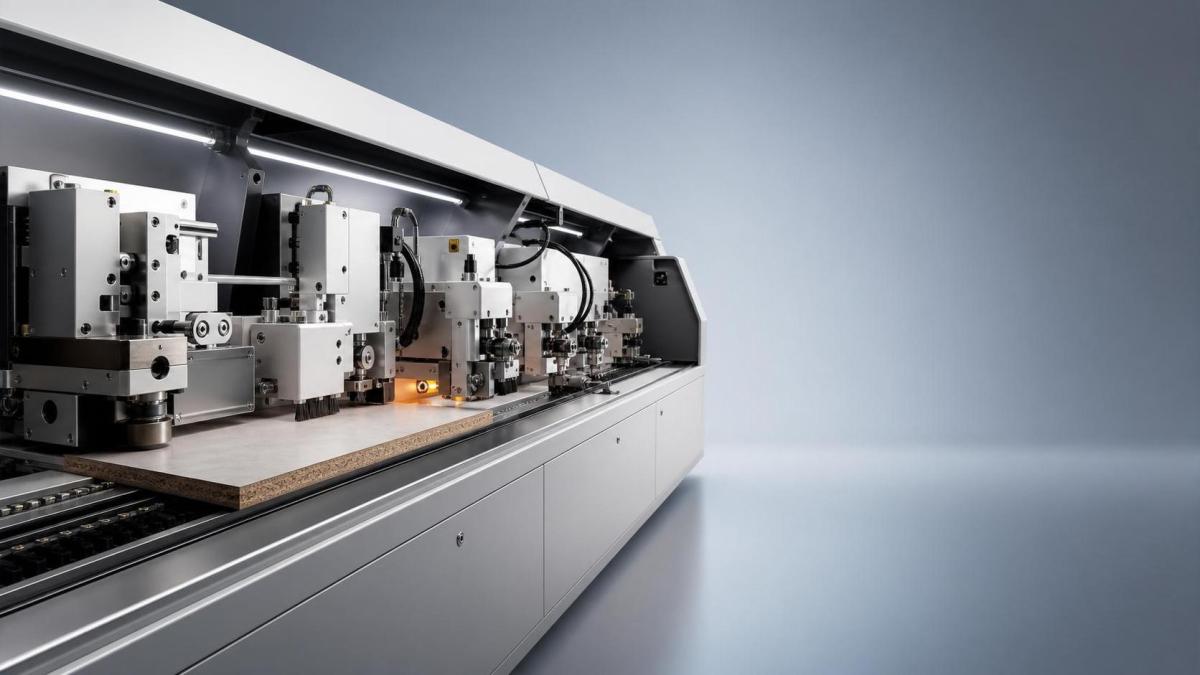
A zero-joint result is often described as a surface effect. In practice, it is a chain of conditions. The laser can only seal consistently when the panel edge is flat, square, and free from tear-out or density variation.
That is why pre milling deserves equal attention. A laser edge banding machine with pre milling removes minor saw marks, chipped fibers, and thickness irregularities before the edging strip meets the panel.
Without stable pre milling, the line may still run fast, but the edge can show weak fusion areas, gloss variation, or visible micro gaps. For decorative panels, those defects become obvious under showroom lighting.
In other words, the machine should be judged as a process platform, not as a laser module with extra stations attached.
What a laser edge banding machine with pre milling actually needs to do
At a basic level, the system must prepare the substrate, activate the functional layer of the edging material, press it evenly, and finish the edge without damaging the panel surface.
That sounds straightforward, but material combinations change the difficulty. MDF, particleboard, plywood, honeycomb panels, and moisture-resistant boards behave differently during cutting and heating.
The same applies to edge materials. ABS, PP, acrylic, and laser-ready coextruded tapes do not respond identically to energy input, pressure, or cooling time.
A capable laser edge banding machine with pre milling therefore needs strong control across five linked stages:
- accurate edge preparation before bonding;
- stable laser energy delivery across different feed speeds;
- precise pressure from the pressing section;
- clean trimming, scraping, and buffing;
- repeatable setup logic for frequent order changes.
If one stage drifts, the zero-joint promise weakens quickly, even when the machine specification sheet looks impressive.
The parameters worth checking first
A useful comparison starts with process stability, not headline speed. Nominal meters per minute matter, but only after confirming whether that speed is sustainable with acceptable finish quality.
Pre-milling assembly
Look for spindle power, cutter diameter, adjustment accuracy, and vibration behavior. The question is not only how much material can be removed, but how smoothly the edge remains after correction.
Tool life and chip evacuation also matter. Dust left near the bonding zone can interfere with laser activation and pressure contact.
Laser source and energy control
Check whether the system uses diode, fiber-coupled, or another industrial laser configuration. More important is whether power modulation stays stable when feed speed, edge color, and tape thickness change.
Dark colors, reflective finishes, and thick edging can create different heating behavior. A machine that handles only ideal samples will struggle on production schedules.
Pressure and alignment
Press rollers must maintain even contact along the full panel length. Watch for corner performance, narrow parts, and long panels that can reveal alignment errors.
Finishing units
A good zero-joint line can still be undermined by weak end trimming, scraping, or buffing. The finished edge should stay clean without whitening, chatter marks, or gloss mismatch.
Material compatibility is often the real separator
Many comparisons focus on machine architecture, but production reality is defined by material range. A laser edge banding machine with pre milling should be tested on the panel and edging combinations that actually drive order volume.
This includes low-density core boards, high-gloss surfaces, super-matte decors, moisture-resistant panels, and narrow components with short edge lengths. Each case stresses control differently.
For example, lightweight boards may require gentler pressure and very clean pre-milling geometry. Thick acrylic edging may demand more stable heat input and better post-processing.
PWFS often frames machinery through the lens of flexible manufacturing. In that context, compatibility is not a side note. It is the difference between a machine that looks advanced and one that actually supports mixed-batch production.
Automation, data, and line integration deserve closer attention
A modern edge bander is increasingly part of a digital cell. It should exchange job data with upstream cutting, drilling, or MES systems, especially where whole-house customization drives rapid order switching.
Recipe management is especially valuable. If operators must manually rebuild settings for every decor or edge thickness, the machine loses much of its theoretical productivity.
Useful control features include:
- stored parameter sets for panel and edging combinations;
- alarm history tied to specific process stations;
- predictive maintenance prompts for cutters, rollers, and filters;
- remote diagnostics for troubleshooting process drift;
- traceable production records for repeatability checks.
These functions are not cosmetic software additions. They help stabilize yield when panel diversity, labor variability, and delivery pressure rise together.
How to compare options in a realistic test
Factory demos can be misleading when they use ideal boards, fresh tools, and limited sample sizes. A better evaluation uses the actual panel structures, edging tapes, and cycle conditions expected in production.
Ask for tests across multiple feed speeds rather than one polished result. Check edge appearance immediately, then again after cooling, handling, and light impact.
It is also worth inspecting the panel before and after pre milling. Small differences in edge straightness often explain larger differences in zero-joint quality later.
A practical comparison matrix usually includes these checkpoints:
- finish consistency across different colors and textures;
- corner integrity on short and narrow parts;
- changeover time between edge thicknesses and decors;
- dust control around the pre-milling and bonding zones;
- energy use, maintenance intervals, and consumable demand;
- operator workload during a multi-order shift.
Where the business case becomes clearer
The value of a laser edge banding machine with pre milling is not only in premium visual appeal. It can reduce manual touch-up, scrap from poor edge preparation, and quality disputes on visible furniture parts.
In bathroom, kitchen, wardrobe, and retail fixture applications, the cleaner edge also supports moisture resistance and easier surface hygiene. For export-oriented producers, finish consistency can matter as much as cycle time.
This fits the broader PWFS perspective on intelligent print and woodworking systems. Final product competitiveness increasingly depends on how well each machine station contributes to repeatable, low-waste, digitally coordinated manufacturing.
That is why a lower purchase price can become expensive if it brings unstable pre milling, limited material flexibility, or weak diagnostics.
A practical next step for selection
Start with a short list built around actual panel categories, edge materials, target feed rates, and required finish grades. Then compare each laser edge banding machine with pre milling against those conditions, not against catalog language.
It helps to score machines on pre-milling quality, laser stability, changeover logic, finishing accuracy, and data integration. Those five dimensions usually reveal the difference between a good demonstration and a dependable production asset.
From there, the decision becomes more disciplined: validate with real materials, review long-run consistency, and confirm how the machine fits the broader digital workflow. That approach gives zero-joint panels a stronger technical foundation and makes the investment easier to defend.
Related News
Get weekly intelligence in your inbox.
No noise. No sponsored content. Pure intelligence.
