
Corrugated Packaging Board Grades Explained: How to Compare Strength and Use Cases
Choosing among corrugated packaging board grades is rarely a simple paper selection exercise. It shapes box strength, stacking reliability, print appearance, machine speed, and the total economics of converting and distribution.
That is why this topic matters across packaging, printing, and logistics. A board that looks adequate on paper may still underperform once humidity, pallet load, die-cut complexity, or long transport cycles enter the picture.
For operations tied to corrugated board lines, offset presses, folder-gluers, and die-cutters, board grade decisions also affect runnability. In practice, the right specification protects both the box and the production line.
What corrugated packaging board grades actually describe
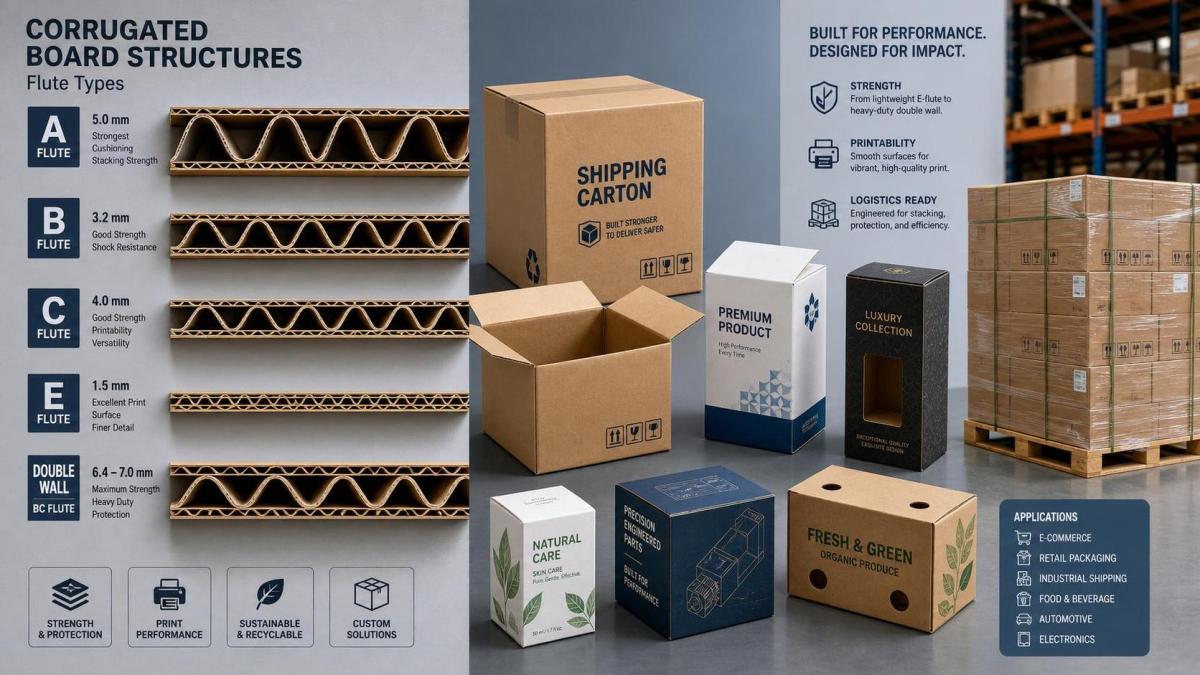
At a basic level, corrugated packaging board grades define how a board is built and how it is expected to perform. The grade reflects liner quality, medium construction, flute profile, board combination, and strength targets.
Many buyers initially focus on thickness. Thickness matters, but it is only one part of the comparison. Two boards with similar caliper can behave very differently under vertical load, impact, or repeated handling.
A useful way to read corrugated packaging board grades is to separate structure from performance. Structure tells you what the board is. Performance tells you what it can survive.
This distinction becomes more important in high-volume packaging environments. A board grade that runs cleanly through die-cutting and folding may still be wrong if warehouse compression or e-commerce abuse exceeds its limit.
The strength metrics that deserve close attention
Several test values appear in specifications, but they do not answer the same question. Good comparison starts with understanding which metric matches the real failure risk.
Edge crush and box compression
ECT measures how much force a board edge can take before it collapses. It is closely tied to stacking performance, which is why it matters for shipping cases and warehouse storage.
If the box must survive pallet loads, long dwell times, or multi-layer stacking, ECT usually deserves more attention than simple burst numbers.
Burst strength
Burst strength indicates resistance to rupture from pressure applied to the board surface. It still has value, especially for rough handling, but it does not directly predict stacking behavior.
That is why older burst-based buying habits can mislead modern distribution planning. E-commerce packaging often fails by compression and corner fatigue before it fails by puncture.
Flat crush, puncture, and stiffness
Flat crush helps indicate flute resilience. This matters when boards move through printing nips, die-cutters, and folder-gluers at high speed.
Puncture resistance becomes relevant for heavy or irregular contents. Bending stiffness matters when packs need shelf presence, cleaner graphics, or better panel flatness.
Why flute profile changes the comparison
Corrugated packaging board grades are also shaped by flute choice. A, B, C, E, and combinations such as BC or EB change cushioning, thickness, print surface, and converting behavior.
C flute remains a common balance between protection and material efficiency. B flute often supports better crush resistance and sharper die-cutting. E flute favors finer graphics and compact retail packaging.
Double-wall formats such as BC or EB are selected when one wall is not enough. They are common in heavier distribution loads, export packaging, and packs exposed to longer handling chains.
From a PWFS perspective, flute selection should never be isolated from line capability. Steam control, bonding consistency, print registration, and folding geometry all interact with the board construction chosen upstream.
Where grade selection creates business value
The value of comparing corrugated packaging board grades properly is not limited to avoiding damage claims. It influences machine efficiency, material use, visual quality, and supply chain stability.
In e-commerce shipping, the board must absorb drops, conveyor friction, and stacking cycles without wasting fiber. Over-specifying the board adds cost and freight weight. Under-specifying it creates failure downstream.
In offset-laminated or flexo-printed packs, smoother liners and stable flute structure support better color results. Print quality is not just an artwork issue. Board consistency directly affects visual registration and finishing accuracy.
For high-speed die-cutting and folder-gluing, board grade can determine whether the plant sees clean creasing or persistent cracking, warp, feeding instability, and glue line variation.
Typical use cases and sensible board choices
The most useful comparison happens when board grades are mapped to actual distribution conditions rather than abstract quality labels.
These pairings are not universal rules. Product geometry, fill weight, warehouse climate, and retailer requirements can easily shift the preferred answer.
Common mistakes when comparing corrugated packaging board grades
Several mistakes appear repeatedly in board evaluation. Most come from reading specifications without connecting them to the actual handling environment.
- Treating grammage as a direct proxy for performance.
- Comparing only price per sheet instead of cost per delivered, undamaged pack.
- Ignoring humidity exposure and storage duration.
- Assuming print-heavy cartons and transit-heavy cartons need the same board logic.
- Selecting a grade that passes lab tests but creates converting losses on press or gluer lines.
A more reliable comparison asks how the board performs through the full chain: corrugation, printing, die-cutting, folding, shipping, storage, and final presentation.
A practical framework for better evaluation
When narrowing corrugated packaging board grades, it helps to build a short decision matrix rather than rely on one headline number.
Start with the load case. Define pack weight, stacking height, transport duration, and climate variation. Then review print expectations, die-cut complexity, and line speed.
Next, compare at least two board options under the same converting conditions. Lab data is useful, but trial performance often reveals warp, cracking, feeding issues, or glue response that the sheet spec hides.
It is also worth checking compliance context. For food, consumer goods, and export applications, liner source, traceability, and material consistency can carry as much weight as raw strength values.
This is where intelligence-led evaluation becomes valuable. Looking across board lines, print systems, and converting equipment creates a better answer than reviewing paper data in isolation.
What to examine next
A strong board decision usually comes from tighter questions, not broader ones. Review which failure mode matters most, which machine constraint is least forgiving, and which cost driver is truly material.
Then compare corrugated packaging board grades against real operating data: compression retention, waste rate, print stability, and field damage frequency. That turns a grade chart into a useful packaging standard.
For teams working across corrugation, printing, and converting, the next step is to align board choice with line capability and end-use evidence. That is usually where the best performance gains are found.
Related News
Get weekly intelligence in your inbox.
No noise. No sponsored content. Pure intelligence.
