Laser Edge Banding Technology Explained: How It Works and Where It Fits Best
Laser edge banding technology is attracting more attention because it solves a problem that panel furniture makers have long accepted as a compromise: exposed edges are both a visual weak point and a functional risk. In CNC woodworking workflows, the cut itself may be precise, but the finishing stage determines whether the panel looks premium, resists moisture, and meets modern environmental expectations. For technical evaluation, laser edge banding technology stands out because it links speed, seam quality, and process stability in one step.
Why the finishing stage now matters more
In the broader PWFS landscape, the logic is familiar. Corrugated board lines protect goods in transit, offset presses shape visual appeal, die-cutters and folder-gluers convert sheets into structures, and CNC routers define furniture parts with digital precision. Edge banding plays the same role on the woodworking side that sealing and registration play in packaging: it turns a processed substrate into a finished product that can withstand use, transport, and inspection.
That is why laser edge banding technology is no longer viewed as a niche upgrade. It has become a practical answer for factories that want cleaner seams, less dependence on visible glue lines, and a more consistent result across high-volume runs. In markets where whole-house customization and short lead times coexist, finishing quality can influence both rejection rates and brand perception.
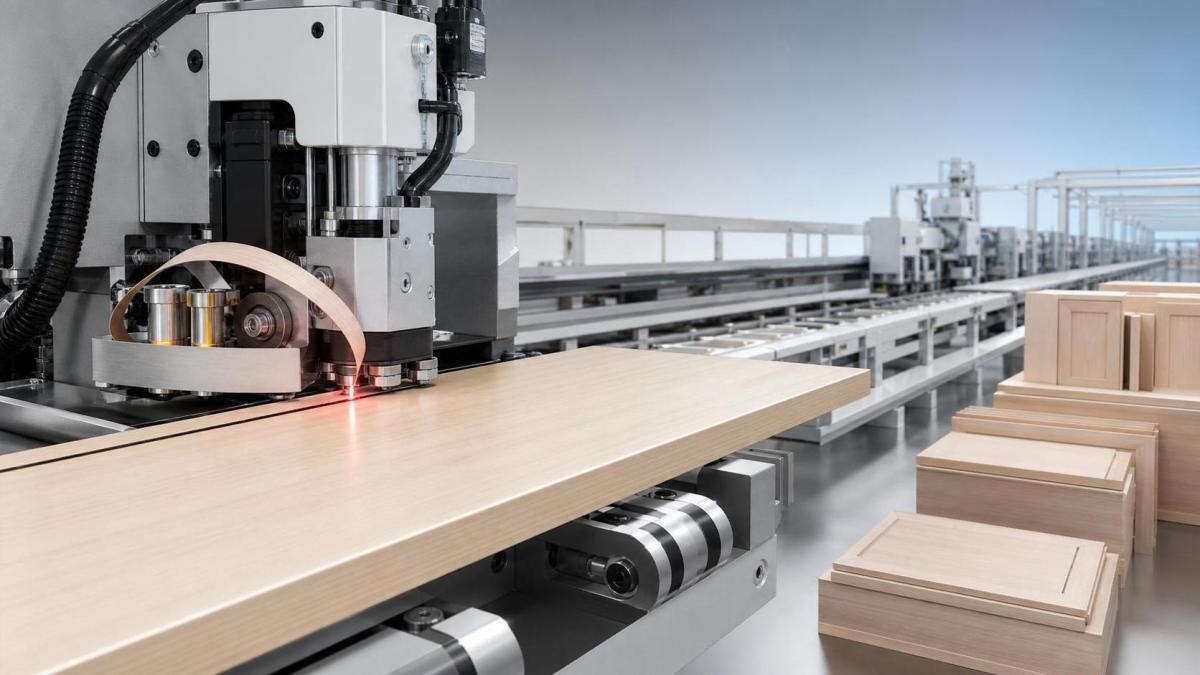
A typical system uses a laser-activated functional layer on the edge band. When the band passes the machine head, the laser heats this layer and activates the bonding surface. The band is then pressed onto the panel edge under controlled pressure, so the adhesive effect is created almost instantly. The result is a tight, narrow joint with very little visible glue residue.
Compared with traditional hot-melt methods, the difference is not just cosmetic. The process can reduce open glue lines, improve moisture resistance, and support a more refined surface feel. In practice, that matters for cabinets, wardrobes, office furniture, and other panels that are expected to look clean from close range, not only from a distance.
How laser edge banding technology works in practice
The process begins with a precisely machined panel edge. Any tear-out, dust, or dimensional error can weaken the final bond, so upstream cutting quality still matters. Once the edge is prepared, the band is guided into place, the laser activates the bonding layer, and the pressing section closes the seam before the material cools.
This is where laser edge banding technology differs from conventional glue-based lines. It reduces the window between activation and fixing, which helps maintain alignment on high-speed equipment. It also removes part of the variability caused by glue temperature, pot condition, or operator adjustment. For plants already using MES-connected workflows, that stability is especially valuable.
Where laser edge banding technology fits best
The strongest fit is usually in panel furniture lines that demand repeatable quality at scale. Cabinet doors, wardrobe panels, vanity units, and commercial interior elements benefit because edge visibility is high and touch points are frequent. In these products, a neat seam is not a luxury; it is part of the purchase decision.
It also fits well where automation is already mature. If upstream CNC routing, drilling, and sorting are linked to a stable digital process, laser edge banding technology can be inserted as a finishing station that preserves throughput. That makes it attractive for factories trying to reduce manual rework and standardize output across multiple product families.
A less obvious but important use case is premium customization. Many projects now ask for visible surfaces with minimal tolerance for defects. In that environment, the technology supports the same design logic seen in high-end packaging: the closer the finish is to a seamless edge, the stronger the perception of quality.
Situations where it is less persuasive
Laser edge banding technology is not automatically the best choice for every line. If the product mix is unstable, panel preparation is inconsistent, or the plant cannot maintain precise machine setup, the gains can be diluted quickly. In lower-value applications, a simpler adhesive process may still offer a better cost-to-benefit balance.
That is why the decision should be based on workload, not on novelty. The right question is not whether the technology sounds advanced, but whether it improves yield, appearance, and lifecycle performance enough to justify the operating model.
What to check before adoption
A useful evaluation starts with panel material, edge band specification, and target output. The laser layer must match the band structure, and the machine must maintain stable power, feed speed, and pressing pressure. Without that alignment, even advanced laser edge banding technology can produce uneven seams or inconsistent bonding.
- Check whether the substrate and edge band are compatible under real production speed.
- Verify that corner quality remains stable after trimming and post-processing.
- Assess energy use, maintenance access, and operator learning curve.
- Compare the finish against current customer and compliance requirements.
In the PWFS context, this kind of check is similar to evaluating print registration or die-cut accuracy. The best technology is the one that fits the line architecture, the product mix, and the quality target together. Laser edge banding technology earns its place when it improves the whole workflow, not only the final appearance.
A practical way to think about the decision
For technical review, the decision usually comes down to three questions. Does the finishing quality support the product positioning? Can the line sustain the speed and consistency needed by the factory? And does the process reduce hidden costs such as glue cleanup, rework, or customer complaints?
If the answer is yes across most of those points, laser edge banding technology is more than a finishing option. It becomes part of the competitiveness of the woodworking system itself, much like accurate color registration matters in printing or precise corrugation matters in packaging.
The next step is usually a line-level comparison: test edge quality, monitor cycle stability, and measure whether the technology aligns with the product mix you actually run. That is the clearest way to judge where laser edge banding technology fits best, and whether it belongs in a high-volume automated future or only in selected premium lines.
Related News
Get weekly intelligence in your inbox.
No noise. No sponsored content. Pure intelligence.
