
Corrugated Box Production Lines: Main Line Configurations and Output Factors
Corrugated Box Production Lines: What actually drives output?
Corrugated box production lines sit at the center of packaging capacity planning. They decide how fast board is formed, how stable quality stays, and how much downtime a plant can tolerate.
For teams comparing corrugated box production lines, the real question is not only speed. It is whether the line can hold strength, recover from changeovers, and match demand without creating hidden waste.
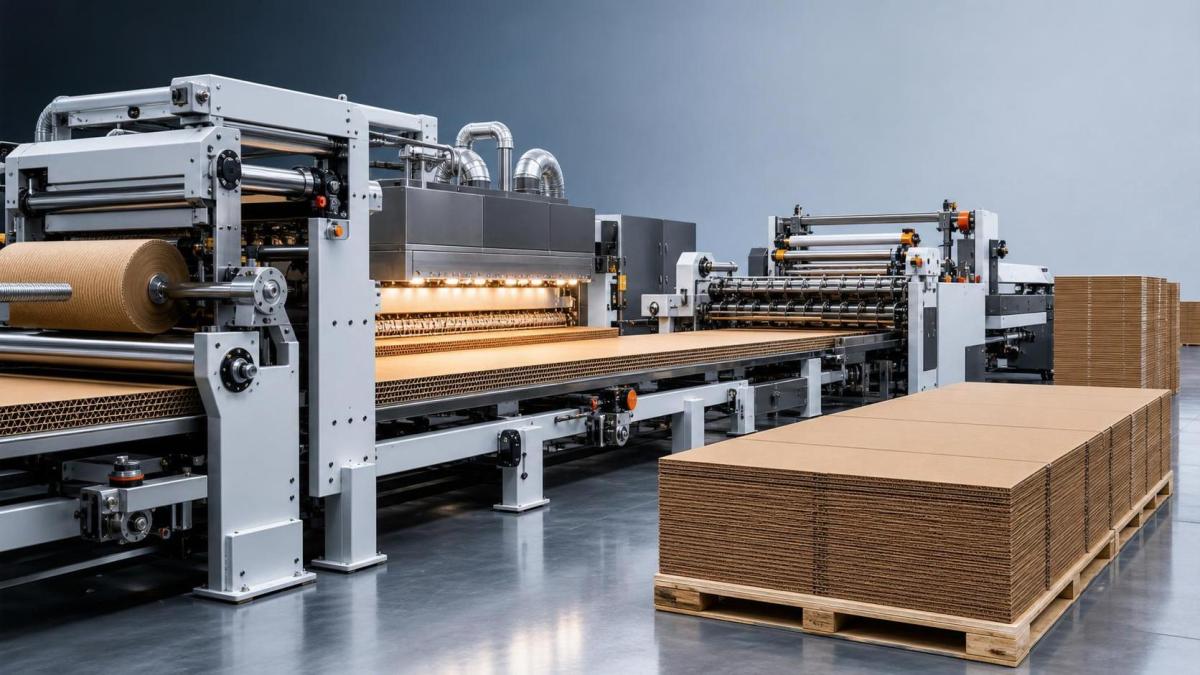
PWFS often treats this topic as part of a broader industrial system. Corrugated board lines, offset presses, die-cutters, folder-gluers, and CNC equipment all share the same logic: throughput rises only when process control, automation, and maintenance move together.
Which main line configurations are most common?
The most common setups start with single-face lines, then move toward double-wall or triple-wall configurations. Each one serves a different balance of cost, strength, and output.
A single-face line is usually chosen for lighter packaging and faster setup. Double-wall lines are preferred when compression resistance matters more, especially for logistics and long-haul shipping. Triple-wall systems are less common, but they appear where heavy products or harsh handling conditions demand extra stiffness.
Fully automated high-speed lines add another layer. They connect paper feeding, heating, corrugating, slitting, cutting, stacking, and data monitoring into one coordinated flow. That does not automatically mean better results, but it does improve consistency when demand is stable and maintenance is disciplined.
In practice, line choice often depends on whether the plant is serving e-commerce boxes, industrial cartons, or mixed-format packaging. The more variable the orders, the more important flexible conversion becomes.
A quick comparison table
This table is a practical shortcut when evaluating corrugated box production lines for a new build or upgrade.
Why does raw material quality change the final output so much?
Because corrugated board is a formed structure, not just a paper product. Base paper weight, fiber quality, moisture balance, and liner consistency all affect board strength and run stability.
If the paper web varies too much, the line may still run, but compression resistance and edge quality can drift. That creates a familiar problem: output volume looks acceptable, yet the finished cartons fail during stacking or transport.
This is why material inspection should be tied to line planning. In more advanced corrugated box production lines, operators track not only paper grade but also reel condition, moisture balance, and glue absorption. Those details are easy to overlook, but they shape real capacity.
PWFS readers often see the same pattern across print and board systems: the line is only as stable as the input stream. When the raw material window is narrow, the entire process becomes easier to scale.
How do steam, speed, and maintenance affect daily output?
Steam control is one of the most underestimated factors. Too little heat weakens flute formation and bonding. Too much heat can distort paper behavior and raise waste.
Line speed matters, but only within a stable process window. A faster line with frequent stoppages usually produces less usable board than a slightly slower line that runs steadily all shift.
Maintenance is the quiet multiplier. Rollers, bearings, sensors, knives, and glue systems need planned attention before failure appears. Once a line is forced into reactive repair, output losses spread across the whole schedule.
A practical rule is simple: if a plant cannot predict its stop points, it cannot predict its real daily output. That is why uptime is often a better decision metric than nominal speed.
What should be checked before choosing a configuration?
The safest approach is to compare the line against actual demand, not against catalog speed. The checklist below is useful when evaluating corrugated box production lines for a new project or expansion.
- Expected box types and board grades
- Required hourly output versus peak demand
- Steam stability and utility capacity
- Spare parts access and maintenance rhythm
- Changeover frequency and operator skill level
- Data integration with MES or production tracking
Where do projects usually misjudge cost and capacity?
One common mistake is treating nominal speed as the same as usable output. Another is underestimating how much downtime comes from paper variation, glue instability, and startup losses.
Cost is also broader than equipment price. It includes energy use, waste rate, labor intensity, spare parts, and the risk of missed delivery windows. In corrugated box production lines, a cheaper setup can become expensive if it cannot handle real order patterns.
This is where the broader PWFS perspective is useful. The same discipline applied to offset presses or folder-gluers applies here too: stable registration, controlled motion, and predictable changeovers usually matter more than one headline number.
The best projects build capacity around evidence, not optimism. That means testing materials, reviewing utility limits, and mapping maintenance before finalizing the line.
What does a practical decision path look like?
Start with the packaging mix, then match it to the line structure. After that, check whether the plant can support the steam, power, and maintenance requirements without strain.
If the workload is stable and large, a highly automated line can make sense. If the product mix changes often, flexibility may be more valuable than top speed. That is usually the decisive point in corrugated box production lines.
A final review should include quality targets, uptime expectations, and expansion room. Those three items often reveal whether the line is sized for today only, or for the next phase of demand as well.
So what should be done next?
The most useful next step is to define the actual box types, target output, and acceptable downtime window. Once those are clear, corrugated box production lines become much easier to compare on equal terms.
From there, evaluate raw material quality, steam behavior, line speed, and maintenance planning together. That combination gives a far better picture of real capacity than any single specification sheet.
When the decision is grounded in process reality, the line is more likely to deliver stable output, better board strength, and a smoother path to scaling.
Related News
Get weekly intelligence in your inbox.
No noise. No sponsored content. Pure intelligence.
