
Common Causes of Waste in Corrugated Box Manufacturing and How to Reduce Them
Why waste in corrugated box manufacturing starts before the line runs
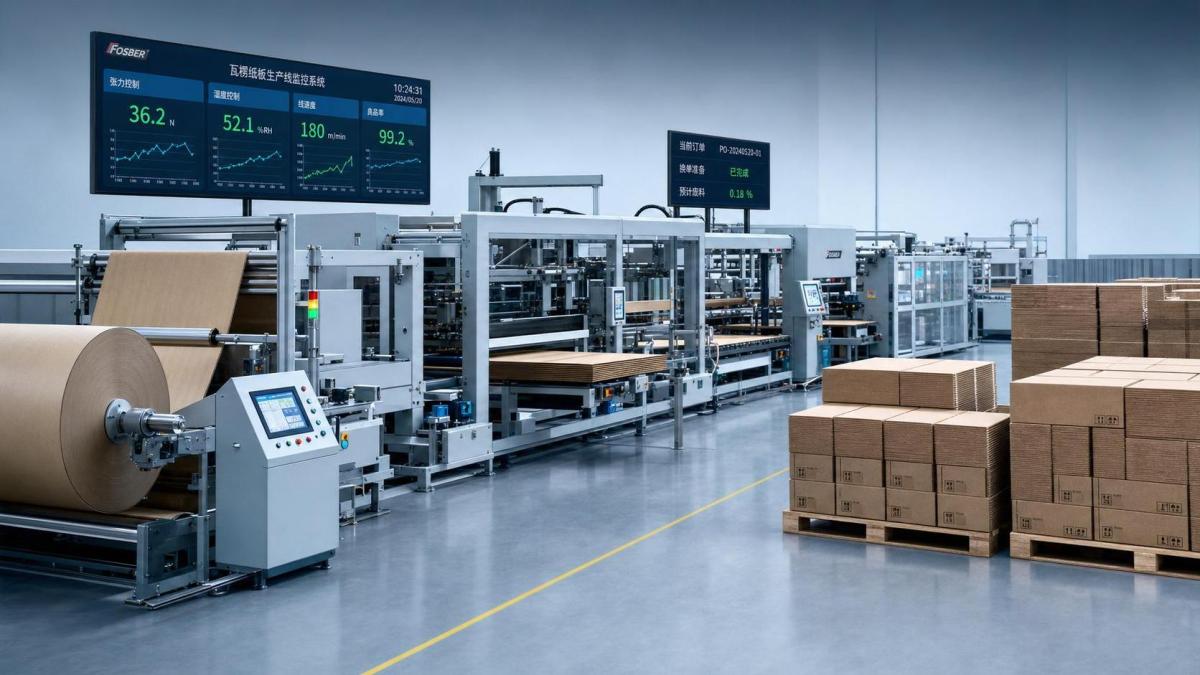
In corrugated box manufacturing, waste rarely begins with an obvious crash, jam, or print defect.
It usually grows from small upstream decisions.
Paper stored in unstable humidity, rushed job changeovers, weak flute matching, and loose process discipline all create avoidable loss.
By the time scrap appears, cost has already spread across board, ink, glue, labor, energy, and delivery risk.
That is why corrugated box manufacturing needs to be judged as a connected system, not as isolated machines.
This broader view matters even more in today’s packaging environment.
E-commerce shipping boxes demand speed and board consistency.
Retail-ready cartons require tighter print and converting control.
PWFS often frames this through linked production intelligence, where corrugated lines, offset printing, die-cutting, and gluing affect one another.
When one section drifts, waste often appears somewhere else first.
Different production settings create different waste patterns
Not every plant loses material for the same reason.
A high-volume shipper box line and a short-run printed carton line can report similar scrap rates, yet the root causes differ.
In practical terms, the first question is not how much waste exists.
The better question is where the waste enters the process.
On fast corrugated board lines, moisture balance, paper tension, and bonding stability are usually the first checkpoints.
On printed box work, registration, die-cut accuracy, and sheet handling often decide yield.
Plants handling mixed orders need stronger changeover discipline because setup loss can exceed defect loss.
This is where corrugated box manufacturing becomes less about one ideal standard and more about matching controls to the real operating scene.
Where judgment points shift by production model
On corrugated board lines, material handling is often the first hidden loss
Many waste problems in corrugated box manufacturing begin before paper reaches the single facer.
Damaged roll edges, uneven moisture, and poor FIFO practice create defects that no downstream adjustment fully removes.
This is common in facilities balancing imported paper, local substitutes, and fluctuating warehouse climates.
The result may appear later as washboarding, warp, cracked liners, or weak crush strength.
A more reliable approach is to treat reel condition as a quality variable, not a logistics detail.
Track roll acclimatization time, edge integrity, and moisture spread before release to production.
Where line speeds are high, splice quality also deserves closer review.
A weak splice can trigger sudden tension changes, web breaks, and a chain of scrap that far exceeds its apparent size.
Practical controls that reduce upstream board loss
- Separate storage rules for kraft, testliner, and specialty papers with different moisture sensitivity.
- Inspect roll edges and core condition before loading, not after defects appear.
- Define acceptable acclimation windows when seasonal humidity shifts are large.
- Review splice failure incidents together with speed, tension, and operator timing records.
When setup drifts, corrugated box manufacturing loses yield faster than expected
Machine settings are an obvious source of waste, but the real issue is often inconsistency between jobs.
Plants may have capable corrugators, printers, and folder-gluers, yet still lose board during every reset.
In longer runs, this may remain hidden.
In shorter and more customized work, setup scrap becomes a major cost center.
More frequent e-commerce promotions and versioned packaging make this especially relevant.
Settings for heat, pressure, glue gap, slot depth, print registration, and folding alignment should not live only in operator memory.
PWFS often highlights this transition from skill-based recovery to data-based repeatability.
Recipe management and MES-linked job history help reduce trial sheets and shorten stabilization time.
A useful difference between similar jobs
Two box orders can share dimensions yet require different settings.
A plain shipping case tolerates small visual variation.
A printed display-ready carton does not.
Treating them as identical often causes overcorrection, wasted setup time, or unnecessary rejects.
Printed and converted boxes need tighter coordination than many lines assume
Waste in corrugated box manufacturing often appears in the printing or converting area, even when the board problem started earlier.
That is why print quality and structural quality should be reviewed together.
A sheet with slight caliper variation may still pass board inspection.
Later, it can trigger uneven ink transfer, registration drift, die-cut pressure imbalance, or folding stress cracks.
In practical operations, the handoff between offset or flexo printing and die-cutting is a common weak point.
Micron-level registration goals are meaningless if sheet flatness is unstable.
Likewise, a perfect print file cannot protect yield if rule wear or anvil condition is ignored.
This is why reduction plans should combine board, print, and converting data rather than assigning blame by department.
Common misjudgments usually come from treating similar conditions as identical
One frequent mistake is focusing only on raw scrap percentage.
Low visible scrap can hide repeated speed reductions, manual sorting, or customer-side failure risk.
Another mistake is judging corrugated box manufacturing only by machine capability sheets.
Rated speed means little if steam stability, paper grade variation, and tooling maintenance are uncontrolled.
There is also a common tendency to separate purchasing cost from operating waste.
Lower-cost paper, glue, or tooling may be reasonable in one application.
In another, it drives more downtime, more setup sheets, and more rejects than the initial savings justify.
- Do not assume all B-flute or C-flute jobs behave the same under changing humidity.
- Do not review print waste without checking board flatness and feeder behavior.
- Do not shorten maintenance windows when line speed and order complexity are rising.
- Do not treat operator correction as a substitute for process stability.
A better reduction plan links process control, maintenance, and production intelligence
The most effective waste reduction in corrugated box manufacturing usually comes from coordinated improvements, not one dramatic upgrade.
Start with loss mapping by stage.
Separate waste from material handling, setup, running defects, and converting mismatch.
Then compare those losses against order mix and actual machine conditions.
Where operations are becoming more digital, recipe control, sensor feedback, and MES reporting can tighten repeatability.
Where lines are older, consistent maintenance discipline often delivers faster returns than chasing headline automation.
PWFS follows this industrial logic closely across corrugated board lines, offset presses, and folder-gluer systems.
The key idea is simple.
Yield improves when process physics, machine behavior, and production data are read together.
Next actions worth taking on the shop floor
- Map the top three scrap sources by process stage, not only by final defect code.
- Review whether setup recipes reflect current paper grades, speeds, and tooling wear.
- Check if warehouse, corrugator, printing, and converting teams share the same quality signals.
- Measure hidden waste, including slowed runs, extra handling, and repeated adjustments.
- Build a scenario-based standard for shipping boxes, printed cartons, and mixed-SKU orders separately.
In the end, reducing waste in corrugated box manufacturing is less about one perfect machine setting.
It is about judging each production scene correctly, then aligning material, process, and control methods to that reality.
That is usually where lower scrap, steadier output, and stronger delivery performance begin.
Related News
Get weekly intelligence in your inbox.
No noise. No sponsored content. Pure intelligence.
