
How to Choose Precision Woodworking Tools for Furniture Parts and Fine Joinery
Choosing precision woodworking tools for furniture parts and fine joinery is less about buying the sharpest cutter and more about controlling the entire cutting result. Surface finish, hole position, edge quality, joint fit, and machine uptime all depend on how well the tool matches the material, spindle, program, and production rhythm.
That matters even more now. Furniture production is moving toward shorter batches, tighter tolerances, and faster CNC-driven customization. In the broader PWFS view of digital print and woodworking systems, the same industrial logic applies everywhere: precision is valuable only when it stays repeatable at speed.
What precision really means in furniture tooling
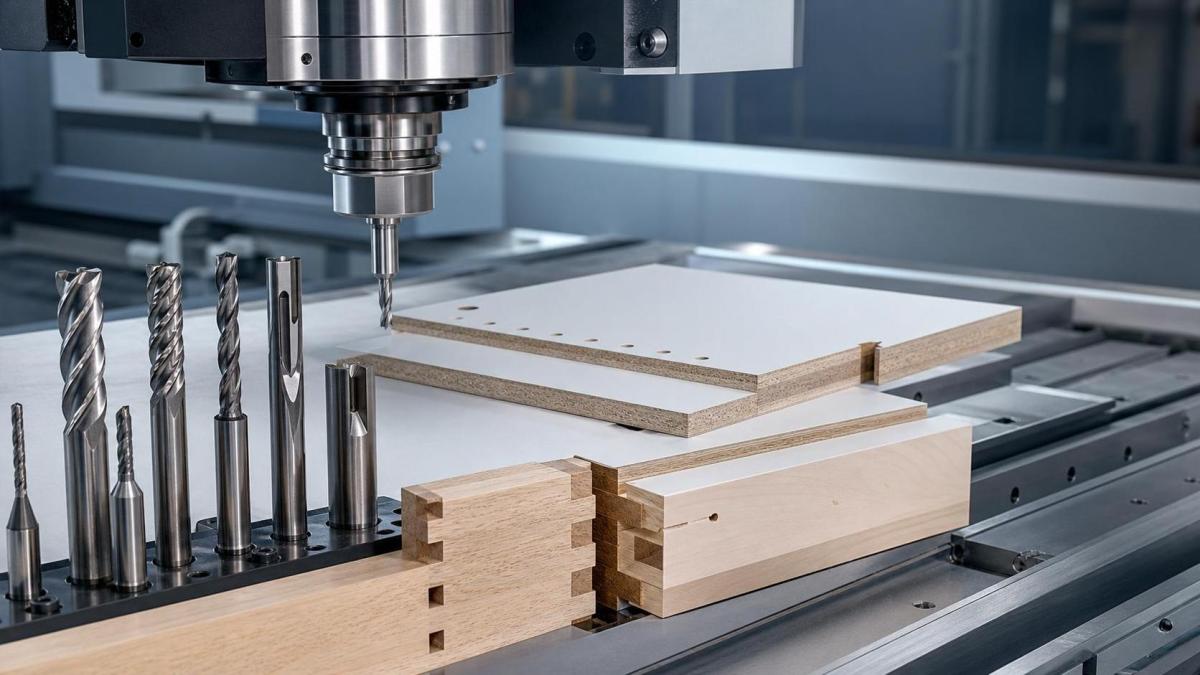
In furniture making, precision is not a single specification. It is a combination of dimensional accuracy, clean edges, controlled heat, stable chip evacuation, and predictable tool life.
For fine joinery, even a small deviation can create visible gaps, weak bonding, or difficult assembly. A drawer front, mortise component, dowel hole, or edge-banded panel can fail visually before it fails structurally.
This is why precision woodworking tools for furniture should be evaluated as part of a process window. Tool geometry, substrate density, feed rate, spindle speed, and clamping quality work together.
Why the topic is getting more attention
Panel furniture, custom interiors, and mixed-material designs have raised the standard for machining accuracy. Shops are cutting MDF, plywood, melamine-faced boards, solid wood, veneered panels, and composite materials on the same line.
That variety increases risk. A tool that performs well on solid oak may chip melamine. A cutter optimized for rough throughput may leave tear-out on exposed parts meant for visible joinery.
PWFS often frames industrial equipment through the lens of precision under pressure. In printing, that means micron-level color registration. In CNC woodworking, it shows up as consistent cut geometry, thermal control, and smooth integration with CAD, CAM, and MES workflows.
The practical takeaway is simple: tooling decisions are no longer isolated workshop choices. They affect yield, rework, edge banding quality, nesting efficiency, and delivery reliability.
The main tool categories to compare
When comparing precision woodworking tools for furniture, it helps to separate them by task rather than by brand alone. Different cutting actions demand different geometries.
Cutting and profiling tools
Compression routers, upcut spirals, downcut spirals, and straight cutters are common for panel sizing, trimming, grooving, and visible edge work.
Compression tools are often preferred for laminated panels because they protect both top and bottom faces. Downcut tools can improve top-edge finish, but chip evacuation must stay under control.
Drilling and boring tools
Hinge holes, dowel patterns, shelf pin holes, and connector bores require consistent diameter and low breakout. Point angle, flute polish, and carbide grade matter more than many operators expect.
Joinery-focused cutters
Tools for tenons, lock joints, finger joints, grooves, and precision slots should be judged by fit consistency over a batch, not just by the first few parts.
How to judge tool quality beyond sharpness
Sharpness matters, but it is only the starting point. Better selection comes from looking at four deeper factors.
Geometry and cutting balance
Helix angle, flute count, shear action, and cutting-edge symmetry influence vibration, chip flow, and finish quality. Poor balance can show up as chatter marks before obvious tool wear appears.
Carbide grade and coating
Dense boards, mineral-filled panels, and engineered composites can be abrasive. Tool life depends on carbide toughness and wear resistance, not only on the tool body design.
Runout control
A high-quality cutter can still perform badly if collets, holders, or spindles introduce runout. For precision woodworking tools for furniture, runout directly affects hole size, edge finish, and tool break risk.
Regrind consistency
In continuous production, regrind quality matters almost as much as new-tool quality. An inconsistent regrind changes diameter, profile accuracy, and tool balance.
Matching the tool to material and process
Good tooling choices always start with the board and the required finish. A mismatch here creates most avoidable defects.
- Melamine-faced panels need chip-resistant geometry and stable feed conditions.
- Solid wood needs attention to grain direction, tear-out behavior, and resin buildup.
- Plywood often demands cleaner evacuation because alternating grain layers can fray easily.
- MDF benefits from wear-resistant carbide because dust and fiber are abrasive over long runs.
Process sequence also matters. A panel that moves next to edge banding needs tight edge squareness and low chipping. A part intended for visible joinery needs cleaner walls and more controlled corner definition.
That is why precision woodworking tools for furniture should be selected together with the downstream requirement, not only the cutting station requirement.
CNC compatibility is now part of tool selection
In modern furniture production, tooling has to fit the digital process. Tool data, offsets, presetting, and repeatability all influence how quickly a machine can return stable parts.
PWFS tracks this across advanced production systems. The best-performing lines are not defined by machine power alone. They connect design files, tool libraries, nesting strategies, and production feedback with minimal manual correction.
For practical evaluation, check whether the tool program can support:
- consistent tool identification across shifts
- documented feed and speed windows
- easy replacement without trial-and-error resets
- performance tracking by material, job type, and tool life cycle
This is where tool choice starts affecting system efficiency, not just individual cut quality.
Common warning signs during use
Several shop-floor signals indicate that the current tool setup is not right, even when parts still look acceptable at first glance.
- Edge whitening or micro-chipping on laminated boards
- Burn marks, especially on dense hardwood or slow passes
- Dust packing in grooves or poor chip evacuation
- Hole diameter drift across a production run
- Joinery fit changing after tool replacement or regrind
- More spindle noise or vibration without a program change
These symptoms often point to geometry mismatch, rising runout, unstable workholding, or incorrect feeds and speeds rather than simple dullness alone.
A practical selection framework
A useful way to compare precision woodworking tools for furniture is to rank them against the actual work mix. That keeps the decision grounded.
This approach usually gives a clearer answer than comparing catalog claims in isolation.
Where to focus next
The best next step is to build a short evaluation sheet around real parts: visible edges, concealed cuts, hardware holes, and key joinery details. Record finish quality, dimensional drift, cycle stability, and regrind behavior.
From there, compare tooling by application family rather than by general reputation. Precision woodworking tools for furniture perform best when matched to a defined material set, CNC method, and quality target.
In a market shaped by fast customization and tighter process control, the strongest decisions come from linking tool performance with the broader production system. That is also where the most durable gains in quality and efficiency are found.
Related News
Get weekly intelligence in your inbox.
No noise. No sponsored content. Pure intelligence.
