
5 Axis CNC Routers vs 3 Axis Machines: Key Differences for Precision Projects
Choosing between 5 axis CNC routers and 3 axis machines is no longer a narrow technical decision. It shapes how quickly a factory can respond to custom orders, how consistently it can hold quality, and how far design teams can push geometry without adding manual rework.
That matters even more in today’s paper and wood value chain. Packaging lines demand speed and repeatability, while furniture and interior production increasingly demand flexible, small-batch precision. In that environment, the gap between basic routing and multi-angle machining becomes a business issue, not just an engineering preference.
Why the axis question matters now
Across woodworking, packaging support equipment, and custom interior manufacturing, production is moving toward shorter runs and higher mix. Standard flat parts still dominate volume, yet margins increasingly come from customization, better finish quality, and reduced downstream correction.
PWFS follows this shift closely because it sits at the intersection of automated packaging and digital woodworking. The same market logic that pushes corrugated lines, offset presses, and folder gluers toward higher precision also pushes CNC cutting toward smarter, more adaptive motion.
In practical terms, a machine’s axis capability affects how many setups a part needs, how much hand finishing remains, and whether unusual shapes can be produced profitably at scale.
The core difference between 3 axis and 5 axis motion
A 3 axis router moves along X, Y, and Z. It cuts left to right, front to back, and up and down. This makes it highly effective for flat panels, nested-based manufacturing, drilling patterns, grooves, and standard contour cutting.
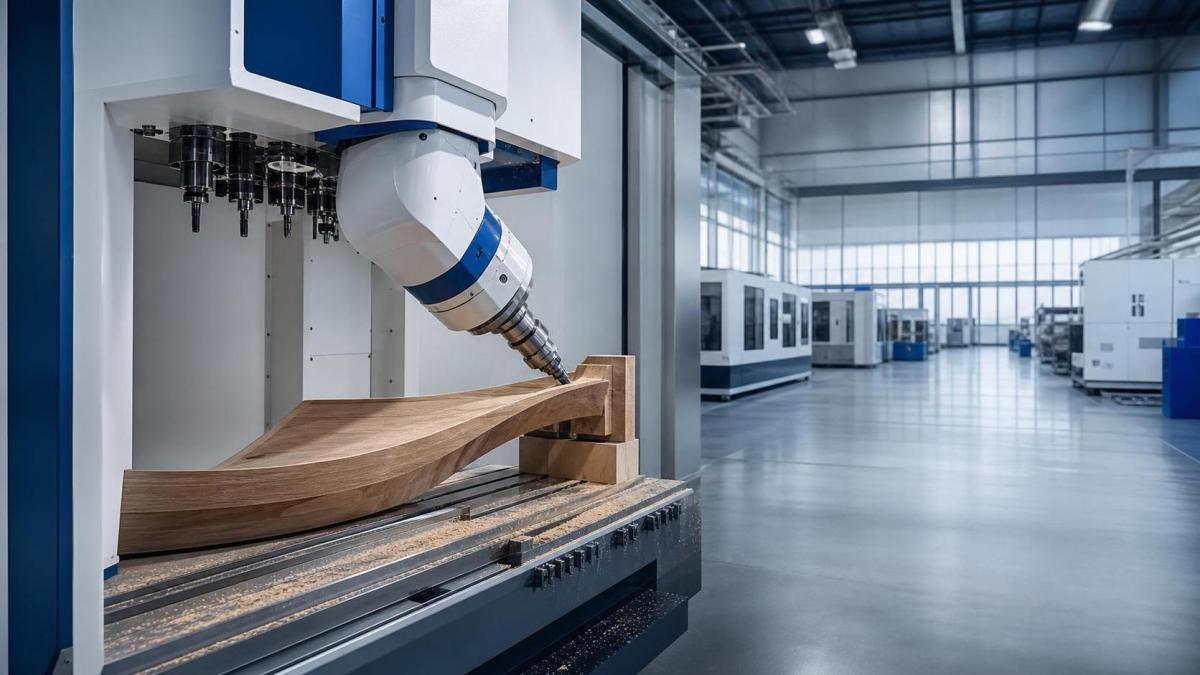
5 axis CNC routers add rotational movement. The cutting head or table can tilt and rotate, allowing the tool to approach the workpiece from multiple angles. That changes the machine from a flat-panel processor into a platform for true spatial machining.
Simple parts rarely need that extra freedom. Precision projects often do. Curved surfaces, compound angles, undercuts, beveled edges, sculpted components, and complex joinery become far easier when the spindle can move around the part instead of forcing the part into repeated repositioning.
A quick comparison
Where 5 axis CNC routers create real business value
The strongest case for 5 axis CNC routers appears when complexity is part of the revenue model. Whole-house customization is a clear example. One project may combine wardrobe panels, decorative curves, angled shelving, stair components, wall systems, and feature doors in small quantities.
In those conditions, fewer setups can mean more than labor savings. They reduce cumulative tolerance drift, lower the risk of edge damage during repositioning, and help preserve visual consistency across premium pieces.
This is also where PWFS’s industry perspective becomes useful. In advanced manufacturing, value is often created by stitching digital design, machine motion, and finishing into one continuous process. 5 axis CNC routers fit that logic because they convert CAD intent into more complete machining at the first pass.
For custom fabrication, the benefits usually appear in four places:
- Reduced handling between operations
- Higher consistency on angled or curved features
- Faster transition from prototype to repeatable production
- Greater design freedom without proportional labor growth
Why 3 axis machines still make sense
A 3 axis machine is not an outdated option. For many factories, it remains the most rational choice. If the production mix is dominated by cabinets, standard nesting, straight drilling, dados, trimming, and rectangular panel work, a well-configured 3 axis platform can deliver excellent returns.
It is usually easier to train on, easier to program, and easier to maintain. Toolpaths are more straightforward, cycle planning is simpler, and daily throughput can be very strong when parts stay within the machine’s natural strengths.
That matters in volume-oriented environments. A factory does not gain strategic advantage from 5 axis CNC routers if most orders never require angled access or 3D contouring. In that case, the extra machine capability may sit underused while capital costs rise.
Precision is about more than the number of axes
The market often treats 5 axis CNC routers as automatically more precise. That is only partly true. Axis count expands capability, but final precision also depends on spindle stability, servo quality, machine rigidity, vibration control, dust extraction, tool condition, software strategy, and thermal behavior.
For high-value parts, toolpath quality matters as much as hardware. A multi-axis machine with weak post-processing or poor fixture design can still produce inconsistency. Meanwhile, a stable 3 axis machine with disciplined workflow can outperform expectations on repeat flat work.
This is especially relevant in integrated factories where routers feed edge banders, drilling cells, or finishing lines. A beautiful cut means less if downstream alignment suffers. The real target is process precision, not isolated spindle performance.
Questions worth asking before comparing quotes
- How often do parts require angled cutting, sculpted surfaces, or side access?
- How many setups are currently needed for complex parts?
- Where do manual sanding, trimming, or correction costs accumulate?
- Is CAM capability strong enough to support multi-axis programming?
- Can the order mix justify higher capital tied to 5 axis CNC routers?
Typical use cases across wood, furniture, and custom fabrication
In panel furniture, 3 axis equipment remains highly effective for nested base production, shelf systems, carcass parts, and routine drilling. It supports fast turnover when design variation stays within predictable geometry.
5 axis CNC routers are more valuable for shaped doors, curved decorative panels, ergonomic seating parts, complex stair elements, acoustic wall forms, and premium retail interiors. These projects reward angle flexibility and smoother surface transitions.
In mixed factories serving both packaging support infrastructure and interior products, the decision can be strategic. Standard lines may run on 3 axis equipment, while a dedicated 5 axis cell handles custom jobs, prototypes, and high-margin specialty work.
That hybrid approach often aligns well with Industry 4.0 goals. It avoids overspecifying every machine while preserving the agility to absorb new product categories.
How to judge return on investment without oversimplifying
A useful ROI comparison goes beyond machine price. The better question is how each platform changes total production economics over time.
For some operations, 5 axis CNC routers pay back through premium product capability rather than raw speed. For others, the right answer is improving tooling, automation, and data flow around a 3 axis line.
A practical next step for evaluation
The clearest path is to review actual part families, not generic brochures. Separate flat, repeatable work from geometrically demanding parts. Measure setup count, finishing time, scrap rate, and lead-time pressure across both groups.
Then compare those findings against software capability, staffing depth, and future product plans. If design complexity is rising and custom lead times are tightening, 5 axis CNC routers deserve serious attention. If production remains heavily standardized, a strong 3 axis platform may still be the sharper investment.
The best decision usually comes from matching machine motion to business direction. In precision projects, the winning platform is not the most advanced one on paper. It is the one that turns digital design into profitable, repeatable output with the fewest compromises.
Related News
Get weekly intelligence in your inbox.
No noise. No sponsored content. Pure intelligence.
