
ATC 5 Axis CNC Router Buying Guide: Travel, Spindle Power, and Tool Changer Basics
An ATC 5 axis CNC router is no longer a niche purchase for complex workshops. It has become a strategic machine in custom furniture, architectural millwork, composite processing, and flexible panel production.
When delivery windows are tight and design variation is high, machine selection affects schedule control, part consistency, labor planning, and the cost of future expansion.
That is why travel range, spindle power, and tool changer design deserve close attention. These three areas shape what the machine can produce, how fast it can switch jobs, and how reliably it can hold quality.
Across the paper and wood industrial chain observed by PWFS, the same pattern appears repeatedly: equipment value comes from matching precision, throughput, and flexibility to real production logic rather than headline specifications alone.
Why the ATC 5 axis CNC router matters now
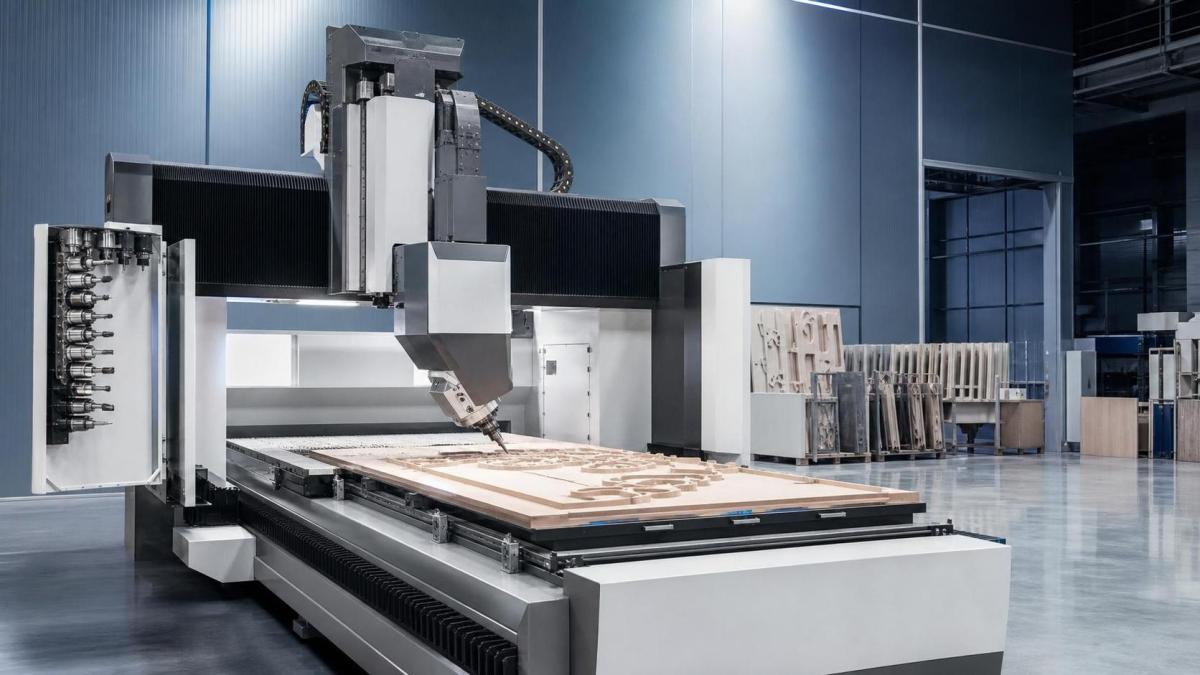
In woodworking, the shift toward whole-house customization has changed machine requirements. Straight cutting is no longer enough. Shops need angled drilling, contour trimming, nesting, slotting, and shaped surface work in one flow.
An ATC 5 axis CNC router answers that need by combining multi-directional machining with automatic tool changes. It reduces manual intervention between steps and shortens the distance between design intent and finished part.
This matters beyond furniture. Display fixtures, acoustic panels, engineered doors, molded components, and even non-wood materials benefit from the same capability structure.
For operations influenced by Industry 4.0 goals, the machine also becomes a data node. It connects CAD, CAM, MES, optimization software, and downstream finishing with fewer handoffs.
What defines a capable machine
At a basic level, an ATC 5 axis CNC router combines five-axis movement with an automatic tool changer. The spindle can approach the workpiece from multiple angles, while the tool system shifts cutters without stopping the production rhythm.
The buying challenge is that many machines appear similar in brochures. Real differences usually sit in travel envelope, spindle behavior under load, tool capacity, kinematic stability, and software integration.
In practice, the best machine is rarely the one with the biggest number in one category. It is the one whose structure fits the part family, shift pattern, and tolerance expectation.
Three parameters that influence most decisions
- Travel range decides whether parts fit comfortably and whether fixtures restrict access.
- Spindle power determines cutting authority, finish quality, and speed stability.
- Tool changer design affects uptime, process flexibility, and setup discipline.
Travel range is more than table size
Buyers often start with X, Y, and Z travel, but effective capacity is more nuanced. A machine may technically fit a panel, yet struggle once clamps, vacuum zones, aggregates, or angled spindle positions are involved.
The useful question is not only, “What is the maximum sheet size?” It is, “What part geometry can be machined safely, repeatedly, and without awkward repositioning?”
Z travel deserves special scrutiny on an ATC 5 axis CNC router. Deep parts, curved surfaces, nested components, and fixtures all consume vertical space. Limited clearance can erase the advantage of five-axis motion.
Swing range matters too. Head articulation may reduce usable space near edges or tall workpieces. A generous axis specification on paper can become restrictive in real cutting positions.
Travel questions worth checking during evaluation
- Largest panel size and smallest repeat part in the same workflow.
- Typical part height, fixture height, and clamp interference risk.
- Need for edge machining, beveling, undercuts, or side access.
- Future product plans that may require longer or thicker materials.
Spindle power should match material behavior
Spindle power is often simplified into a single horsepower or kilowatt figure. That number matters, but it does not tell the whole story.
A useful assessment includes torque across the speed range, thermal stability, bearing quality, vibration control, and the machine’s ability to maintain feed rates during longer cycles.
For MDF, plywood, particleboard, and solid wood, the spindle must manage chip evacuation, heat, and edge finish at production speed. For composites, plastics, and aluminum, the load profile changes again.
In other words, spindle selection should begin with the material mix and cut strategy, not just the catalog’s top power figure.
A strong spindle on a weak frame will still disappoint. Machine rigidity, vacuum hold-down performance, and tool balance must be considered together.
Tool changer basics that affect daily output
The automatic tool changer is one of the most practical advantages of an ATC 5 axis CNC router. It allows drilling, roughing, finishing, grooving, and trimming to run in sequence with less manual interruption.
Still, not every ATC system performs equally well. Tool count, magazine layout, change speed, recovery logic, and accessibility for maintenance all shape the real production result.
A compact tool library may work for stable part families. It becomes limiting when jobs change frequently or when multiple materials require dedicated cutter sets.
What to check in the ATC system
- Magazine capacity relative to the number of tools used per shift.
- Tool-to-tool change time in actual programs, not isolated demos.
- Compatibility with aggregates, saw blades, drills, and specialty tools.
- Sensor reliability for tool presence, length measurement, and breakage detection.
- Ease of cleaning around chips, dust, and resin buildup.
When evaluating an ATC 5 axis CNC router, tool changer design often separates an impressive showroom machine from a dependable production machine.
Where these choices create business value
The value of the machine becomes clearer when it is viewed in the broader manufacturing chain. PWFS tracks this connection across board production, printing, converting, woodworking, and finishing.
In furniture systems, faster and cleaner CNC processing supports downstream edge banding, assembly accuracy, and on-time installation. Better machining quality reduces hidden rework later in the line.
In mixed manufacturing groups, the same digital discipline also supports packaging fixtures, retail displays, and custom transport components. The ATC 5 axis CNC router becomes part of a broader flexible production strategy.
That is why return on investment should include more than hourly output. Setup reduction, fewer hand corrections, improved nesting flow, and stronger schedule predictability often matter just as much.
Common buying mistakes
Several buying errors appear repeatedly in field comparisons. Most come from evaluating isolated features instead of the full process.
- Choosing oversized travel without checking floor space, loading flow, and vacuum zoning efficiency.
- Paying for spindle power that production never uses, while ignoring rigidity or dust extraction.
- Selecting too few tool positions for a variable product mix.
- Overlooking software post-processing, simulation quality, and data handoff from design.
- Focusing on machine price while underestimating downtime, service access, and operator learning curve.
A disciplined evaluation usually prevents these issues. That means running sample parts, reviewing cycle logic, and asking how the machine behaves after long hours, not just during a clean demonstration.
How to build a stronger comparison framework
A practical shortlist for an ATC 5 axis CNC router should start with actual parts and production plans. Group the work by material, size, geometry, tool demand, and expected daily volume.
Then compare each candidate on process fit, not only specifications. A smaller but better-matched machine often outperforms a larger one that complicates workflow.
Useful decision criteria include:
- Part envelope coverage with realistic fixturing.
- Spindle performance in the actual material mix.
- ATC capacity for current jobs and future variation.
- Integration with CAD, CAM, MES, and labeling workflows.
- Service response, spare parts, and preventive maintenance access.
The next step is straightforward: define the part family, map the tool sequence, and test whether the proposed ATC 5 axis CNC router supports that flow without compromise. That approach turns a complex purchase into a measurable engineering decision.
Related News
Get weekly intelligence in your inbox.
No noise. No sponsored content. Pure intelligence.
