
CNC Woodworking Equipment for Cabinetry: How to Choose for Nesting, Drilling, and Precision Joinery
CNC Woodworking Equipment for Cabinetry: How to Choose for Nesting, Drilling, and Precision Joinery
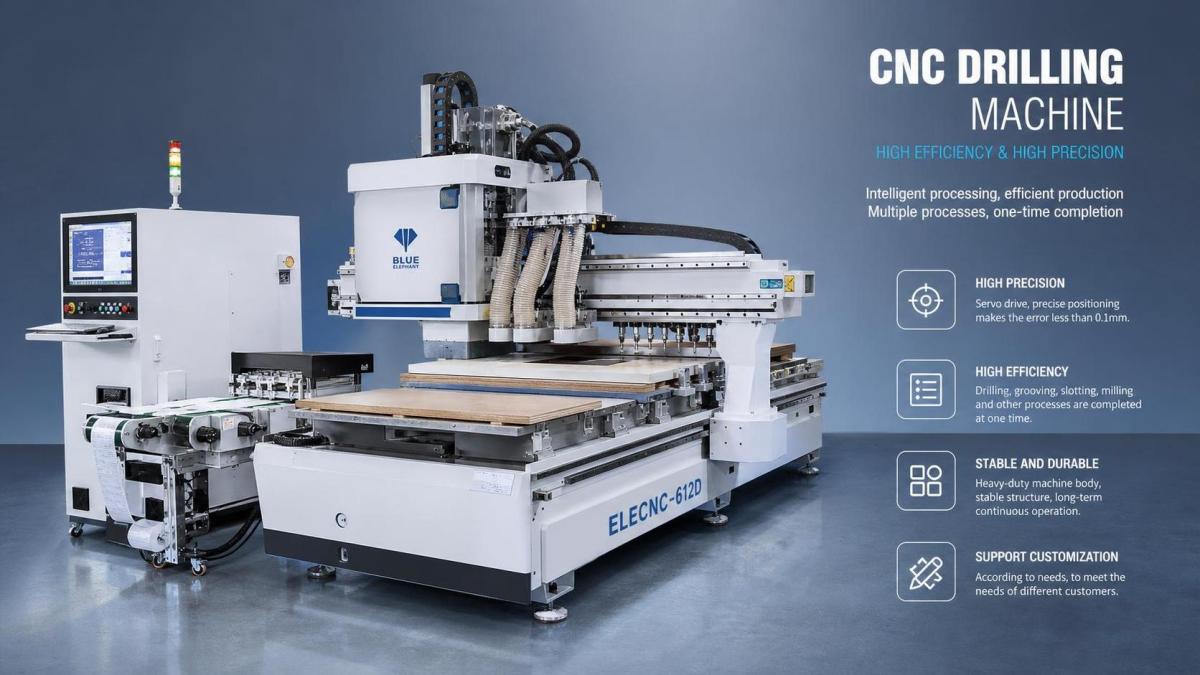
Choosing the right CNC woodworking equipment for cabinetry shapes output, cost control, and delivery speed.
For cabinet production, nesting quality, drilling accuracy, and joinery consistency are not separate issues.
They affect material yield, assembly time, rework, and customer satisfaction at the same time.
That is why CNC woodworking equipment for cabinetry should be evaluated as a production system, not a single machine purchase.
In practical buying decisions, the cheapest machine rarely delivers the lowest long-term cost.
Downtime, board waste, poor hole positioning, and unstable joinery usually cost more than the initial discount.
A better approach is to compare machine capability against real cabinet workflows.
This makes it easier to judge ROI, expansion potential, and operational risk.
Start with the Cabinet Workflow, Not the Machine Brochure
Every cabinetry plant has a different production profile.
Some run high-volume standard kitchen boxes.
Others focus on whole-house customization with frequent order changes and mixed panel sizes.
The right CNC woodworking equipment for cabinetry depends on that production reality.
Before comparing brands, define four basic inputs:
- Daily board throughput
- Main panel materials and thickness range
- Joinery types and drilling patterns
- Required lead time from design to assembly
This step sounds basic, but it prevents overbuying and underbuying.
A machine built for speed may fail on flexibility.
A flexible machine may become a bottleneck if spindle power, tool capacity, or loading automation are too limited.
What Matters Most in Nesting Performance
Nesting is where cabinet cost control starts.
Good nesting reduces waste, shortens cutting time, and improves part traceability.
When assessing CNC woodworking equipment for cabinetry, look beyond the advertised table size.
Key nesting checkpoints
- Vacuum table zoning that holds small parts securely
- Spindle power matched to panel density and feed rate
- Automatic labeling for downstream sorting and assembly
- Tool change speed that supports mixed jobs
- Software that optimizes yield without slowing programming
Material utilization should be reviewed with real production files, not sample layouts only.
Ask the supplier to simulate typical cabinet orders using your board sizes and component mix.
From a cost perspective, even a small yield improvement becomes significant across MDF, plywood, and melamine panels.
This is especially true when order variety is high.
Drilling Accuracy Drives Assembly Speed
Many cabinet factories focus on cutting speed first.
In reality, drilling accuracy often has a bigger effect on final assembly efficiency.
If dowel holes, hinges, cam fittings, or shelf pins drift, assembly slows immediately.
For CNC woodworking equipment for cabinetry, drilling units must be checked carefully.
What to verify
- Vertical and horizontal drilling configuration
- Repeatability across long production runs
- Hole quality on laminated surfaces
- Cycle time when drilling and routing are combined
- Calibration ease after tool replacement
A common buying mistake is accepting precision claims without process context.
Static accuracy numbers do not always reflect real performance at production speed.
Request test cuts with common cabinet hole patterns and edge distances.
Then inspect fit quality during actual assembly.
Precision Joinery Is a System Capability
Precision joinery depends on more than machine tolerance.
It also depends on software logic, tool stability, panel handling, and operator consistency.
This is where better CNC woodworking equipment for cabinetry stands out from low-cost alternatives.
Joinery-related factors that affect quality
- Frame rigidity under continuous load
- Servo stability during fast directional changes
- Automatic tool measurement and compensation
- Chip extraction around slots and blind holes
- CAD to CAM integration for error-free data flow
In cabinet lines with frequent custom orders, software reliability becomes critical.
A strong machine with weak programming support creates hidden waste.
Parts may be cut correctly, yet still fail because labels, drilling logic, or orientation data are wrong.
That also means software support should be part of total equipment evaluation.
How Much Automation Is Worth Paying For
Automation level should match labor cost, order complexity, and shift pattern.
Not every cabinet plant needs a fully automated cell on day one.
But manual loading and unloading can quietly limit output.
For CNC woodworking equipment for cabinetry, automation usually affects ROI in three ways.
- It reduces handling time between jobs.
- It lowers dependency on highly experienced operators.
- It makes throughput more predictable across shifts.
The most useful automation options often include automatic loading, part labeling, conveyor discharge, and waste removal.
These features improve workflow without forcing a full factory redesign.
A modular upgrade path is usually a safer investment than a fixed all-in-one configuration.
Look Past Price and Compare Total Ownership Cost
Purchase price matters, but it should never be the only decision point.
Total ownership cost gives a more realistic picture of value.
For CNC woodworking equipment for cabinetry, compare the following cost areas:
A lower-priced machine with unstable support can become expensive very quickly.
On the other hand, a higher initial investment may pay back faster through better uptime and cleaner first-pass production.
Questions to Ask Before Signing the Order
A disciplined supplier review reduces surprises after installation.
These questions help test whether CNC woodworking equipment for cabinetry will perform as promised.
- Can the supplier run sample cabinet jobs using your original files?
- What output level is guaranteed in normal shift conditions?
- How are installation, training, and acceptance defined in the contract?
- Which parts are stocked locally, and what is the response time?
- What software updates and technical support are included?
- Can the machine scale with future automation modules?
Request measurable answers whenever possible.
General promises are less useful than cycle time data, tolerance samples, and post-sale support commitments.
A Smarter Way to Choose CNC Woodworking Equipment for Cabinetry
The best buying decision balances today’s workload with tomorrow’s production direction.
For cabinetry, nesting efficiency, drilling precision, and joinery accuracy should be reviewed together.
That gives a clearer view of real throughput, true cost, and long-term flexibility.
The strongest CNC woodworking equipment for cabinetry is not simply the fastest model.
It is the one that fits your cabinet process, supports reliable assembly, and protects profit as order complexity grows.
Use production files, acceptance tests, and ownership-cost comparisons to make the final call.
That approach leads to a purchase decision grounded in performance, not sales claims.
Related News
Get weekly intelligence in your inbox.
No noise. No sponsored content. Pure intelligence.
