
Custom Furniture Cost Breakdown: Materials, Labor, Hardware, and Installation
Why does custom furniture cost swing so widely from one quote to another?
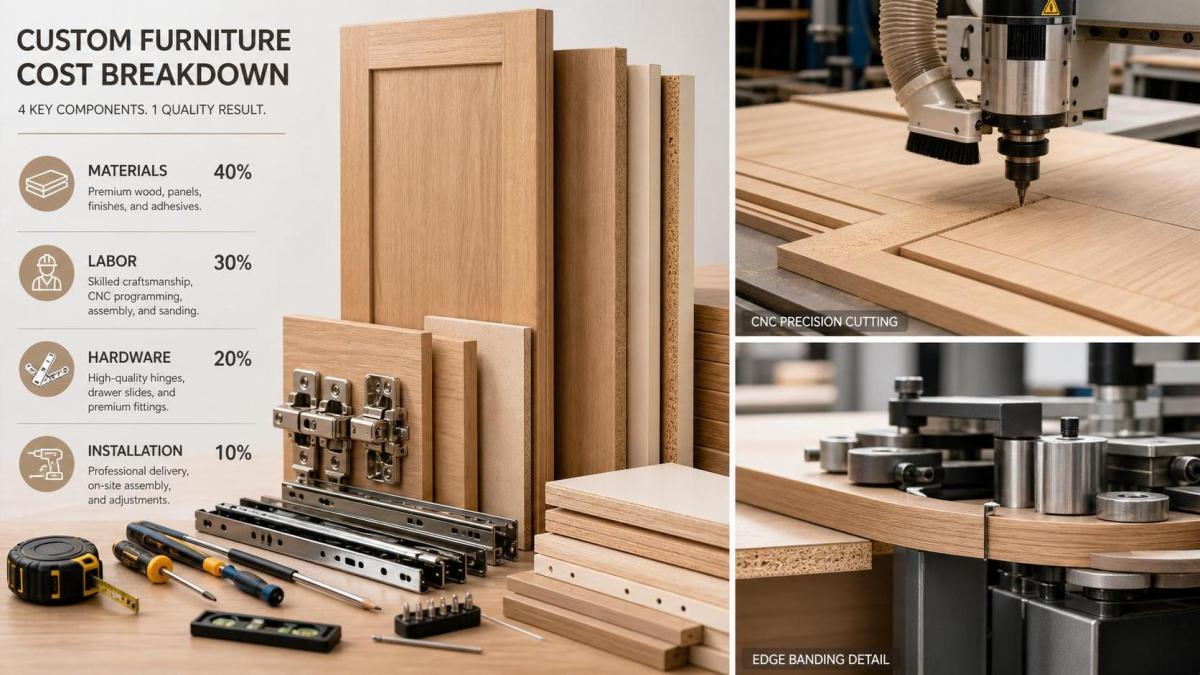
Custom furniture cost rarely moves by a small margin. One design choice can shift the budget more than most people expect.
A basic built-in in melamine board may look similar online to a white oak unit, yet the pricing logic is completely different.
The final number usually combines four cost blocks: materials, labor, hardware, and installation. Finish, logistics, and project complexity sit around them.
In practice, custom furniture cost rises when tolerances tighten, surfaces expand, shapes become irregular, or site conditions get harder.
That is also why serious woodworking platforms such as PWFS pay close attention to CNC routers, edge banders, and production intelligence.
Behind a polished wardrobe or media wall, there is usually digital cutting, drilling accuracy, edge sealing, and repeatable finishing quality.
So when two workshops price the same drawing differently, the gap is not always markup. It may reflect machine capability, waste control, or installation risk.
Which part of custom furniture cost usually takes the biggest share?
Materials often lead, but not always. For a simple cabinet run, boards and veneer may be the largest expense.
For a complex staircase storage wall or curved reception desk, labor may overtake materials because fabrication hours multiply quickly.
A useful way to read custom furniture cost is this:
For many residential projects, materials may account for 35% to 50% of custom furniture cost. Labor often follows closely.
Once premium hardware and difficult installation enter the picture, the balance changes fast. That is why a line-by-line quote matters more than a lump sum.
How much do materials really change the budget?
More than any brochure suggests. Material choice affects not just appearance, but machining time, waste rate, finishing behavior, and lifespan.
Engineered boards are usually the most cost-stable route. Melamine-faced particle board and plywood support clean geometry and predictable cutting.
Solid wood adds warmth and repairability, but it also introduces grading variation, movement control, and more selective milling.
Veneered panels sit in the middle. They can deliver a premium look with better dimensional stability, though edge treatment becomes critical.
This is where advanced equipment changes outcomes. PWFS often frames CNC routing and edge banding as cost topics, not only technical topics.
A precise nesting strategy reduces waste. Better edge sealing improves durability and indoor safety, especially on panel-based custom furniture.
- Melamine board: budget-friendly, consistent, strong value for wardrobes and utility storage.
- Plywood: stronger core, good for kitchens, baths, and long spans.
- Veneer over engineered core: premium visual finish with controlled movement.
- Solid hardwood: highest craft appeal, usually highest material and labor cost.
If you are comparing quotes, ask whether edges are laser-banded, PUR-bonded, or standard hot-melt sealed. That detail can explain a real price difference.
Why can labor cost more than the wood itself?
Because custom work is not just cutting boards. It includes drafting, revisions, machine setup, assembly, sanding, finishing, inspection, and rework control.
A straight run of lower cabinets is relatively efficient. A full-height unit around beams, outlets, and uneven corners is another story.
Labor climbs when the design includes many interruptions: open niches, angled ceilings, curved panels, flush reveals, or concealed access doors.
Finishing labor also matters. A clear matte lacquer is not priced like a brushed stain, open-grain texture, or color-matched painted system.
Factories using refined digital workflows can often control labor better. CAD-to-CNC integration reduces manual interpretation and helps avoid remake costs.
That is one reason the PWFS view of furniture production connects design data, machining precision, and profitability in the same chain.
When labor seems high, check whether the quote includes shop drawings, finish samples, and on-site measuring. Those are not decorative extras.
Are hardware and installation minor add-ons, or major cost factors?
They are often underestimated. In many projects, premium hardware is the difference between acceptable furniture and furniture that still feels good after years.
Drawer runners, lift systems, concealed hinges, pull-out organizers, and integrated lighting add convenience, but they also add budget quickly.
Installation can be just as influential. A factory may build perfectly, yet poor site access or bad wall conditions can push final custom furniture cost higher.
The more tailored the fit, the less tolerance there is for site error. A built-in bench between out-of-square walls is harder than a freestanding cabinet.
Use this quick check before approving the quote:
- Are hardware brands and model levels clearly named?
- Does installation include leveling, scribing, anchoring, and touch-up?
- Is delivery upstairs, through narrow elevators, or after-hours?
- Are electrical cutouts or lighting connections included?
If those points are vague, your initial number may look attractive but the final invoice may not.
What mistakes make custom furniture cost feel higher than it should?
The most common mistake is changing the design after production drawings are approved. Even small dimension changes can trigger remaking entire parts.
Another issue is comparing estimates that use different assumptions. One quote may include plywood backs, premium slides, and site templating. Another may not.
There is also a material mismatch problem. Choosing a luxury finish for a high-wear utility zone can inflate cost without adding practical value.
A better approach is to match specification to use. Kitchens, closets, TV walls, and bathroom vanities should not be priced with the same logic.
How should you judge whether a custom furniture quote is fair?
Start with the intended life of the piece. A guest room shelf and a daily-use kitchen pantry do not need the same specification.
Then look for quote clarity. Fair pricing usually comes with specific board type, finish system, hardware brand, lead time, and installation scope.
It also helps to ask what production method supports the quote. Shops using well-managed CNC workflows may price differently for good reasons.
That does not guarantee a better result, but it often signals better repeatability, lower waste, and tighter fit on custom work.
A sensible next step is to shortlist two or three options and normalize them. Make every bidder price the same drawing and hardware level.
If you want to control custom furniture cost without stripping quality, simplify shapes before downgrading materials that affect durability.
In the end, the best decision usually comes from understanding what you are paying for, where the risks sit, and which details truly matter in use.
Before moving forward, confirm dimensions, finish samples, hardware selections, installation conditions, and any change-order rules. That is where smarter buying starts.
Related News
Get weekly intelligence in your inbox.
No noise. No sponsored content. Pure intelligence.
