
Industrial Equipment Sourcing North America: How to Compare Suppliers, Lead Times, and Support
Industrial equipment sourcing North America starts with the right comparison lens
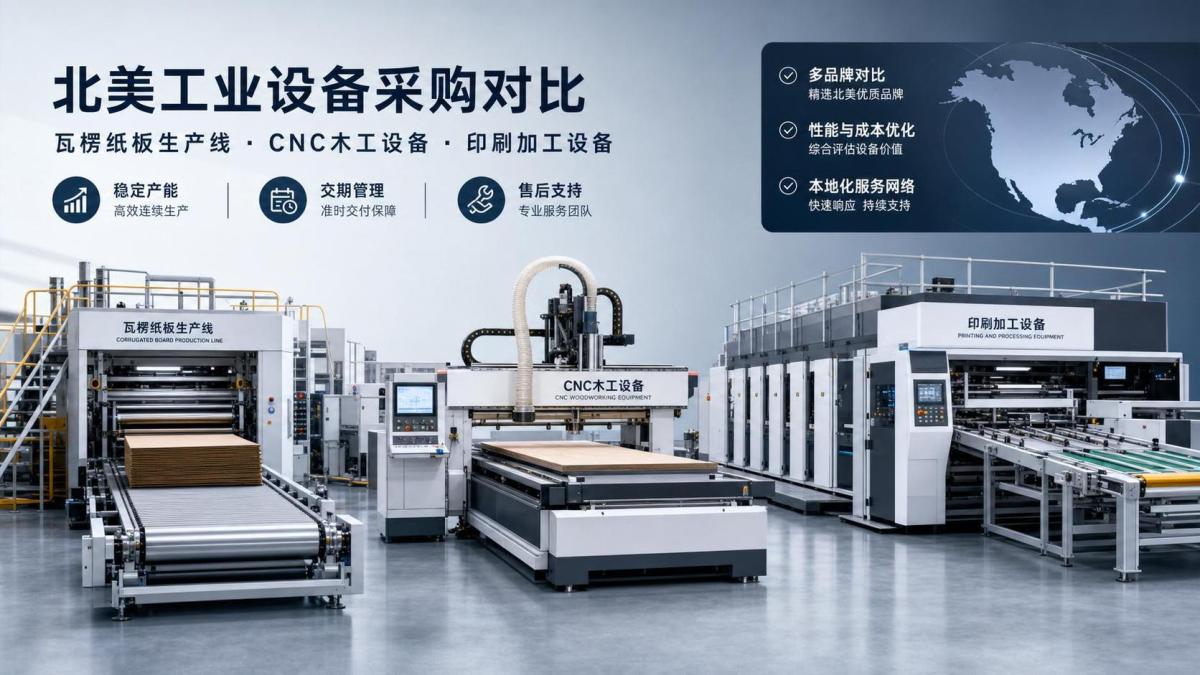
Industrial equipment sourcing North America is rarely a simple price exercise. The real decision sits between output stability, delivery risk, service depth, and the cost of downtime.
That becomes even more important when the equipment is complex. Corrugated board lines, offset presses, die-cutters, folder-gluers, CNC routers, and edge banders all shape production economics differently.
In practice, the best sourcing decisions connect machine capability with packaging demand, furniture customization cycles, compliance requirements, and future automation plans.
This is also where sector-focused intelligence matters. PWFS tracks the paper and wood equipment ecosystem closely, from micron-level print registration to high-speed cutting and flexible manufacturing logic.
So the useful question is not only, “Which supplier quoted lower?” A better question is, “Which supplier can support the operating model over five to ten years?”
When does supplier comparison go wrong?
A common mistake in industrial equipment sourcing North America is comparing vendors on headline specifications alone. Two machines may show similar speed ratings, yet deliver very different real-world uptime.
Another weak approach is treating lead time as a shipping date only. For heavy industrial lines, the timeline often includes engineering review, component sourcing, factory acceptance testing, site readiness, and commissioning.
Support is often underestimated as well. A supplier with slower response, thinner spare parts coverage, or weak controls expertise can erase any savings made during purchase.
This is especially true in packaging and woodworking. A corrugated line affects logistics capacity. An offset press affects print consistency. A CNC router affects custom order turnaround.
In other words, each machine is tied to revenue flow, labor structure, and customer promises. That is why industrial equipment sourcing North America needs a broader evaluation frame.
What should be compared beyond the machine brochure?
The useful comparison starts with capability under load, not empty claims. Ask how the machine performs during shift changes, mixed job runs, material variation, and operator turnover.
For print and packaging lines, register stability, waste rates, makeready time, and adhesive consistency usually matter more than peak speed shown on a sales sheet.
For woodworking systems, drilling accuracy, tool life, nesting efficiency, dust extraction logic, and software integration often define usable capacity better than spindle power alone.
A practical supplier review usually includes these checkpoints:
- Installed base in North America and comparable production environments.
- Local or regional service engineers, not only remote support.
- Controls platform familiarity and integration with MES, ERP, or CAD/CAM workflows.
- Spare parts stocking strategy for wear items and critical electronics.
- Training depth for operators, maintenance teams, and process tuning.
- Compliance readiness, including safety, traceability, and material standards where required.
This broader view fits well with how PWFS interprets equipment value. The machine is one layer; process control, compliance, and digital continuity are the real operating system.
How should lead times be judged without being misled?
Lead time in industrial equipment sourcing North America should be separated into stages. Without that breakdown, one supplier can appear faster simply because the quote excludes hidden steps.
A more reliable timeline usually covers commercial release, engineering finalization, manufacturing, FAT, shipping, customs, site preparation, installation, SAT, and output stabilization.
That last part matters. Many projects are technically installed before they are commercially stable. A machine that runs is not always a machine that produces saleable output consistently.
For example, a high-precision offset press may arrive on schedule, but ink-water balance, substrate adaptation, and register tuning still delay full utilization.
Likewise, a CNC woodworking cell may be mechanically complete, yet remain constrained by postprocessor setup, label flow, or toolpath optimization.
The table below helps compare supplier timelines in a more realistic way.
This kind of staging gives a much cleaner view of actual project risk than a single delivery promise.
Is local support really worth paying more for?
Usually, yes, but only when the support model is specific and measurable. “North America support” can mean a real field network, or it can mean one phone line and long travel waits.
In industrial equipment sourcing North America, support quality is best tested through response structure. Ask who answers first, who troubleshoots controls, who carries parts, and who owns escalation.
For high-speed die-cutting and folder-gluing, support affects carton quality, waste, and recovery time after jams or registration drift. For edge banding, adhesive process expertise can be as important as hardware service.
Remote diagnostics are valuable, but they do not replace process engineers who understand substrate behavior, glue systems, tooling wear, or chip evacuation under production pressure.
A useful way to compare support offers is to ask for evidence, not promises:
- Average response time for urgent stoppages.
- Average time to restore operation.
- Local inventory of drives, sensors, belts, knives, pumps, and controls parts.
- Named specialists for print quality, converting accuracy, or CNC process tuning.
- Training refresh options after operator turnover.
When these details are unclear, the lowest capital quote can become the highest ownership cost.
How do cost, compliance, and scalability fit into one decision?
The smarter model for industrial equipment sourcing North America is total operating value. That includes price, utilities, labor impact, waste, maintenance burden, spare parts exposure, and future upgrade paths.
This matters a lot in sectors where regulation and customer expectations keep rising. Packaging lines may need stronger traceability, food-contact controls, and color consistency. Woodworking systems may need cleaner bonding, safer emissions, and digital design connectivity.
PWFS often frames this through five equipment pillars because each one carries a different cost logic. Corrugated lines reward throughput and energy discipline. Offset presses reward precision and waste control. CNC systems reward flexibility and software flow.
A short decision filter can keep evaluations grounded:
- Will the equipment still fit the product mix after demand shifts?
- Can the line integrate with current digital systems without custom workarounds?
- Does the supplier understand compliance needs such as FSC traceability or ink migration limits?
- Is there a realistic path toward automation, recipe control, and lower dependence on scarce labor?
When those answers are positive, the sourcing decision tends to age well instead of creating a second replacement project too soon.
What is the most practical next step before issuing a final supplier shortlist?
Before narrowing the list, build a weighted comparison sheet around output reality, not generic specifications. This usually reveals gaps that a standard RFQ summary hides.
Include job mix, target throughput, acceptable waste, changeover frequency, compliance obligations, operator skill assumptions, service expectations, and ramp-up timing.
Then ask each supplier to respond against the same operating scenario. That makes industrial equipment sourcing North America more transparent and easier to defend internally.
It also helps separate impressive presentations from dependable execution. In capital equipment, that difference is where most cost surprises begin.
A solid next move is to validate three things in parallel: reference installations, timeline assumptions, and post-installation support ownership.
The strongest sourcing decisions usually come from that disciplined sequence. Compare the machine, test the supplier, and judge whether the full system can support growth, compliance, and stable output over time.
Related News
Get weekly intelligence in your inbox.
No noise. No sponsored content. Pure intelligence.
