
Intelligent Furniture Production Systems Explained: Key Modules, Data Flow, and ROI Factors
Intelligent furniture production systems have moved from optional automation to a practical operating model for factories facing shorter lead times, smaller batch sizes, and rising quality expectations.
The real shift is not one machine replacing one task. It is a connected production environment where design data, material flow, machining logic, and shopfloor feedback work as one system.
That matters because furniture production now sits inside a broader industrial chain. Packaging lines, print systems, and woodworking equipment are all being pushed by the same pressures: flexibility, traceability, uptime, and margin control.
What the system really includes
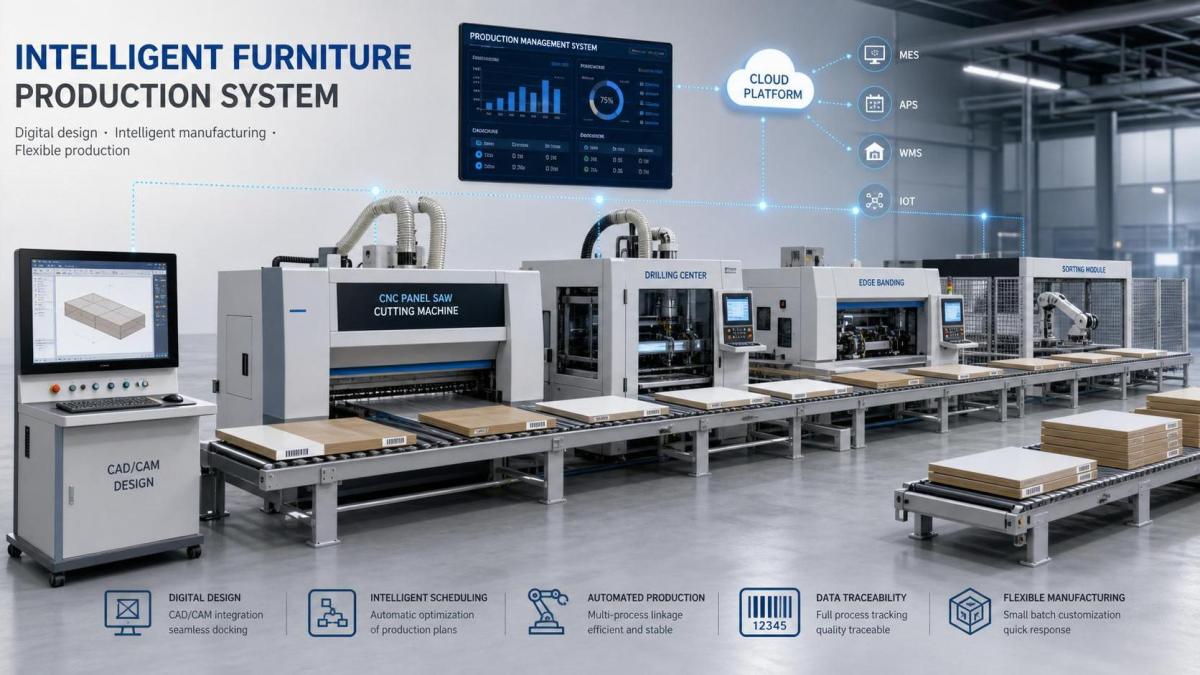
At a basic level, intelligent furniture production systems combine software, machinery, sensors, and production rules into a unified workflow.
In practice, the system usually starts with order capture and design configuration. It then passes through engineering, nesting, cutting, drilling, edge processing, sorting, assembly support, and delivery coordination.
The value comes from continuity. Once data is created upstream, it should not be manually re-entered at every station.
This is why intelligent furniture production systems are closely tied to MES, ERP, CAD/CAM, barcode tracking, and machine controllers rather than to standalone equipment alone.
Core modules usually seen on the factory side
- Order management and product configuration for variable designs.
- CAD/CAM and nesting engines that convert design intent into machine-ready instructions.
- CNC routers and drilling centers for precision machining.
- Edge banding, labeling, sorting, and buffer handling modules.
- MES and scheduling tools that manage sequence, exceptions, and workload balance.
- Quality, traceability, and maintenance systems built around live production data.
Why the topic is getting more attention
Furniture used to tolerate fragmented workflows because product ranges were narrower and delivery windows were longer. That operating logic is fading quickly.
Whole-house customization, e-commerce expectations, and material cost volatility have changed the economics of delay and error.
A missed label, wrong drill pattern, or poor edge finish can now disrupt an entire order batch rather than a single component.
From the wider industry view, PWFS tracks a similar pattern across corrugated board lines, offset printing presses, die-cutters, folder gluers, and CNC woodworking routers.
Different sectors use different machines, but the strategic requirement is the same: turn physical production into a digitally coordinated, high-yield system.
That is also why intelligent furniture production systems are often discussed alongside traceability, compliance, energy use, and dark-factory ambitions.
How data flows through the production chain
The strongest systems are designed around data flow first, then machine layout second.
An order enters through a sales or dealer platform. Product rules validate size, finish, hardware, and manufacturability before production begins.
That approved order feeds design and engineering logic. CAD models, BOMs, drilling maps, panel dimensions, and edge requirements are generated automatically.
Next, nesting software optimizes sheet usage and cutting sequence. Labels are created so each panel keeps a digital identity throughout production.
CNC machines read the instructions directly. Edge banders, sorters, and downstream stations receive the same order context instead of separate manual instructions.
MES then captures actual cycle time, machine status, scrap, rework, queue depth, and completion status. That feedback closes the loop for planning and costing.
Where value shows up in daily operations
The most immediate gains are usually not dramatic headline numbers. They show up as fewer disruptions across routine operations.
For example, intelligent furniture production systems reduce dependence on tribal knowledge. Production does not stall because one operator understands a custom job better than everyone else.
They also improve material yield. Better nesting, clearer remnant tracking, and fewer remake panels directly affect margin when board costs rise.
Another benefit is scheduling realism. Instead of pushing theoretical capacity, planners can see bottlenecks by station, material type, tool availability, or order complexity.
Quality control becomes more specific as well. A defect is easier to trace back to a program version, tool condition, supplier batch, or edge parameter.
That level of visibility is similar to what advanced print and packaging operations seek in color control, registration accuracy, and high-speed die-cutting stability.
ROI is broader than labor savings
Many investment cases for intelligent furniture production systems are weakened by one mistake: treating ROI as a simple headcount reduction exercise.
Labor matters, but the fuller return usually comes from a mix of yield, speed, order accuracy, capacity release, and revenue protection.
ROI factors worth measuring early
- Material utilization improvement by board type and thickness.
- Reduction in rework, scrap, and remakes.
- Shorter engineering preparation time per order.
- Higher machine uptime through better scheduling and maintenance visibility.
- Faster order-to-delivery cycle for customized products.
- Lower warranty or complaint cost tied to traceable defects.
- Ability to absorb more order variation without operational chaos.
Sometimes the best ROI signal is not a percentage at all. It is whether the factory can take profitable customized orders that were previously too complex to process reliably.
Common scenarios and decision points
Not every factory needs the same architecture. The right design depends on order structure, product mix, and the maturity of existing systems.
Three situations appear frequently
- High-mix custom furniture operations need strong configuration rules, fast engineering automation, and precise panel tracking.
- Scale-oriented panel furniture plants often focus on line balancing, automated sorting, and machine utilization.
- Hybrid factories need a system that handles standard products and custom orders without creating two separate digital worlds.
A useful evaluation question is whether the current bottleneck is information latency or machine capacity. Many factories buy speed before fixing data integrity.
If design files, labels, or BOM logic are inconsistent, new equipment may only automate confusion faster.
What to check before moving forward
A credible adoption path starts with baseline visibility.
Current scrap by process, order lead time, engineering hours, machine downtime, and rework causes should be measured before system design begins.
It also helps to map where data is manually recreated. Those handoff points often hide the largest operational losses.
Vendor comparison should go beyond machine specifications. Integration capability, data openness, service depth, and upgrade path matter just as much.
This is where sector intelligence becomes useful. PWFS follows not only woodworking equipment, but also the digital disciplines proven in packaging and print environments.
That broader view helps separate isolated automation from system-level transformation.
The next practical step is to define one production flow end to end, from order entry to final packaging, and test where intelligent furniture production systems would change outcomes measurably.
Once those breakpoints are visible, it becomes easier to compare architectures, set ROI logic, and decide which modules should be deployed first.
Related News
Get weekly intelligence in your inbox.
No noise. No sponsored content. Pure intelligence.
