
What Drives Industrial Woodworking Cost in Automated Production Lines?
What is really moving industrial woodworking cost now
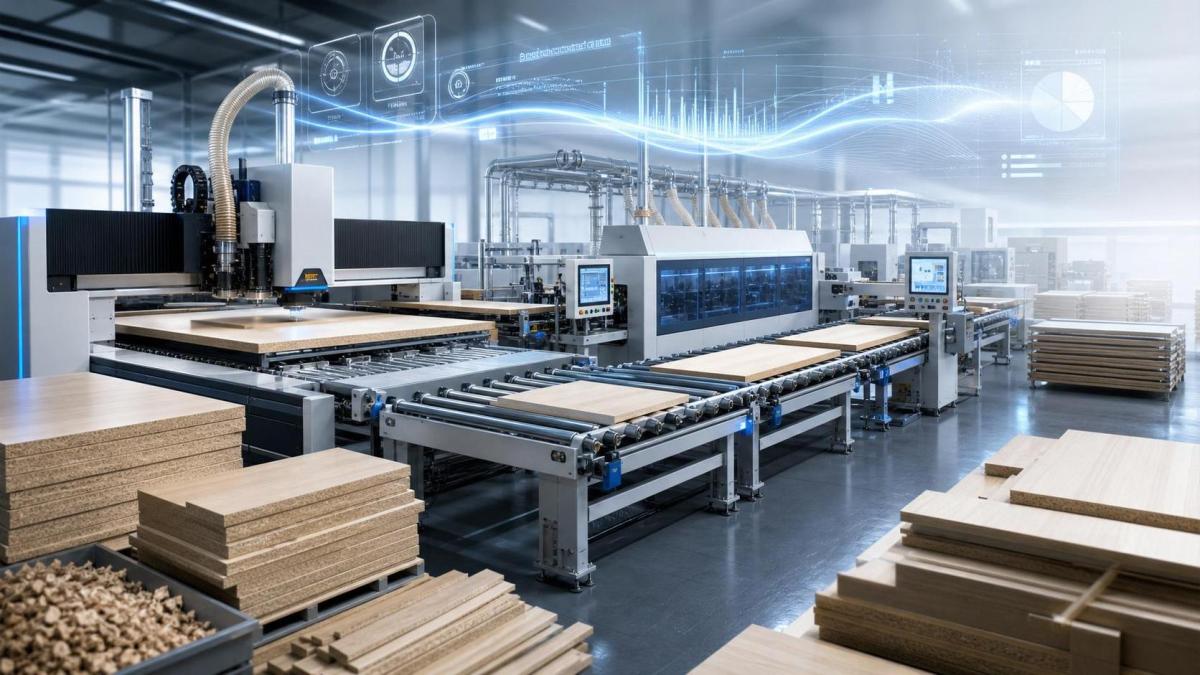
Industrial woodworking cost has entered a different era.
Labor still matters, but it no longer explains most cost swings inside automated production lines.
The sharper changes are happening around utilization, yield, tooling life, software connectivity, maintenance discipline, and energy intensity.
That shift is visible across furniture, interior fit-out, packaging-linked wood components, and custom panel processing.
It is especially clear where high-mix orders meet short delivery promises.
In that environment, industrial woodworking cost becomes a system question, not a machine price question.
PWFS has tracked this pattern across paper and wood automation for years.
Its broader view matters because the same forces reshaping corrugated lines and high-speed converting are also reshaping CNC woodworking economics.
When order volatility rises, every minute of idle spindle time and every sheet lost to poor nesting carries more financial weight.
That is why industrial woodworking cost is now reviewed through CAPEX and OPEX together, not in separate boxes.
Why the cost picture has become more complicated
A few demand-side signals explain why industrial woodworking cost has become harder to estimate with old rules.
Whole-house customization keeps pushing batch sizes down while SKU complexity rises.
At the same time, delivery windows are tightening.
That combination punishes slow setup, disconnected data, and unstable changeover routines.
Material pricing also remains less predictable than before.
When panel costs stay elevated, yield losses become a direct profit leak.
A line that looks affordable on paper can become expensive if optimization software leaves too much recoverable waste.
Another signal comes from compliance and finish quality.
Low-emission boards, traceable inputs, tighter edge quality, and cleaner surfaces are no longer premium exceptions.
They increasingly shape baseline production expectations, which adds pressure on machine accuracy and process control.
- Higher order variability increases setup frequency and raises effective cost per panel.
- Shorter lead times reward lines with faster data transfer from design to machining.
- Rising material value makes nesting efficiency and defect prevention more important.
- Energy and maintenance inflation expose weak automation strategies over time.
The biggest cost drivers are increasingly hidden inside throughput
The market still talks about machine price first.
In practice, industrial woodworking cost is more often decided by what happens after installation.
Throughput quality matters as much as throughput speed.
If a line runs fast but produces rework, chipped edges, excessive dust, or unstable drilling accuracy, the apparent productivity gain disappears.
Tooling wear is another underestimated factor.
High-frequency cutting under flexible production schedules can shorten tool life quickly when chip evacuation, spindle stability, or feed matching are poorly controlled.
This is where PWFS’s physics-based observation is useful.
The same discipline used to analyze registration precision or die-cut stress balance also applies to woodworking toolpath quality and thermal behavior.
Seen this way, industrial woodworking cost is really a measure of controlled flow.
Software is now part of the machine cost, whether budgets admit it or not
A more obvious recent shift is the growing weight of software in industrial woodworking cost.
Many lines already have strong mechanics.
What limits them is fragmented information.
Design files may arrive cleanly, yet production instructions still require manual adjustment, exception handling, or duplicate entry.
That hidden friction expands labor needs without appearing as direct machine cost.
It also reduces the economic value of automation.
Where MES, nesting software, labeling, machine controls, and warehouse logic are connected, the cost picture changes materially.
The line can process more mixed orders with fewer stops.
That does not just improve efficiency.
It lowers industrial woodworking cost per finished unit under volatile demand.
This is one reason why dark-factory ambitions are spreading beyond large flagship plants.
The operating model is becoming easier to justify when software removes repeatable manual loss.
The impact does not stop at the CNC router
Industrial woodworking cost is often discussed around the CNC cell alone.
That misses where cost leakage usually spreads.
A stable router cannot compensate for weak upstream board handling or downstream edge banding bottlenecks.
If panel identity is lost between cutting and finishing, re-sorting and rework rise quickly.
If edge quality drifts, reject rates can erase savings from high cutting speed.
This is why the broader PWFS perspective matters.
Across corrugated, printing, folding, and woodworking, the strongest performers treat each line as a connected value stream.
They measure transition losses between stages, not only performance inside each stage.
For industrial woodworking cost, that means reviewing cutting, labeling, transport, drilling, edging, and final assembly readiness together.
A lower quoted machine price can become the more expensive option if adjacent stages cannot keep pace.
What deserves closer attention before cost assumptions are approved
The next useful question is not whether automation reduces labor.
It is whether the proposed line can defend margin under real order conditions.
Several checkpoints make industrial woodworking cost estimates more credible.
- Check utilization assumptions against mixed-order reality, not ideal production blocks.
- Model tooling consumption by board type, cut complexity, and shift pattern.
- Test yield performance using actual nesting logic and defect scenarios.
- Map software interfaces early, including error handling and version control.
- Review maintenance access, spare-part lead time, and remote diagnostics capability.
- Compare energy draw at idle, ramp-up, and peak throughput, not only rated power.
These checks help separate headline productivity from durable economics.
They also improve internal alignment between capital approval and operating expectations.
The next phase of industrial woodworking cost will reward disciplined integration
The direction is becoming clearer.
Industrial woodworking cost will be shaped less by isolated labor substitution and more by integrated line intelligence.
Facilities that combine reliable mechanics, better data flow, stronger maintenance routines, and tighter material control will hold their cost base more steadily.
Facilities that automate only one layer will continue to see hidden leakage.
That is the practical lesson emerging across both wood processing and adjacent print-packaging automation.
The most resilient operations are not simply faster.
They convert complexity into repeatable flow.
For the next step, it is worth auditing current cost assumptions against actual utilization, actual waste, and actual downtime paths.
Then compare equipment options as operating systems, not as standalone machines.
That is where a more accurate view of industrial woodworking cost usually starts to appear.
Related News
Get weekly intelligence in your inbox.
No noise. No sponsored content. Pure intelligence.
