
Industrial Industry Category Guides: How Buyers Compare Segments, Suppliers, and Entry Barriers
Why do industrial industry category guides matter before any supplier shortlist?
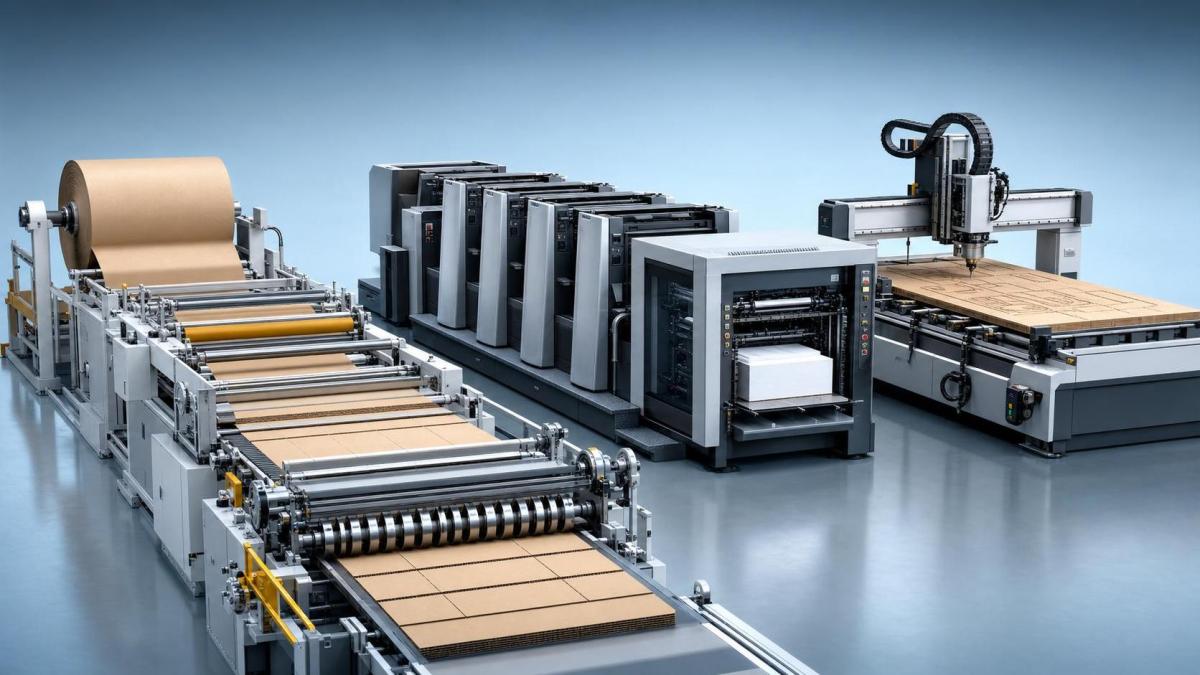
Industrial industry category guides are useful when market labels feel too broad to support a serious equipment decision.
A corrugated board line, an offset press, and a CNC router may all sit inside industrial manufacturing, yet their cost logic is completely different.
That is where industrial industry category guides become practical rather than academic.
They help separate process-critical segments, compare supplier depth, and expose entry barriers that are not visible in generic market summaries.
In paper and wood processing, this matters even more because machine value comes from hidden system performance.
Speed alone is not enough.
Registration stability, glue control, chip evacuation, traceability, energy use, and software integration often decide real return.
PWFS follows this industrial landscape from that exact angle.
Its coverage of corrugated lines, high-precision offset presses, die-cutting and folder-gluer systems, CNC woodworking routers, and edge banders reflects how packaging and living-space production actually works.
Instead of treating equipment as isolated products, the better approach is to read each category as a production capability with its own physics, compliance burden, and automation path.
That shift makes industrial industry category guides valuable for cost control and risk screening from the very beginning.
When does one category become several different buying decisions?
This usually happens when a segment contains very different production goals under one familiar name.
Take printing as an example.
A high-output offset press for folding cartons is not judged by the same logic as a press chosen for strict food-grade migration control.
The same pattern appears in woodworking.
A CNC router for custom panel furniture must handle changing designs, drilling patterns, nesting efficiency, and fast data transfer from CAD.
A machine built for repetitive components may prioritize cycle stability instead.
Good industrial industry category guides break these differences into decision layers:
- Core production process: forming, printing, cutting, folding, drilling, sealing.
- Output profile: long runs, mixed runs, customized batches, or rush delivery.
- Tolerance demands: micron-level registration, cut accuracy, edge finish, bonding quality.
- Compliance exposure: FSC traceability, food-contact rules, emissions, workplace safety.
- Digital maturity: MES connectivity, recipe management, remote diagnostics, data feedback.
Once these layers are clear, a category stops being a vague label and becomes a structured buying decision.
That is the real purpose of industrial industry category guides.
How should buyers compare segments without getting lost in technical claims?
A simple way is to compare each segment by production risk, not by brochure language.
The table below works well as a first filter.
In practice, industrial industry category guides are most helpful when they turn claims into verification points.
Ask what happens during difficult runs, fast changeovers, mixed materials, or tight compliance audits.
Those situations reveal the true difference between segments and suppliers.
What separates a credible supplier from a catalog assembler?
The clearest sign is whether the supplier can explain process outcomes, not only machine features.
For example, a serious offset press source should discuss dot gain, substrate behavior, washup time, and food-grade ink constraints.
A serious CNC supplier should explain tool loading, thermal behavior, software nesting logic, and maintenance intervals under real throughput.
This is where industrial industry category guides support supplier evaluation very well.
They help identify whether a vendor owns engineering knowledge or simply integrates purchased components.
Useful signals include:
- Documented installations in similar output ranges and material types.
- Clear commissioning scope, not vague startup promises.
- Named standards for traceability, migration, safety, or environmental control.
- Evidence of software integration with MES, ERP, or design systems.
- Service structure for critical spares, remote support, and operator training.
PWFS often frames this question through process intelligence.
That includes compliance interpretation, kinematics, overprint behavior, flexible manufacturing logic, and the economics of automation.
Those are stronger indicators than polished sales language.
Where do entry barriers really show up in packaging and woodworking equipment?
Entry barriers rarely appear as one dramatic obstacle.
They usually appear as a stack of smaller barriers that compound over time.
For corrugated lines, barrier strength comes from thermal process tuning, line synchronization, and field service capability across very large machines.
For offset presses, barrier strength sits in precision mechanics, ink-water balance, and repeatable color under speed.
For die-cutters and folder-gluers, the challenge is stable high-speed geometry.
For CNC routers and edge banders, the barrier includes software flow, motion control, and finish quality under customization pressure.
Industrial industry category guides are useful here because they connect entry barriers to commercial consequences.
A supplier that cannot cross these barriers may offer a lower price, yet create expensive instability later.
More common warning signs include:
- Strong nominal speed, but weak performance on mixed orders.
- Imported core parts without proven support coverage.
- No clear answer on consumables, spare parts, or operator learning curves.
- Compliance language copied from standards without implementation detail.
When those signals appear, category analysis should pause the shortlist rather than accelerate it.
How should cost, timeline, and implementation risk be judged together?
The biggest mistake is treating purchase price as the main comparison line.
In capital equipment, lower entry price can hide higher operating cost and slower ramp-up.
Industrial industry category guides help by widening the cost view.
A realistic review should include installation complexity, utilities, tooling, waste rate, skill transfer, software adaptation, and post-startup stability.
For packaging lines, short startup with unstable output is usually worse than a slightly longer but controlled commissioning phase.
For furniture production, flexible equipment only creates value if digital orders, nesting files, drilling logic, and finishing steps connect smoothly.
A practical review sequence often looks like this:
- Define the dominant order mix and quality threshold.
- List the hidden constraints around compliance, utilities, and staffing.
- Compare suppliers by ramp-up risk, not headline speed.
- Request proof from similar installations and difficult operating cases.
- Model cost over several years, including waste and downtime.
This is where industrial industry category guides become decision tools instead of content assets.
What is the smartest next step after reading industrial industry category guides?
Use the guide to build a category-specific question set before contacting any supplier.
That question set should reflect output mix, tolerance needs, compliance exposure, automation goals, and service expectations.
In other words, move from broad market interest to measurable decision criteria.
PWFS is relevant in this stage because its view spans packaging and woodworking as connected production ecosystems.
Its intelligence focus on registration physics, die-cutting dynamics, traceability, digital manufacturing, and flexible customization helps sharpen what should be verified.
The most useful outcome is not a quick ranking.
It is a cleaner decision frame.
When industrial industry category guides are used well, they show which segment truly fits the production model, which supplier can support it, and which entry barriers protect long-term value.
From there, the next move is straightforward: define the must-have process outcomes, test supplier evidence against those outcomes, and compare lifecycle cost before approving the shortlist.
Related News
Get weekly intelligence in your inbox.
No noise. No sponsored content. Pure intelligence.
