
Precision Woodworking Tools High Accuracy: Which Tolerances and Specs Matter Most?
Precision Woodworking Tools High Accuracy: Which Tolerances and Specs Matter Most?
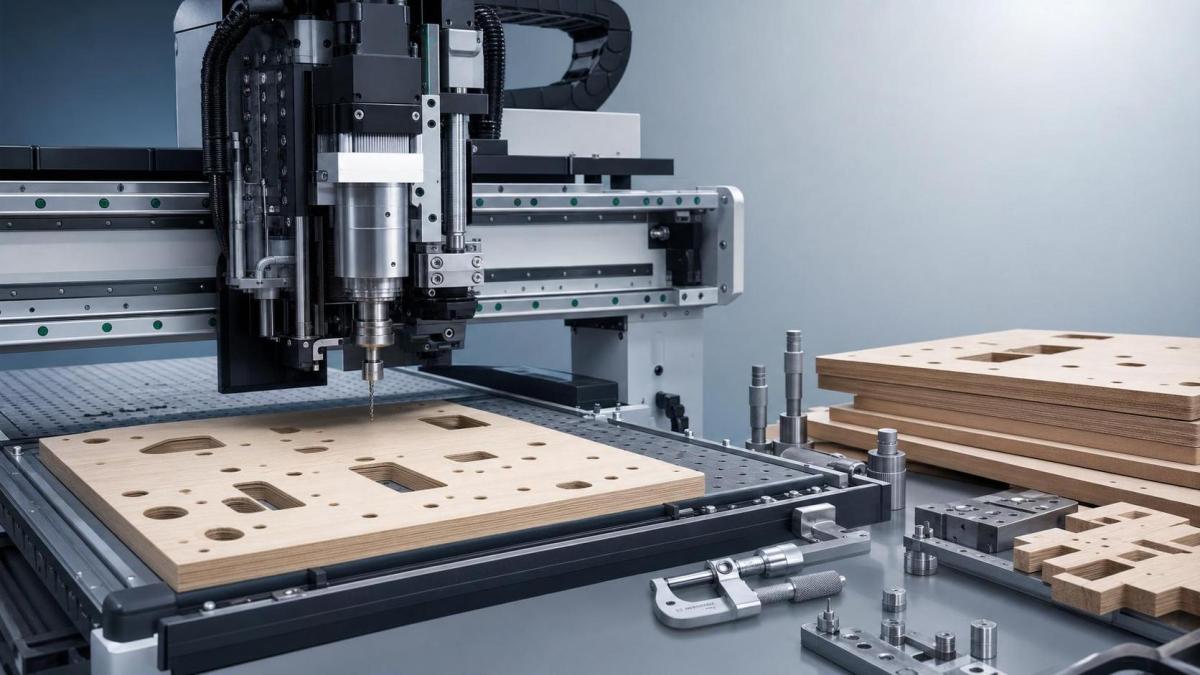
In precision woodworking, tiny errors rarely stay tiny for long.
A 0.2 mm drift can become a visible gap, a failed dowel fit, or a cabinet line that looks off.
That is why precision woodworking tools high accuracy should be judged by measured performance, not brochure language.
In day-to-day production, the specs that matter most are tolerances, repeatability, spindle behavior, axis motion, and thermal stability.
These numbers decide whether nested parts assemble cleanly and whether custom orders can move fast without rework.
For CNC routers, drilling cells, and custom furniture lines, the real question is simple.
Which specifications actually protect cut quality, fit consistency, and throughput under production conditions?
Start With Tolerance, But Separate Accuracy From Repeatability
Many buyers look at one accuracy number and stop there.
That is usually where confusion begins.
In precision woodworking tools high accuracy, accuracy means how close the tool reaches the commanded position.
Repeatability means whether it returns to that same position every time.
For furniture parts, repeatability often matters more than absolute positioning.
If every panel is consistently off by the same tiny amount, software compensation may fix it.
If the error changes from part to part, fitting problems multiply quickly.
Useful tolerance ranges in practice
- Panel sizing tolerance for nested furniture parts: usually within plus or minus 0.10 to 0.20 mm.
- Hole-to-edge location tolerance for connectors: often within plus or minus 0.05 to 0.15 mm.
- Repeat positioning on axis return: ideally within plus or minus 0.02 to 0.05 mm.
- Diagonal consistency across large panels: more important than a single edge reading.
When comparing precision woodworking tools high accuracy, ask whether the stated value is positioning accuracy, bidirectional repeatability, or test-piece tolerance.
Motion System Specs Usually Predict Real Cutting Consistency
Machine motion quality drives most dimensional results.
A rigid frame helps, but servo tuning, guideways, rack quality, and backlash control matter just as much.
From recent market changes, faster custom production has pushed motion specs into the center of purchase decisions.
More small-batch orders mean more starts, stops, short moves, and direction changes.
That also means weak acceleration control shows up faster than before.
Motion specs worth checking
- Backlash value under load, not just unloaded lab conditions.
- Servo response during rapid reversals and corner transitions.
- Linear guide preload and wear resistance over long duty cycles.
- Rack-and-pinion or ballscrew pitch error compensation capability.
- Maximum acceleration that remains stable while cutting, not only in air moves.
Precision woodworking tools high accuracy should keep path fidelity during circles, pockets, and short linear segments.
If corners overcut or arcs flatten, the issue is often motion control, not only tool sharpness.
Spindle Runout and Vibration Matter More Than Peak Power
A powerful spindle can still produce poor edges.
For precision woodworking tools high accuracy, spindle runout is one of the most important indicators.
Excess runout enlarges kerf width, worsens chip load balance, and shortens tool life.
It also creates visible edge fuzz, burn marks, and unstable hole diameters.
That problem becomes more obvious in MDF, plywood veneer, and laminated decorative boards.
What to ask for on spindle performance
- Measured spindle runout at the taper or collet.
- Runout measured at tool length, not only at the spindle nose.
- Bearing temperature rise during long production cycles.
- Vibration amplitude across common RPM ranges.
- Toolholder and collet quality control standard.
As a rule, lower runout supports cleaner edges and more reliable drilling.
In real production, this often matters more than chasing the highest spindle kilowatt rating.
A stable 9 kW spindle can outperform a poorly controlled 12 kW spindle on finished part quality.
Thermal Drift, Tool Measurement, and Z-Axis Control Decide Assembly Fit
The more demanding signal today is not only speed, but stable quality across long shifts.
That makes thermal behavior a major part of precision woodworking tools high accuracy.
As spindles warm up and gantries cycle repeatedly, dimensions can drift.
Even small Z-axis shifts change groove depth, blind hole depth, and hinge cup quality.
This is especially critical in whole-house customization, where mixed hardware systems must fit first time.
Watch these control points
If panel hold-down is uneven, even the best precision woodworking tools high accuracy will struggle to deliver repeatable depth control.
Look at the Whole Process, Not Just the Machine Nameplate
A machine can be mechanically strong and still miss production targets.
Precision woodworking tools high accuracy depend on the full process chain.
Tool balance, dust extraction, board material variation, and CAM strategy all affect final tolerance.
In actual factory work, poor chip evacuation often causes more edge damage than operators expect.
Heat builds up, the tool starts rubbing, and the measured size begins to wander.
Common hidden causes of poor accuracy
- Worn collets that no longer clamp concentrically.
- Tool deflection from aggressive feed settings.
- Insufficient vacuum on smaller nested parts.
- Poor calibration after transportation or floor settling.
- Mixed sheet thickness from different material lots.
This is why acceptance testing should include real materials, real toolpaths, and full-shift conditions.
A simple demo cut on one panel rarely proves high-accuracy woodworking performance.
How to Evaluate Precision Woodworking Tools High Accuracy Before Buying
The best buying method is practical and measurable.
Ask suppliers to show data, test methods, and tolerance stability over time.
For precision woodworking tools high accuracy, one clean sample is not enough evidence.
You need repeated cuts, measured offsets, and process records.
A practical evaluation checklist
- Run ten identical parts and measure all critical dimensions.
- Check hole location consistency after multiple tool changes.
- Test part quality at the start and end of a long shift.
- Measure spindle runout with the actual production tool installed.
- Verify vacuum hold-down on small and narrow parts.
- Inspect edge finish, not only dimensional readings.
- Ask for maintenance intervals affecting accuracy retention.
A capable supplier should explain how their control system manages compensation, calibration, and wear monitoring.
That conversation often reveals more than the catalog sheet.
The Specs That Matter Most
When all the noise is removed, a few metrics decide the outcome.
For precision woodworking tools high accuracy, focus first on repeatability, backlash control, spindle runout, thermal stability, and Z-axis depth consistency.
Then confirm those numbers under actual production loads.
That is where theoretical precision becomes usable precision.
In a market shaped by mass customization and faster delivery, that difference has direct cost impact.
Fewer rejects, cleaner assembly, and less adjustment time all come from the same source.
Measured control over the process.
When reviewing the next machine, use the specs to predict results on the shop floor, not just features on a sales page.
Related News
Get weekly intelligence in your inbox.
No noise. No sponsored content. Pure intelligence.
