
Whole House Customization Equipment: Key Machine Configurations for Flexible Batch Production
Why machine configuration changes with production reality
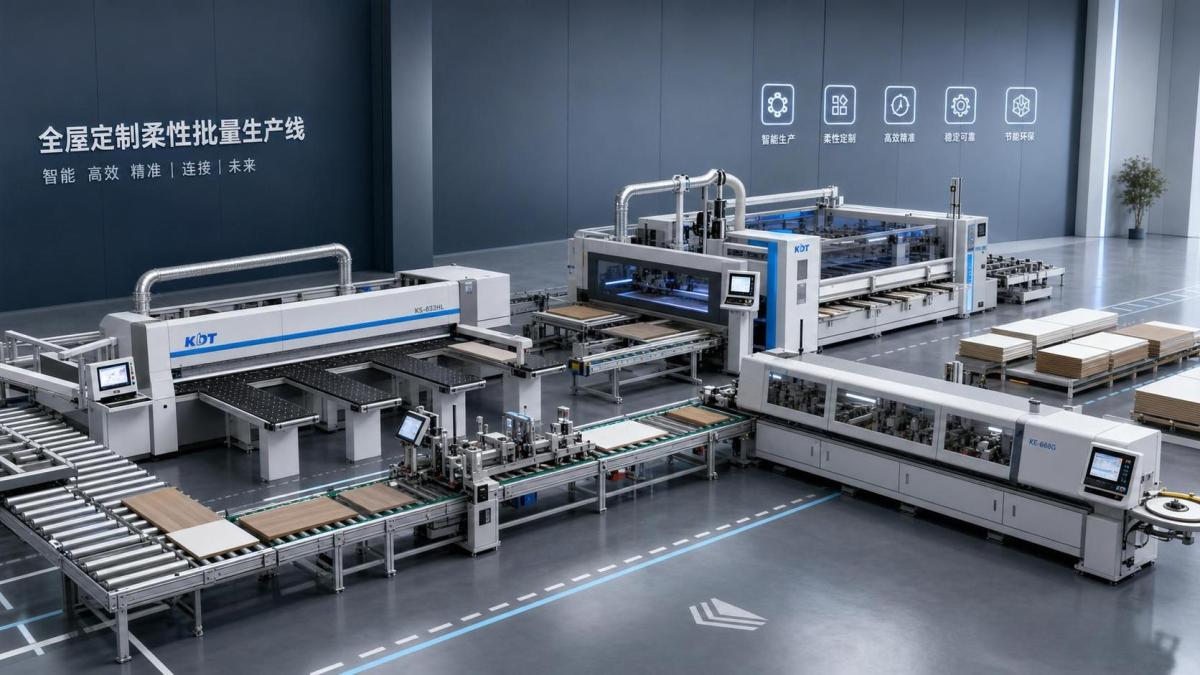
Whole house customization equipment is rarely judged by headline speed alone. In practice, the right setup depends on order structure, panel variety, lead time pressure, and the level of digital coordination across the line.
A plant producing repeated cabinet modules faces different constraints from one handling mixed wardrobes, wall panels, vanity units, and small-batch add-on pieces. Both use CNC routers and edge banders, yet their bottlenecks appear in different places.
This is where PWFS brings useful context. Its long view across corrugated, printing, die-cutting, and woodworking systems highlights one shared rule: flexible manufacturing only works when machine rhythm, material flow, and data accuracy stay aligned.
For whole house customization equipment, that alignment usually starts with cutting and drilling, then extends to edge sealing, part identification, sorting, and recovery from order changes. A strong configuration supports variety without losing control.
When orders are fragmented, nesting and drilling become the first decision point
A common production situation involves many SKUs, changing dimensions, and short delivery windows. In that environment, whole house customization equipment must reduce setup loss before it tries to maximize absolute machine speed.
More useful than a single large router is often a matched CNC cell. That usually means auto-loading, label printing, optimized nesting, drilling capability, and a stable unloading path for irregular parts.
If the product mix includes cabinets with standard geometry, a machining center with fast tool change may be enough. When orders include complex grooves, hidden connectors, and diverse hole patterns, multi-process flexibility matters more.
In actual use, the better question is not whether a 4-axis or 5-axis machine sounds advanced. The better question is whether programming complexity, tool path efficiency, and maintenance burden match daily order behavior.
What usually matters in this scenario
- Nesting software accuracy for mixed panel dimensions and grain direction.
- Spindle and drill block configuration for repeated hole patterns.
- Tool magazine capacity when styles change frequently.
- Label traceability before parts leave the cutting zone.
- Dust extraction stability, especially with thin decorative boards.
Stable edge quality becomes critical when finish expectations rise
Not every whole house customization equipment project is driven by speed. Premium residential orders often fail on appearance consistency, edge durability, or low-emission expectations rather than on raw throughput.
That shifts the equipment focus toward edge banding technology. EVA systems may fit cost-sensitive runs, while PUR or laser edge banding is often chosen where moisture resistance, seam appearance, and environmental positioning carry more weight.
The mistake here is to compare glue systems in isolation. Edge quality also depends on panel conditioning, pre-milling precision, pressure section stability, and downstream cleaning and corner rounding performance.
PWFS often frames these choices through process physics, not sales language. That matters because a beautiful sample piece tells little about long-shift performance under adhesive buildup, ambient temperature changes, and mixed board materials.
Different production scenes, different edge bander priorities
Sorting and material flow matter more once output starts scaling
Many lines underperform because investment stops at the core machines. The CNC and edge bander may be strong, yet the factory still struggles with part searching, queue imbalance, and mis-sequenced assembly kits.
For flexible batch production, whole house customization equipment should be viewed as a coordinated system. Intelligent buffers, return conveyors, robotic sorting, and WMS or MES links often decide whether the line stays predictable.
This is similar to what high-speed packaging lines learned years ago. In corrugated and folder-gluer systems, upstream speed means little when downstream transfer logic breaks. Woodworking lines face the same operational truth.
If batch size is small but order count is high, part identification accuracy becomes more valuable than adding another standalone machine. Lost parts, rework, and resorting can quietly erase the gains from faster cutting.
Signals that material flow should be upgraded first
- Finished parts wait longer than raw panels.
- Assembly kits are delayed by missing labeled components.
- Rework is caused by routing mistakes, not machining defects.
- The edge bander idles because upstream release is unstable.
The same whole house customization equipment is not ideal for every business mix
A business focused on apartment projects often benefits from semi-standard modules and stronger takt control. A studio handling individualized home layouts usually needs higher tolerance for design variation and late-stage change orders.
That difference affects the entire machine strategy. Project-driven production may justify more automated feeding, buffering, and batch balancing. Design-driven production often benefits from software integration, quick correction loops, and flexible tooling.
There is also a meaningful distinction between board processing and visual finishing. Some operations need only functional machining. Others depend on decorative panel protection, precise edge appearance, and low damage handling from cut to pack.
Within the broader PWFS perspective, this is why woodworking equipment cannot be separated from adjacent industries. Packaging lines teach discipline in traceability and flow. Printing lines teach process tolerance and repeatability. Both lessons transfer well.
Common misjudgments appear before the first board is processed
One frequent error is buying whole house customization equipment around peak theoretical speed. That works poorly when order data is messy, panel storage is inconsistent, or software cannot push clean instructions to the machine layer.
Another is treating similar board materials as interchangeable. Melamine panels, plywood, MDF, and moisture-resistant boards behave differently during cutting, drilling, and edge sealing. Tool wear, chip evacuation, and glue performance shift with them.
Implementation cost is also easy to underestimate. A stronger CNC cell may require power upgrades, dust collection redesign, spare tool management, and operator retraining. None of those appear attractive in a brochure, but all affect payback.
The most expensive mismatch is often digital. If CAD, nesting, labels, and MES records do not speak the same language, flexible production becomes manual firefighting hidden behind expensive equipment.
A practical way to choose the next configuration step
A sound decision process starts with production evidence, not model preference. Track where orders stall, where rework begins, and which product types create the most instability. That usually reveals the right upgrade sequence.
For many facilities, the path is clear: stabilize data, secure cutting and drilling accuracy, protect edge quality, then strengthen sorting and closed-loop flow. Only after that does pure capacity expansion make consistent sense.
When evaluating whole house customization equipment, compare at least five conditions side by side: order mix, panel material, finish expectations, digital readiness, and maintenance capability. Those factors explain most long-term performance gaps.
The next useful step is to build a scenario matrix for current orders and expected growth. From there, machine selection becomes more disciplined, implementation risk becomes visible, and flexible batch production becomes something measurable rather than assumed.
Related News
Get weekly intelligence in your inbox.
No noise. No sponsored content. Pure intelligence.
