
CNC Woodworking Router Basics: What It Does, Common Configurations, and Best-Fit Jobs
A CNC woodworking router sits at the center of modern panel processing because it turns digital design data into repeatable cutting, drilling, grooving, and shaping with far less manual intervention. In furniture, interior fit-out, and custom cabinet production, that matters not only for speed, but also for accuracy, nesting efficiency, and the ability to deliver high-mix orders without rebuilding the entire workflow.
That is why the topic has moved beyond machine comparison alone. Across the broader paper-and-wood manufacturing landscape tracked by PWFS, the real value of a CNC woodworking router is its role inside a connected production chain, where CAD, MES, material optimization, edge processing, and final assembly all depend on precise upstream machining.
What a CNC woodworking router actually does
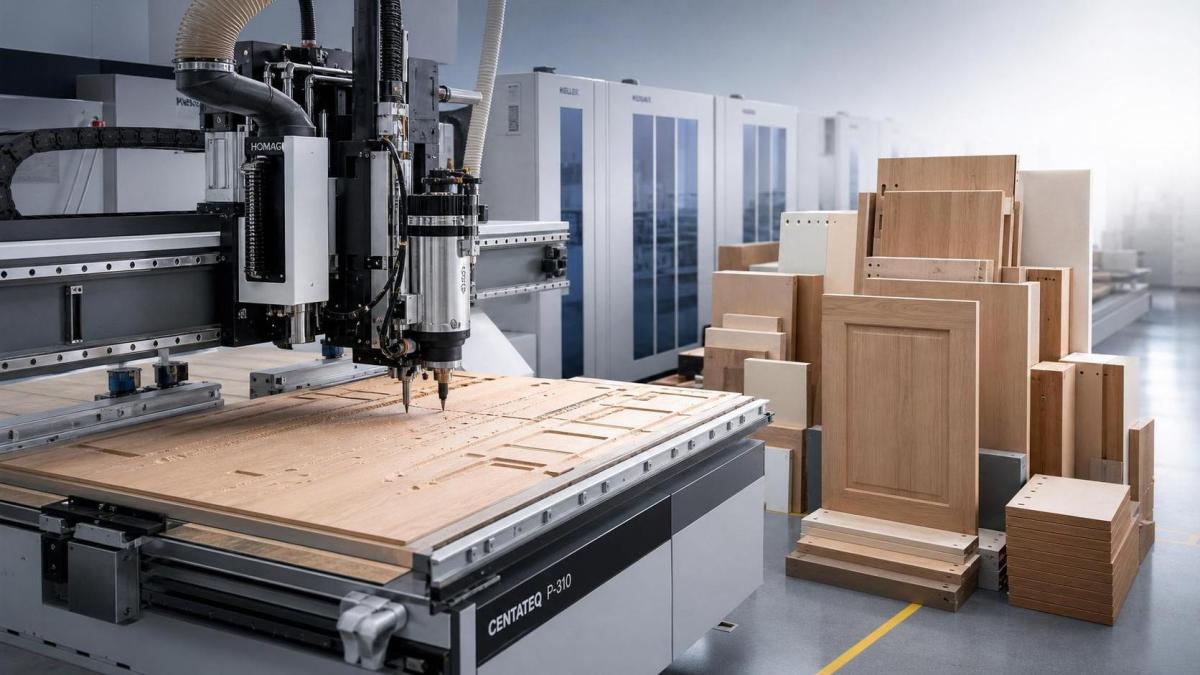
At a basic level, a CNC woodworking router is a computer-controlled machine that moves a spindle and tooling across a worktable to process wood-based panels. It reads production instructions from software, then executes each path with controlled speed, depth, and position.
In practical terms, the machine handles several core tasks in one digital sequence. It can cut panel outlines, drill vertical and horizontal holes, mill slots, carve contours, and create joinery features that would otherwise require several separate machines or substantial handwork.
For flat-pack furniture and whole-house customization, this matters because every panel can be different while still being manufactured from the same digital backbone. A single CNC woodworking router may process wardrobes, kitchen cabinets, bathroom vanities, shelving parts, and decorative components within the same shift.
Its value becomes clearer when compared with manual routing or standalone drilling. The router does not simply automate motion. It standardizes dimensions, improves repeatability, reduces layout errors, and makes design changes easier to implement at scale.
Why the machine draws so much industry attention
The growing interest in CNC router systems is tied to a wider manufacturing shift. Order volumes are less predictable, batch sizes are smaller, finish expectations are higher, and delivery cycles are shorter. In that environment, flexibility becomes a production asset rather than a convenience.
PWFS often frames this through the logic of industrial coordination. In packaging, precision printing and die-cutting only create value when every stage remains synchronized. In woodworking, the same principle applies. A CNC woodworking router becomes more valuable when it works as part of a streamlined chain that includes design software, label identification, sorting, edge banding, and installation-ready output.
Another reason for the attention is labor structure. Skilled manual carpentry remains important, but routing knowledge is increasingly embedded in software libraries, tool databases, and machining templates. That changes the economics of training, consistency, and expansion.
More importantly, the machine supports business models built on customization. When every apartment, retail display, or office project has different dimensions, a digital cutting platform is no longer optional. It becomes the mechanism that keeps customization commercially manageable.
Common configurations and how they differ
Not every CNC woodworking router is built for the same production logic. Some are designed for compact shops and varied orders. Others are built for continuous panel throughput, automatic loading, and highly standardized workflows.
Entry and mid-range nesting routers
These machines usually feature a flat table, vacuum hold-down, and one spindle or a simple tool-change setup. They fit operations that need flexible cutting for cabinets, closets, doors, or display components without full-line automation.
Their strength is accessibility. They are easier to deploy, easier to program, and often sufficient for businesses where product variety is high but daily output remains moderate.
Automatic tool-change models
An ATC CNC woodworking router adds productivity by switching tools automatically during a job. This allows one panel to move through cutting, slotting, drilling, and profiling with fewer pauses and less operator involvement.
That is often the preferred balance for factories handling many SKUs, especially when cycle time and setup losses start to erode profitability.
Multi-process and drilling-integrated systems
Some configurations combine spindle routing with vertical drills, horizontal drills, saw blades, or aggregate heads. These are aimed at panel furniture lines where hole accuracy and process consolidation matter as much as cutting speed.
By reducing secondary handling, they improve flow into edge banding and assembly. They also help keep part identification and orientation under control.
Five-axis machines
A 5-axis CNC woodworking router is used when parts require angled machining, complex surfaces, sculptural forms, or blind-area access. These machines are common in advanced furniture, staircase parts, molds, custom interiors, and specialty wood components.
They deliver exceptional flexibility, but they also demand stronger programming discipline, better fixture planning, and higher investment.
Best-fit jobs for a CNC woodworking router
The best application is not always the most complex one. A CNC woodworking router performs especially well where design variation is high, dimensions must stay tight, and part data needs to move quickly from screen to shop floor.
- Cabinet and closet panels with frequent size changes and drilling patterns.
- Whole-house customization projects with room-by-room variation.
- Office and retail interiors where installation speed depends on accurate prefabrication.
- Decorative wood parts that need shaped profiles or carved details.
- Short to medium production runs where setup reduction is commercially important.
The machine is less compelling when output consists of very simple, highly repetitive rectangular parts that can be processed more economically on dedicated saws and boring lines. In other words, flexibility creates the strongest return when complexity, variation, or data-driven production is present.
How to judge value beyond headline specifications
A router comparison should go further than spindle power and maximum travel. Those numbers matter, but they rarely explain total production performance on their own.
In actual use, software compatibility is often decisive. A CNC woodworking router should communicate cleanly with CAD/CAM systems, optimization software, barcode workflows, and plant-level data systems. If data transfer is unstable, mechanical performance alone will not protect throughput.
Vacuum quality, dust extraction, tool management, and chip evacuation also deserve attention. Routing accuracy is not only about servo control. It depends on stable workholding, clean cutting conditions, and predictable bit life.
Service logic matters as well. Tool libraries, post-process support, spare parts access, and training quality can influence long-term output more than a marginal gain in nominal speed.
- Match machine type to order structure, not just annual volume.
- Check whether the CNC woodworking router fits downstream edge banding and assembly flow.
- Review tooling strategy for chipboard, MDF, plywood, and specialty boards separately.
- Measure expected yield losses from mislabeling, remakes, and handling, not only cutting time.
- Test digital workflow stability with real production files before final judgment.
Where the next layer of evaluation should go
For a grounded assessment, the next step is to map the machine against real production scenarios rather than abstract capability lists. A strong evaluation usually starts with part families, order mix, board materials, labeling method, and the handoff into edge banding or assembly.
From there, it becomes easier to compare whether a basic nesting platform, an ATC CNC woodworking router, or a more integrated line will produce the best balance of flexibility, consistency, and capital efficiency.
That broader systems view is also where PWFS adds useful context. The same logic that improves precision in packaging lines applies here: digital continuity, process synchronization, and stable output matter more than isolated machine claims. A CNC woodworking router is most valuable when it supports a complete manufacturing rhythm, not just a single cutting task.
A practical next move is to build a shortlist around three things: the jobs that define daily workload, the configuration that removes the biggest bottleneck, and the data flow needed to keep customization profitable over time.
Related News
Get weekly intelligence in your inbox.
No noise. No sponsored content. Pure intelligence.
