
What Is MES for Furniture Manufacturing and Which Processes Should It Control First?
MES for furniture manufacturing has moved from a digital upgrade topic to an operational necessity. Panel furniture production now runs on tighter delivery promises, smaller batches, more SKU variation, and less tolerance for workshop errors.
That pressure is strongest where design data meets machines. A cabinet order may look simple on screen, yet it becomes dozens of parts, labels, holes, edges, and routing decisions on the shop floor.
In that environment, MES for furniture manufacturing is not just a reporting tool. It is the execution layer that connects ERP, CAD/CAM, CNC routers, drilling cells, edge banders, operators, and quality records into one controlled production flow.
Where MES fits in furniture production
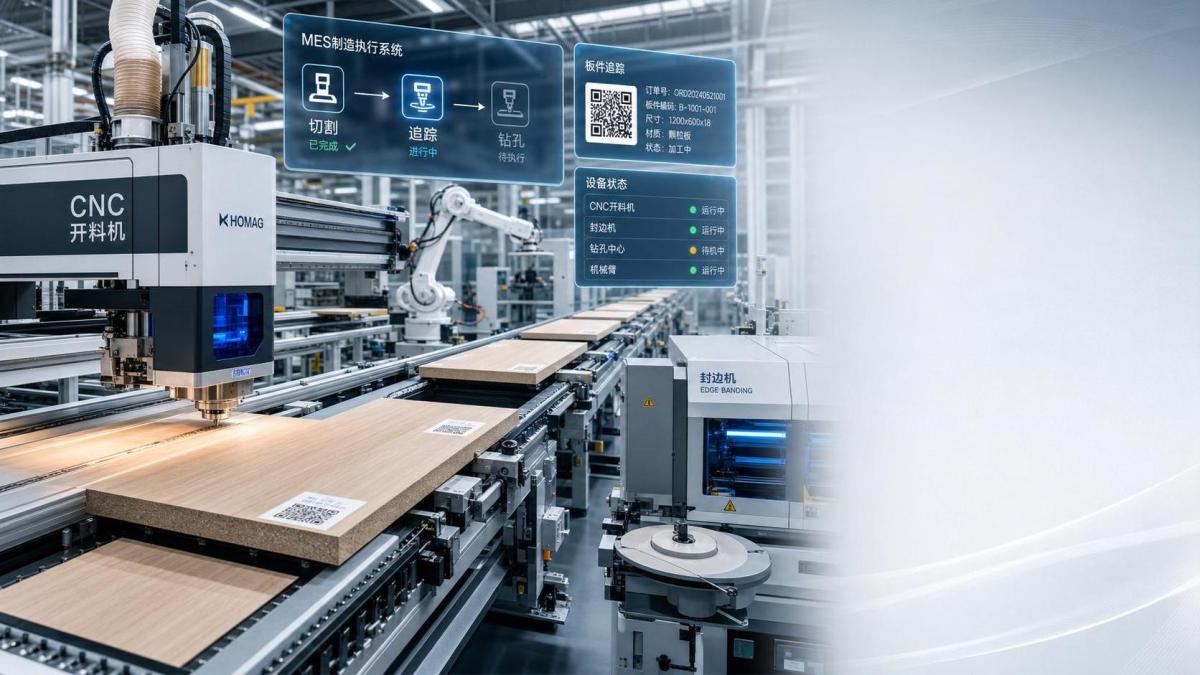
Furniture factories, especially panel-based operations, do not struggle only with capacity. They struggle with synchronization. A cutting line may run fast while drilling waits for the right panels, or edge banding may rework parts because labels and routing data were not matched correctly.
MES for furniture manufacturing sits between planning and physical execution. It translates orders into work instructions, dispatches jobs by priority, tracks each part across stations, and captures what really happened at machine level and operator level.
This matters even more in the wider paper and wood automation landscape observed by PWFS. Across corrugated lines, offset presses, die-cutters, and CNC woodworking equipment, the same pattern appears: output rises only when data continuity reaches the machine, not when software remains isolated in the office.
What MES for furniture manufacturing actually controls
A useful MES should control execution details that affect delivery, traceability, and yield. It should not stop at dashboard visibility.
In practical terms, MES for furniture manufacturing often covers these functions:
- Order release by due date, material status, and production rules
- Part-level identification through barcodes, QR codes, or RFID
- Machine program distribution to saws, nesting CNCs, and drilling centers
- Work-in-progress tracking across each routing step
- Exception handling for missing parts, rework, and urgent inserts
- Quality confirmation, defect coding, and genealogy records
- Labor, machine, and order performance feedback
The key idea is simple. MES should control decisions that operators previously handled through paper lists, memory, and verbal coordination.
Why the first control points matter more than a full rollout
Many projects fail because they try to digitize everything at once. Furniture production contains too many moving parts for that approach to work well.
A better path is to start where errors multiply downstream. In panel furniture, one wrong cut, one mislabeled part, or one incorrect drilling pattern can create delays across assembly, packing, and delivery.
That is why the first phase of MES for furniture manufacturing should focus on the process steps that define part identity and part readiness. Once those are stable, later stations become easier to schedule and audit.
The processes MES should control first
1. Cutting and nesting execution
Cutting is the foundation. Whether the factory uses beam saws or nesting CNC routers, this stage defines part size, part count, material consumption, and the first traceability point.
MES for furniture manufacturing should release the correct cutting job, confirm board type, issue the right machine program, and attach a unique identity to each part immediately after cutting.
If this step remains manual, every downstream process inherits uncertainty.
2. Part labeling and order tracking
Labeling is often underestimated. In custom furniture, the label is the digital passport of the panel. It links the order, component name, dimensions, edge requirements, drilling pattern, hardware relation, and destination cabinet or room.
Without strong label control, MES becomes blind between machines. With it, MES for furniture manufacturing can track every panel through rework, buffering, sorting, and final kit completion.
3. Drilling and routing verification
Blind holes, hinges, connectors, slots, and hardware locations directly affect final assembly. Drilling errors are expensive because they may not be visible until assembly starts.
The MES layer should send the right program, confirm the right part arrived, and record completion status. Where possible, it should also capture alarms, cycle time, and scrap causes.
4. Edge banding control
Edge banding combines appearance, durability, and compliance. Wrong tape color, wrong glue system, or missed edge direction can turn a finished panel into scrap.
For that reason, MES for furniture manufacturing should control edge recipes, machine assignment, queue sequencing, and confirmation of completed edges. This is especially important with PUR, laser edge banding, and mixed material orders.
5. Rework and missing-part handling
Factories often digitize standard flow and ignore exceptions. Yet exceptions are where delivery dates slip.
An effective MES should identify missing parts fast, trigger recut or redrill tasks, protect priority orders, and update status automatically. This avoids the common workshop habit of solving urgent issues through informal workarounds.
A practical priority map
The first wave should target process control points that drive both accuracy and flow. The sequence below is usually more effective than a broad software-first deployment.
What makes MES valuable in a mixed automation environment
Many factories operate a mix of advanced CNC cells and semi-manual stations. That is common across the broader PWFS ecosystem, where highly automated machines still depend on disciplined data exchange and process timing.
In furniture, MES for furniture manufacturing creates value when it bridges those uneven automation levels. It lets one order move from CAD-driven machining to barcode-based manual inspection without losing context.
That bridge also improves measurement. Instead of asking whether the plant is busy, managers can see whether parts are flowing, where they wait, and why they fail.
Questions worth asking before implementation
The right MES scope depends less on software features and more on process discipline. Several questions help separate useful projects from expensive visibility layers.
- Is the bill of materials accurate at part level, not only order level?
- Can every panel receive a reliable identity at the first machine?
- Do CNC, drilling, and edge banding programs come from one governed data source?
- Are rework routes defined, measured, and visible?
- Can the factory trace a complaint back to material batch, machine step, and operator action?
If the answer is no in several areas, the first target should be execution discipline rather than advanced analytics.
How to move from concept to a workable first phase
A sensible first phase for MES for furniture manufacturing usually starts with one product family, one cutting flow, and a clear tracking standard. That keeps integration manageable while producing measurable evidence.
The next step is to define three things precisely: where part identity begins, where routing decisions change, and where quality must be confirmed before the order can move forward.
From there, software selection becomes easier. Instead of comparing broad claims, the team can test whether the system truly controls cutting, drilling, edge banding, and exceptions in the way the factory actually runs.
That is the practical lens worth using. MES for furniture manufacturing should first control the processes that create traceable parts, protect downstream accuracy, and stabilize delivery performance. Once those are visible and reliable, wider automation decisions become much easier to justify.
Related News
Get weekly intelligence in your inbox.
No noise. No sponsored content. Pure intelligence.
