
Product Information Resources for CNC Machinery Buyers: What to Check Before You Compare
Product Information Resources for CNC Machinery Buyers: What to Check Before You Compare
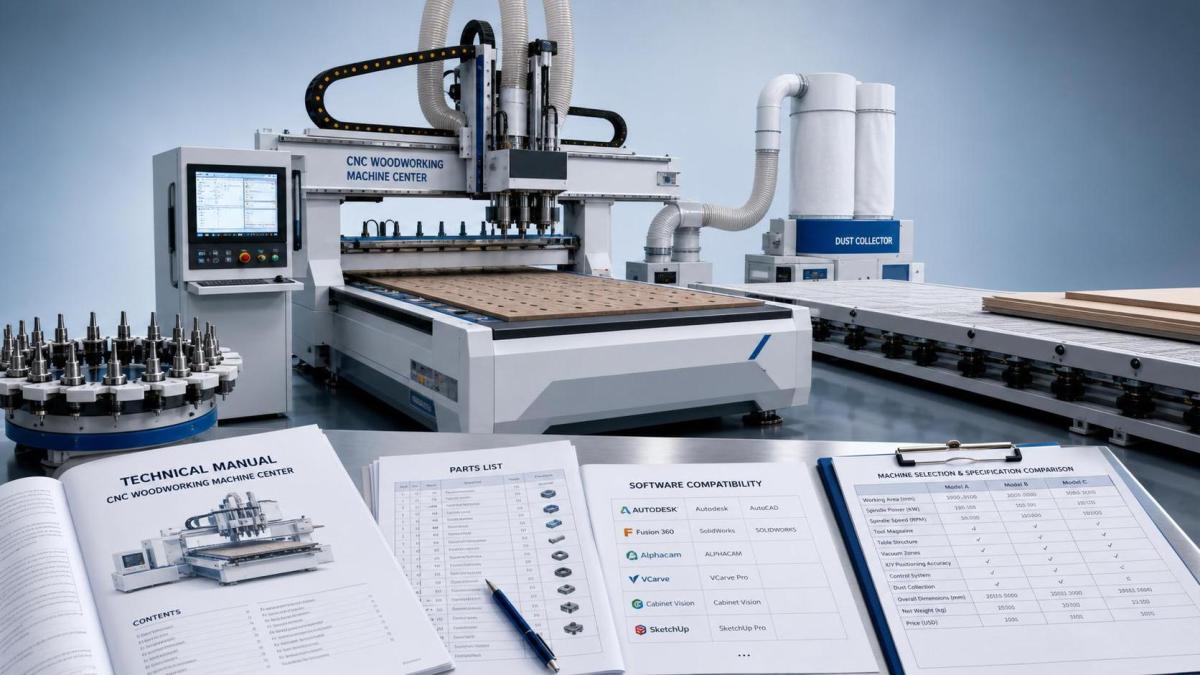
For CNC woodworking equipment, strong product information resources shape better buying decisions from the very beginning.
Price lists alone never tell the full story.
A machine may look competitive on paper, yet fail in software matching, uptime, tool life, or after-sales support.
That is why useful product information resources must go beyond brochures and headline specs.
They should help verify fit, risk, total cost, and production impact before any comparison starts.
In actual sourcing work, this matters even more for furniture, panel processing, and whole-house customization projects.
Cycle time pressure is rising, order sizes are getting smaller, and design variation keeps growing.
This also means product information resources must support faster, more accurate screening.
Start with trustworthy product information resources, not sales slides
The first mistake in CNC comparison is treating all sources as equally reliable.
They are not.
Good product information resources usually include factory test data, installation references, spare parts lists, controller details, and maintenance schedules.
They also show how the machine performs in real production, not only under ideal demo conditions.
When reviewing product information resources, check whether the data comes from:
- OEM technical documents
- Independent industry intelligence portals
- Installed customer case studies
- Operator training manuals
- Service response commitments
- Parts and software support policies
A platform like PWFS is useful here because it connects machinery data with process logic.
That broader view helps compare CNC routers as part of a full production system, not as isolated assets.
Check machine specifications that actually affect production
Many buyers compare spindle power first.
That is important, but incomplete.
The best product information resources explain which specifications change output, quality, and waste.
For CNC woodworking machinery, focus on these points before shortlisting.
Core hardware checks
- Working area and table structure
- Spindle brand, power range, and cooling type
- Tool magazine capacity and tool change speed
- Drive system, guide rails, and rack accuracy
- Vacuum capacity and sheet holding stability
- Dust extraction design and chip removal path
Precision and repeatability checks
- Positioning accuracy under load
- Repeat accuracy after long shifts
- Drilling consistency across panel materials
- Surface finish at different feed rates
- Performance on nested cutting layouts
This is where product information resources become practical decision tools.
If the source cannot show loaded accuracy, continuous output, and tolerance stability, comparison remains shallow.
Review software compatibility before comparing speed claims
A fast machine is not automatically a productive machine.
If software integration is weak, throughput drops long before spindle limits are reached.
Reliable product information resources should clearly state compatibility with CAD, CAM, MES, barcode systems, and nesting software.
From recent market shifts, this has become a bigger buying factor than many expect.
Custom furniture plants increasingly depend on digital order flow, not manual file handling.
Before comparing suppliers, confirm these software questions:
- Which file formats are natively supported?
- Can the controller connect with existing design software?
- Does nesting optimization run automatically or manually?
- Can labels, barcodes, and work orders flow into production?
- How are software updates delivered and maintained?
- Is remote troubleshooting available for control issues?
These details often hide inside technical appendices, which is why deep product information resources matter so much.
Use product information resources to estimate total cost, not just machine price
Low purchase price can be expensive in operation.
That is one of the most common sourcing traps in CNC projects.
High-quality product information resources should support a full cost view over three to five years.
That includes visible costs and hidden costs.
This kind of comparison makes vendor quotes far more transparent.
It also helps explain why one machine with a higher list price may still deliver a better cost outcome.
Validate supplier support with the same rigor as technical specs
Technical performance and supplier support are tightly connected.
Even excellent equipment becomes risky if service coverage is weak.
Strong product information resources should show support depth, not just contact details.
Look for evidence in four areas.
- Local or regional spare parts availability
- Installation and commissioning scope
- Remote diagnostics and software support hours
- Preventive maintenance programs and training plans
A useful signal is response transparency.
If a supplier avoids uptime guarantees, escalation paths, or parts lead times, that should slow the comparison process.
In real operations, service delays often cost more than minor differences in purchase price.
Build a practical comparison checklist before final quotes
The most effective product information resources are the ones you can turn into a repeatable checklist.
This keeps different vendors on the same evaluation standard.
Before requesting final quotations, confirm the following:
- Machine specs match actual board size, thickness, and output targets.
- Software and controller compatibility are proven with current workflows.
- Accuracy data reflects continuous production, not one-time demos.
- Maintenance plans and wear parts costs are documented.
- Supplier service response and spare parts access are verified.
- Total cost model includes tooling, power, labor, and downtime.
- Reference installations match your production scenario closely.
This final step turns product information resources into procurement leverage.
Instead of comparing claims, you compare validated operating value.
For CNC machinery buyers, that is usually the difference between a fast purchase and a smart one.
When product information resources are complete, structured, and realistic, the final decision becomes clearer, lower risk, and far easier to defend internally.
Related News
Get weekly intelligence in your inbox.
No noise. No sponsored content. Pure intelligence.
