
Carton Die Cutting Machines with Blanking: When Blanking Improves Output and Reduces Labor
Carton Die Cutting Machines with Blanking: why the topic matters now
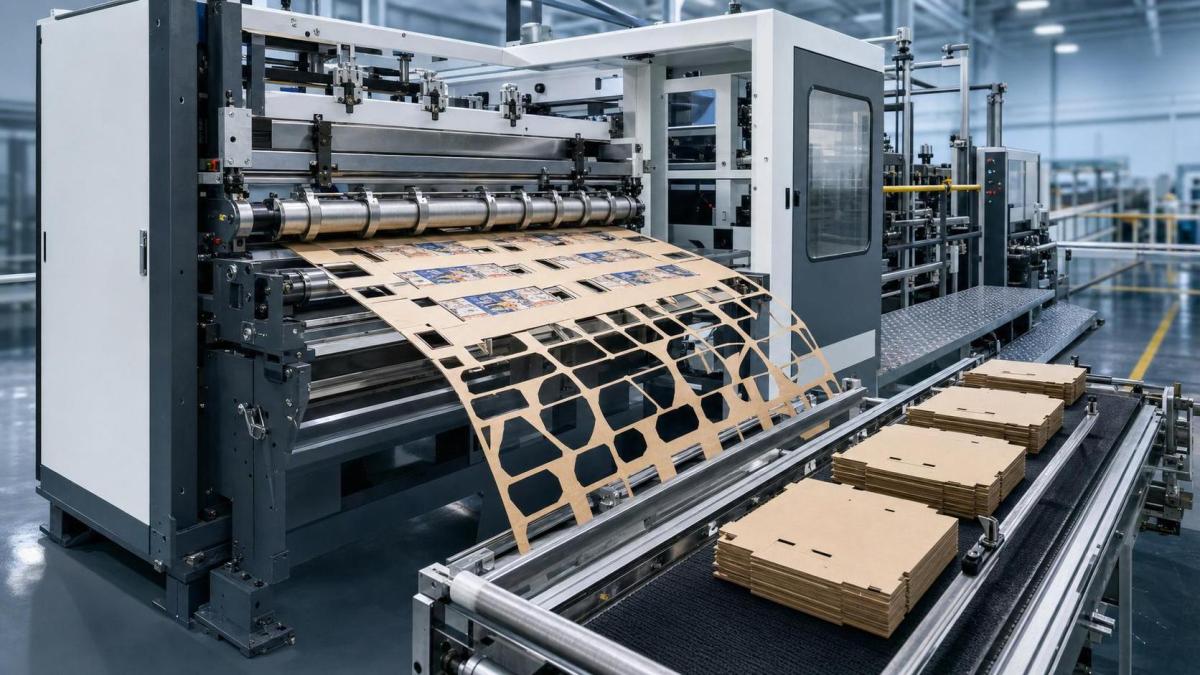
Carton converting is under pressure from two sides at once.
Order cycles are shorter, while labor remains harder to stabilize.
That is why carton die cutting machines with blanking are getting closer attention.
They do more than cut printed sheets into carton shapes.
They also separate usable blanks from the surrounding waste automatically.
In practical terms, that means less hand stripping, fewer touchpoints, and steadier output.
For plants running folding cartons, display packs, or high-volume retail packaging, this changes the economics of the line.
At PWFS, this question sits inside a bigger industrial picture.
Corrugated board lines feed logistics demand, offset presses drive visual quality, and die-cutters shape finished packaging at production speed.
Within that chain, blanking matters because it connects print precision with labor efficiency.
So the real question is not whether blanking sounds advanced.
It is whether carton die cutting machines with blanking improve output enough to justify the added system complexity.
What does blanking actually do in a die-cutting process?
A standard die-cutter cuts, creases, and strips waste from the sheet.
Blanking adds one more step after that.
It pushes the finished carton shapes out of the sheet layout in a controlled way.
The result is a clean pile of usable blanks, already separated from the skeleton.
Without blanking, operators often need to break apart connected pieces manually.
That extra handling slows the line and introduces inconsistency.
Carton die cutting machines with blanking remove much of that downstream effort.
This is especially valuable when layouts are dense or carton shapes are intricate.
In real production, blanking is not only about speed.
It also supports smoother transfer to folder-gluers and packing stations.
That is why high-precision die-cutting lines increasingly treat blanking as a workflow tool, not just an add-on station.
When does blanking improve output in a measurable way?
Blanking creates the strongest value when manual separation is already a bottleneck.
That usually happens in medium to long runs with repeatable layouts.
It also appears when labor cost per shift is rising faster than machine cost per hour.
More importantly, carton die cutting machines with blanking help when throughput depends on stable handoff.
If separated blanks feed directly into folder-gluing, every interrupted stack affects the next process.
Blanking reduces that friction.
A quick screening table helps clarify where the gain is usually strongest.
The common mistake is to judge blanking only by top machine speed.
A better measure is net sellable blanks per labor hour.
That is where carton die cutting machines with blanking often outperform standard configurations.
Which jobs are the best fit, and which ones are not?
The best fit is usually folding carton work with stable substrates and repeat geometry.
Pharma cartons, cosmetics packs, food sleeves, and branded retail boxes are common examples.
These jobs value clean edges, pile quality, and efficient transfer into finishing.
Blanking also supports plants where offset printing quality is already high.
Once registration and die-cut accuracy are under control, labor reduction becomes the next obvious target.
That is consistent with the PWFS view of integrated production intelligence.
Precision in printing only pays fully when converting can keep pace.
Still, not every job needs carton die cutting machines with blanking.
Very short runs, unstable board quality, or highly variable designs can reduce the benefit.
If jobs change constantly and tooling discipline is weak, blanking may add operational stress.
In those cases, a strong stripping system and flexible scheduling may bring a better return.
The useful question is simple: does the job mix reward automation, or punish changeover?
How should you compare carton die cutting machines with blanking against standard die-cutters?
The comparison should go beyond catalog speed and pressure ratings.
A machine may look fast on paper yet lose time in handling, pile instability, or tool adjustment.
When comparing carton die cutting machines with blanking, focus on the full conversion path.
- Net output after separation, not gross sheets per hour.
- Operator requirement per shift, including stripping and repiling tasks.
- Setup repeatability for blanking tools and changeover parts.
- Pile quality for the next folder-gluer or packing stage.
- Waste behavior on thin, coated, or embellished board grades.
- Integration with inspection, MES, and production traceability.
This last point matters more than it used to.
Plants moving toward data-driven scheduling need machine states that are visible and measurable.
PWFS often frames automation this way across print and woodworking systems.
The value is not only mechanical motion.
It is the ability to turn skilled, manual judgment into repeatable process control.
Where do projects go wrong after choosing blanking?
Most problems start before installation, not after startup.
The first issue is poor job analysis.
If the real bottleneck is printing, curing, or folder-gluer uptime, blanking will not fix the line.
The second issue is underestimating tooling and setup discipline.
Carton die cutting machines with blanking reward repeatability.
They also expose weak process control very quickly.
Another risk is assuming labor savings appear instantly.
In reality, benefits grow when scheduling, stack logistics, and downstream flow are adjusted together.
A short implementation checklist is usually more useful than a broad promise.
- Map actual labor time spent on separation, repiling, and internal movement.
- Identify the ten most repeated carton layouts by annual volume.
- Verify substrate consistency, print registration, and die accuracy.
- Confirm who owns tooling standards and setup verification.
- Measure handoff performance into folder-gluing or packing.
When these basics are clear, the business case becomes easier to trust.
What is a sensible next step if you are still evaluating?
Start with three numbers: annual volume, labor hours around separation, and downstream interruption frequency.
Those numbers usually reveal whether blanking is a strategic upgrade or just an interesting feature.
Then compare a standard die-cutter and carton die cutting machines with blanking using the same live jobs.
Do not rely only on brochure specifications.
Look at pile quality, operator intervention, and actual sellable blanks at shift end.
In many plants, blanking proves its value when labor is tight and job flow is repeatable.
In others, the better move is to strengthen process discipline first.
That balanced view is essential.
PWFS follows the same logic across corrugated, offset, converting, and woodworking equipment.
The right machine is the one that fits the real production chain, not the most impressive specification sheet.
If evaluation is still open, build a short decision matrix around job mix, labor exposure, setup repeatability, and downstream stability.
That will show, with much less guesswork, whether carton die cutting machines with blanking deserve a place in the next upgrade cycle.
Related News
Get weekly intelligence in your inbox.
No noise. No sponsored content. Pure intelligence.
